Crowdsourcing the History of Trinity School Traffic in New Rochelle
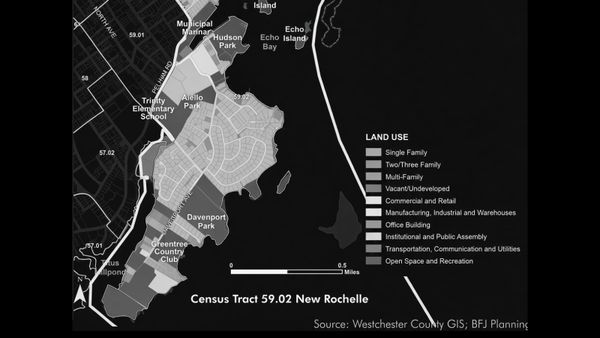
For decades, traffic around Trinity Elementary School has been a source of complaints in New Rochelle, particularly for residents of Davenport Neck who use Church Street to reach Pelham Road and the rest of the city.
Exactly how long the problem has existed — and why a school with hundreds of students was placed at one of the principal gateways to Davenport Neck in the first place — is considerably less clear.
So I went looking.
What follows is not intended as a definitive history of Trinity School traffic. It is what I could readily assemble from my own past reporting, my own involvement with school district facilities issues, city and school district records available online, historical material available through the New Rochelle Public Library and other publicly accessible sources.
There is clearly much more sitting in archives somewhere. That is why I am crowdsourcing this issue.
If readers have documents, photographs, reports, old newspaper articles, meeting minutes or firsthand knowledge that can fill in the gaps, send them to me. If enough additional material comes in, I will update this history.
The point is to establish the record.
People are going to argue about Trinity traffic. They have been doing that for years. But there is little value in repeatedly proposing ideas that have already been considered, studied or implemented because nobody knows what happened before. If there is going to be a serious debate about what should happen next, everyone ought to begin with the same basic set of facts.
Trinity Moves to Pelham Road
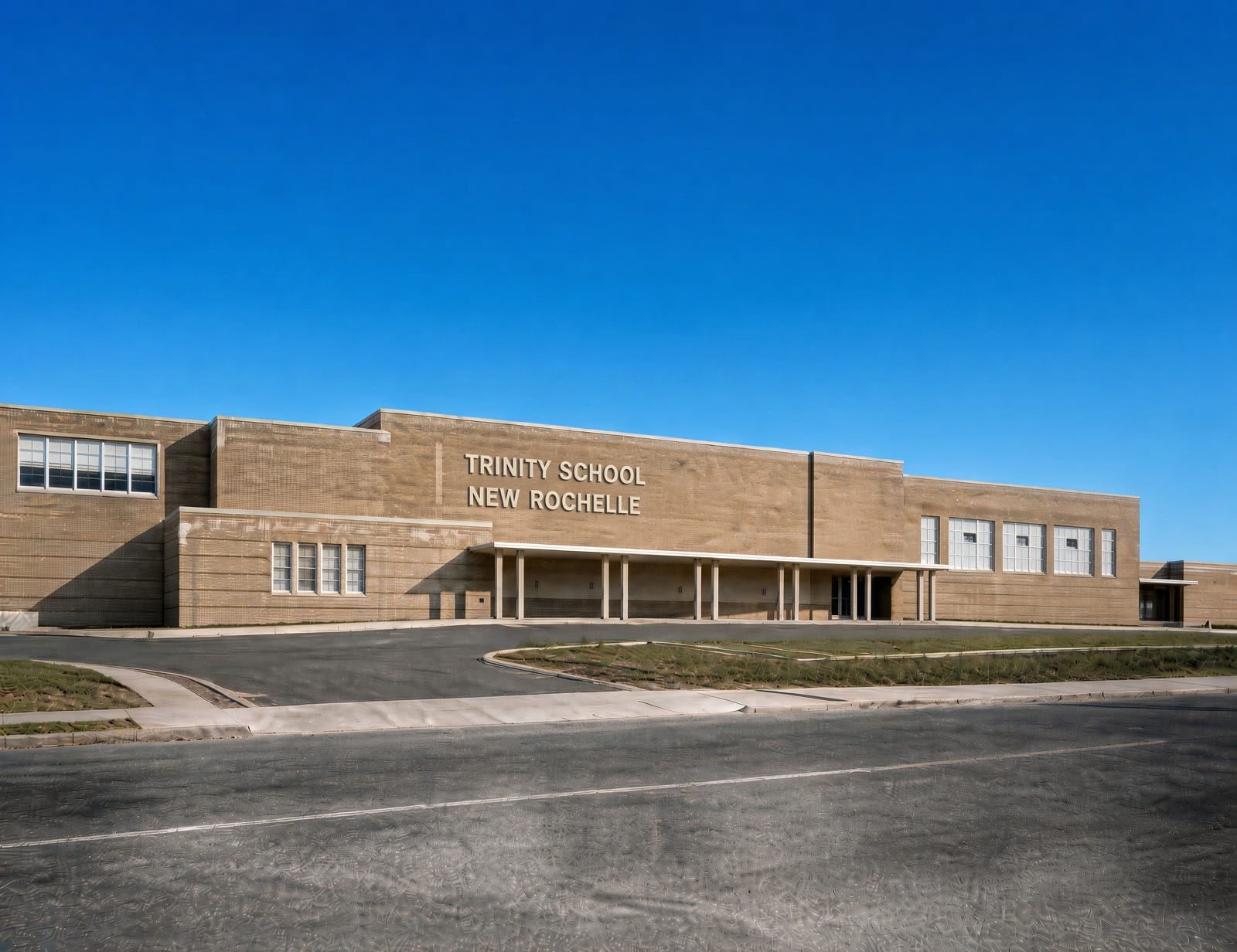
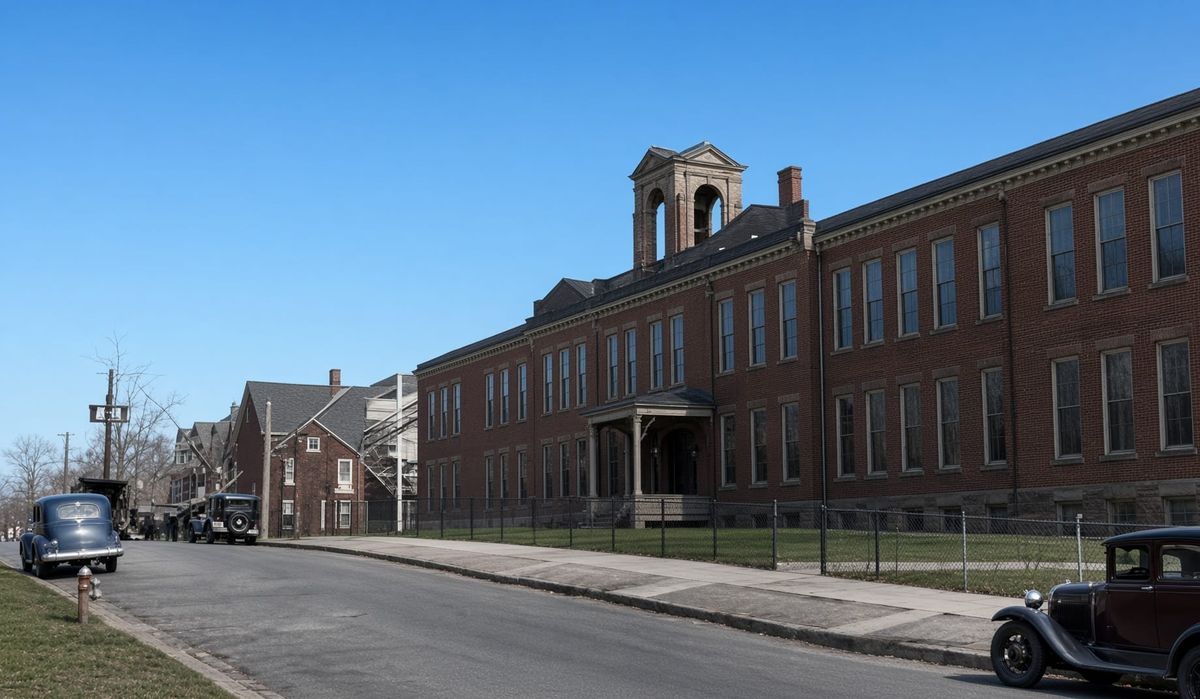
Trinity was New Rochelle’s first public school, dating to 1856. The original school was on Trinity Place near Church Street. After that building was destroyed by fire in 1882, Trinity School No. 1 was built in its place.
The New Rochelle Public Library’s historical collection says Trinity eventually moved to its present location at Pelham Road and Church Street in 1957.
That gives us an obvious date, but probably not the correct place to begin looking for the decisions that put it there.
If the school opened at its current location in 1957, planning, property acquisition, design and approvals would have begun years earlier. Anyone trying to reconstruct the complete history should probably begin in the early 1950s, perhaps even earlier.
The central question is straightforward: Why was this location selected, and what consideration was given at the time to traffic on Church Street, Pelham Road and access to Davenport Neck?
I do not yet have the answer.
The School Did Not Remain the Same
Another important question is whether today’s traffic conditions bear much resemblance to what city and school officials anticipated when the new Trinity was planned in the 1950s.
The school was subsequently expanded. Publicly available information describes the addition of a three-story classroom addition and a kindergarten wing.
That raises an obvious question, although at this point it is only a question: Did the traffic problem become significantly worse as Trinity became larger and its use changed?
It would be useful to know the school’s original capacity, its enrollment when it opened, the dates and capacities of subsequent additions and what, if any, traffic studies accompanied those projects.
The addition of kindergarten space is potentially relevant as well. Younger children can produce different arrival and dismissal patterns. Parents may be more inclined to drive younger children to school, and loading and unloading them may take longer.
I have not found evidence establishing that the kindergarten addition caused or even measurably increased the Church Street traffic problem. But it is one of the questions worth examining rather than simply assuming that the traffic generated by Trinity today bears any meaningful resemblance to what was anticipated when the school opened in 1957.
The City Has Been Working Around the Problem for Years
What is much easier to document is a long series of attempts by the City of New Rochelle to manage traffic around the school.
Over the years, the city has adopted parking restrictions around Church Street, created a school-zone speed limit, changed parking regulations, prohibited certain U-turns, imposed turn restrictions and modified traffic signals.
In 2016, the city traffic engineer evaluated conditions around Pelham Road, Centre Avenue and Church Street adjacent to Trinity Elementary School and Isaac E. Young Middle School. That review led to additional traffic restrictions.
The following year, New Rochelle retained Provident Design Engineering for a citywide review of traffic around the school district’s schools. Trinity was specifically included in the study.
The Trinity portion examined Pelham Road and Church Street, Pelham Road and the Trinity exit driveway, Pelham Road and North Avenue, and Church Street and the Trinity entrance driveway.
Later city traffic work examined crash history in the area. The city has also undertaken traffic-signal work around Church Street and Trinity Place and continued changing school-hour turning regulations around Church Street and Pelham Road.
As recently as the city’s 2026 budget process, New Rochelle listed among its initiatives a continuing review of “Davenport Neck zoning and Church Street/Trinity School traffic issues.”
In other words, this is not some newly discovered inconvenience. City government itself has treated Trinity traffic as a recurring problem over a period of many years.
There Was Also a Traffic Committee
I also recall a city traffic committee or working group that spent considerable time examining the Trinity problem, probably a couple of decades ago.
I have not yet located its report or reconstructed exactly when it operated, who served on it or what recommendations it made. It may have been an ad hoc committee rather than a permanent city board, which would help explain why its records are not readily searchable online.
Someone reading this probably knows.
If copies of its reports, correspondence, minutes, maps or recommendations still exist, I would very much like to see them.
The School Property Has Been Looked At, Too
There is another part of this history that I know firsthand.
As co-chair of the school district’s facilities committee during work associated with the $106.5 million bond, I was involved in looking at Trinity School itself. We were not studying the surrounding public roads. We were looking at the school property and what might be done there to create a better internal flow of traffic.
The basic idea was straightforward: the more arrival and dismissal activity that can safely take place on school property, the less of it has to take place on Church Street and other public roads.
There is an obvious safety component to that. If young children can board and leave buses on school property rather than doing so along public streets, that is inherently a different environment from loading and unloading children amid ordinary street traffic.
We looked at possibilities for improving circulation on the Trinity property, but there was not sufficient institutional energy behind making a major change happen.
That remains one of the central realities of the issue.
A meaningful redesign of traffic circulation on school property would require somebody inside or closely connected to the school district to champion it over a long period of time. It could involve the Trinity PTA and probably the Isaac E. Young PTA. It would likely require one or more Board of Education members willing to stay with the issue. Building leadership would have to be involved. District administrators and facilities personnel would have to determine what is physically possible.
And there would be tradeoffs.
Roadways, bus loops, additional loading areas or parking consume land. Space currently used for fields, recreation or some other school purpose might have to be repurposed. Engineering, drainage, pedestrian safety, emergency access, cost and school operations would all have to be considered.
That does not mean such a project cannot be done. It means somebody has to decide it is important enough to do.
Absent that, the likely result is what New Rochelle has had for years: complaints about the traffic, followed by another attempt to adjust signs, turning movements, parking rules or enforcement around the edges of the problem.
What Is Missing
The biggest holes in this history are the earliest ones.
Someone who really wants to get to the bottom of the issue would need to examine Board of Education minutes going back at least to the early 1950s and perhaps earlier. My understanding is that old board minutes may still exist in bound volumes or files maintained by the school district clerk, although I do not know how thoroughly those records have been indexed.
That may require the decidedly old-fashioned form of research in which somebody goes to the district offices, sits down with decades-old minutes and starts turning pages.
The same may be true at City Hall. City Council records, traffic committee materials, engineering records, planning documents and correspondence from the 1950s onward may contain pieces of the story that have never been digitized.
The New Rochelle Public Library may have additional photographs, newspaper clippings, maps and other material. Old editions of The Standard-Star and other local newspapers could be particularly useful in determining whether the location of the new Trinity School generated controversy when it was proposed and whether Davenport Neck residents were raising traffic concerns before the doors ever opened.
Anyone doing that archival work should photograph or scan the relevant pages and record exactly where each document came from.
The Questions Worth Answering
There are several questions that could turn a collection of scattered records into an actual history.
Why was the Pelham Road site chosen? What alternatives were considered? What did traffic on Church Street and Pelham Road look like when officials made that decision? Were Davenport Neck residents consulted or did they object? What was Trinity’s original enrollment and capacity?
Then there is the second chapter: When was Trinity expanded, by how much, and what happened to enrollment? Were traffic studies conducted before those additions? When do complaints about school traffic first appear in city or school district records? Did the arrival and dismissal system change as the student population increased?
And finally: when did city officials conclude that the problem required something more than ordinary parking and traffic enforcement?
Those dates matter because they could tell us whether Trinity’s traffic problem was inherent in the original site or developed as the school, surrounding neighborhoods, enrollment patterns and automobile use changed over time.
The City May Have Reached the Limits of What It Can Do on the Street
There is a tendency whenever Trinity traffic becomes particularly aggravating for somebody to propose another change on Church Street or Pelham Road.
Maybe some additional improvement remains to be made. But the historical record already shows years of parking changes, turn restrictions, school-zone regulations, traffic engineering, signal work and enforcement.
At some point, the question has to become whether the remaining problem can actually be solved on the street.
A more fundamental solution may require changing the way vehicles move onto, through and off school district property.
That would put much of the responsibility where it ultimately may belong: with the school district.
The city controls the public streets. The school district controls the school property. If the fundamental problem is that too much school-related loading, unloading and vehicle circulation is spilling onto public roads, there is only so much municipal traffic engineering can accomplish without changing what happens inside the property line.
That kind of change will not happen because everybody continues complaining about Trinity traffic.
Somebody will have to make it a cause.
Help Build the Record
There are undoubtedly New Rochelle residents who know parts of this history that I do not.
Some may remember the old traffic committee. Others may have lived on Davenport Neck when Trinity was expanded. Former school board members, city officials, administrators, teachers and parents may remember earlier attempts to solve the problem. Someone may even have a report sitting in a basement or filing cabinet that is not available online.
If you have documents, photographs, newspaper clippings, meeting minutes, correspondence or firsthand knowledge concerning Trinity School traffic — particularly material from the 1950s through the early 2000s — send it along.
I am especially interested in anything that establishes when traffic first became a recognized problem, what was anticipated when the current school was planned, what happened when the school was expanded and what previous committees or studies recommended.
There is an old line about everybody talking about the weather but nobody doing anything about it. Trinity traffic can sometimes feel like the New Rochelle version of that.
Complaining about it is easy.
Establishing what has already been tried, understanding why it did or did not work, and developing a proposal capable of addressing the underlying problem takes considerably more effort.
That is what this crowdsourcing exercise is intended to help accomplish.
This article was prepared with the assistance of AI tools under the direction and editing of Robert Cox.
Have information about this story? Email robertcox@talkofthesound (preferred) or contact via WhatsApp: +353 089 972 0669