History, Desegregation, the Lincoln Attendance Zone and the Continuing Question of a Neighborhood School

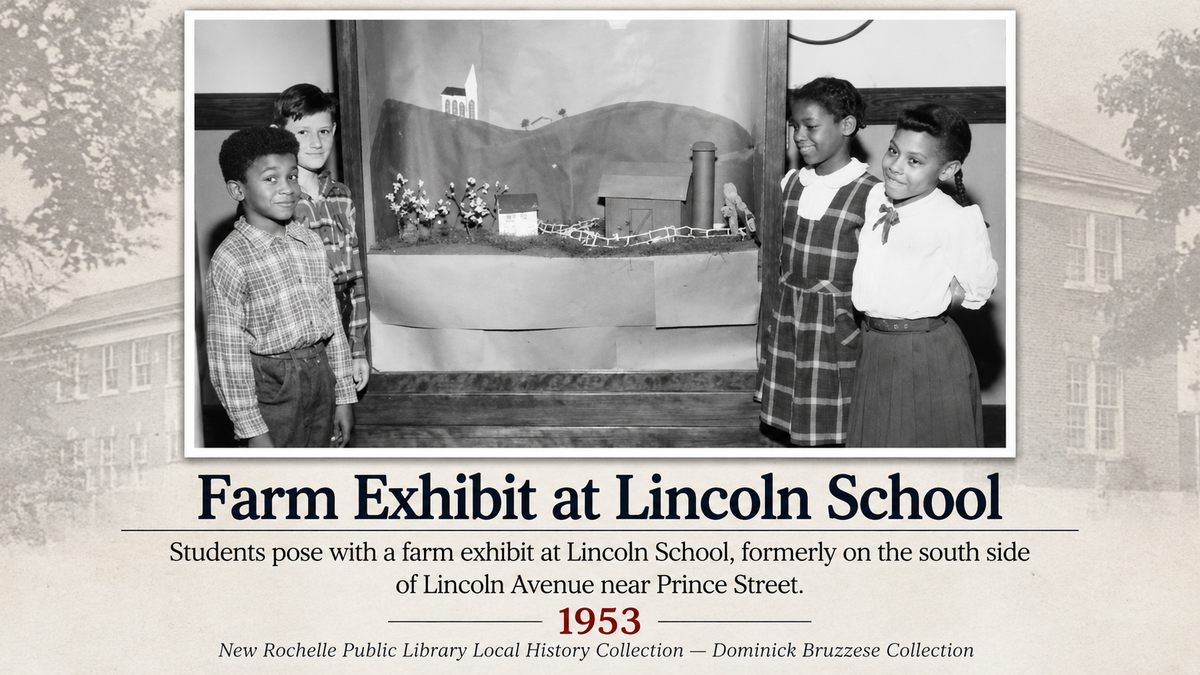
DUBLIN, IRELAND (September 28, 2026) — With a school in the Lincoln Attendance Zone back on the table in New Rochelle, I spent some time pulling together my past reporting, the work of the City School District of New Rochelle's District-Wide Health & Safety Committee — otherwise known as the RESCUE Committee — and related historical material.
I'm using this archive to make a simple case: New Rochelle should not start from scratch. The RESCUE Committee already did much of the foundational work needed to approach the question of restoring a neighborhood school to the Lincoln Attendance Zone.
This is a living archive of reporting, historical material and public records concerning Lincoln School, the Lincoln Attendance Zone, Taylor v. Board of Education of New Rochelle, and efforts to restore a neighborhood school to the Lincoln community.
The archive includes more than 17 years of reporting by Talk of the Sound, historical material going back decades, and records from the school district's 2021--22 examination of what would actually be required to establish a neighborhood school in the Lincoln Attendance Zone.
It will be updated as additional material becomes available.
Don't Reinvent the Wheel
My interest in Lincoln School began in 2006, before Talk of the Sound existed.
My son's teacher at Ward Elementary School, Dr. Gail Kaplan Guttman, had written her doctoral dissertation on New Rochelle and its history, Division and Diversity: Community Transition in Postwar America, 1945--1970. New Rochelle, New York, a Case Study. She was gracious enough to allow me to read it at a time when she was reluctant to circulate it. I could read it and return it, but not make a copy.
What I learned about Lincoln School stuck with me.
The 50th anniversary of the landmark 1961 federal desegregation decision was only five years away. My sense was that there was a large segment of New Rochelle that either did not know this history or had forgotten it. That began what became a long effort to research it, preserve it and bring it before the community for those readers.
Over the years, that took many forms: historical reporting, an eight-part series on the Lincoln School desegregation case, anniversary events and coverage, speeches, advocacy and, eventually, my work on the City School District of New Rochelle's District-Wide Health & Safety Committee.
I believe what happened to Lincoln School and the Lincoln community was an injustice with lasting consequences. I support the goal of restoring a neighborhood school to the Lincoln Attendance Zone. But believing something ought to happen is different from figuring out how to make it happen.
A moral argument establishes why something should be done. It does not acquire land, satisfy state requirements, finance construction, resolve the continuing legal implications of Taylor and the Kaufman orders, determine enrollment, find a site or build a school.
Those are not arguments against a Lincoln school.
They are the questions that have to be answered if there is actually going to be one.
That was the purpose of the work undertaken by the District-Wide Health & Safety Committee in 2021 and 2022. Rather than debate the aspiration again, we tried to convert it into a project: identify the obstacles, assemble the available facts, determine what remained unknown and leave behind a roadmap that could be used by people who wanted to move the idea forward.
In May 2022, the committee completed that work and delivered its final report to Superintendent Jonathan Raymond.
Four years later, the question of a Lincoln Attendance Zone school has returned as the district considers a much broader reconfiguration of its schools in response to declining enrollment.
That is a significant milestone.
My suggestion to the Board of Education, district officials and people advocating for a Lincoln school is simple:
Don't reinvent the wheel.
Some information from 2022 needs to be updated. Circumstances have changed. Some questions remain unanswered. But New Rochelle does not have to start from zero.
Start Here: The 2021--22 Lincoln Attendance Zone Study
How the Health & Safety Committee Became Part of the Lincoln Story
The Lincoln study did not come from an ad hoc committee created specifically to consider Lincoln School. It grew out of a much longer effort to change how the school district dealt with its buildings.
For years, I had reported extensively on corruption and dysfunction in the district, much of it centered on facilities operations under Aramark and its on-site director, John Gallagher. My reporting helped force Gallagher and the Aramark management team out of New Rochelle. I later worked directly with federal investigators on the facilities corruption I had documented. Gallagher was arrested in 2017, pleaded guilty to federal bribery charges and was sentenced to federal prison. The district terminated the Aramark facilities-management contract and brought facilities management in-house.
That transition opened the way for a different facilities culture with School Business Official Jeff White. Then came the Webster ceiling collapse. I broke the story after several tons of material fell from a ceiling into a classroom at Daniel Webster Elementary School. Fortunately, students and staff were not in the room when it happened. The collapse brought the consequences of years of deferred maintenance and inadequate facilities management into sharp focus.
This paved the way for White to hire Carl Thurnau, Keith Watkins and others were part of a new group of people prepared to take the condition of the district's buildings seriously.
But before that could happen, the district responded with a proposed capital bond of $49,529,094.
I opposed it aggressively.
That confused some people because I had spent years reporting on deteriorating school buildings. Why would someone who had been demanding that the district fix its facilities campaign against a bond intended to do exactly that?
The answer was simple: I did not believe $49.5 million was remotely enough to do the job.
My approach to these issues has generally been the same. Identify the problem. Establish the facts. Determine what fixing it actually requires. Then try to build a mechanism capable of doing it. Opposition by itself does not fix anything.
I organized a full-scale campaign to defeat the December 2015 bond. In a short period of time, I raised about $2,000 and mounted a full-court press that included radio advertising, robocalls, mailers and media appearances. WVOX contributed airtime to run the commercials. The campaign came together quickly and caught the district flat-footed; from its perspective, a full-fledged opposition campaign had suddenly appeared with little time to respond.
On Dec. 15, 2015, the $49,529,094 bond was defeated, 1,479 to 1,444 --- a margin of 35 votes.
Defeating the bond was not the end of the campaign. It created the opportunity to do the job properly.
Tony Costa, the Building Condition Surveys and the Missing $20 Million
One of the people central to what happened next was Tony Costa, an active member of FUSE who knew the district's facilities extraordinarily well.
Tony educated me about the buildings. We walked school properties together many times, looking at roofs, basements, mechanical systems and other conditions. He had institutional knowledge I did not have, including something that would soon become very important: Tony had served on the district's earlier Health & Safety Committee.
As architects and engineers presented the 2015 Building Condition Survey findings school by school, Tony and I attended the meetings and went through the proposed work building by building. We identified projects and conditions that had been omitted from the developing capital plan. They were not theoretical omissions. They were added back into the program.
The developing proposal was roughly $86 million before about $20 million in additional work was incorporated, bringing the eventual capital program to $106.5 million.
That created another moment that confused some people. I had just led the campaign that killed a $49.5 million bond. A few months later, I was arguing that the district should spend more than twice that amount. There was no contradiction.
I was not reflexively opposed to borrowing money or repairing schools. I opposed the first proposal because I believed it was inadequate to accomplish its stated purpose. Once the district had identified the actual scope of the work, I argued that it should fund the entire documented program rather than knowingly leave identified building problems behind.
Reestablishing the Health & Safety Committee
During that process, another problem surfaced.
Tony Costa knew the district once had a Health & Safety Committee because he had served on it. By 2016, however, there was no functioning district-wide committee doing that work. Any bond had to receive a referral from the RESCUE committee. I raised the issue and pushed for the committee to be reestablished.
The reconstituted District-Wide Health & Safety Committee held its first meeting in March 2016, and I was appointed as a member.
The committee could easily have become a temporary vehicle: create it, have it review the Building Condition Surveys, obtain its recommendation for the May bond referendum and then allow it to fade away again. I was determined not to let that happen.
Once I had a seat at the table, I pushed to institutionalize the committee as a continuing facilities body. That meant doing the basic work required to turn a committee that existed on paper into a functioning institution: regular agendas, meeting packets, minutes, recordings, resolutions, votes, task lists, follow-up items and orderly meetings under Robert's Rules. I pushed to have the records and supporting materials made publicly available and to make sure unfinished work did not simply disappear between meetings.
I later became co-chair.
Over the following years, the committee became a continuing facilities oversight mechanism. We reviewed construction and building conditions, tracked open issues, conducted inspections and revisited problems until they were resolved. I spent years walking district buildings, including roofs, basements and mechanical spaces, talking with facilities staff and contractors and following the implementation of the bond program.
The point was not to create meetings. It was to create a mechanism that could get things done. That history matters to the Lincoln story at three levels.
First, I pushed to reestablish the Health & Safety Committee.
Second, I pushed to prevent it from languishing and instead give it the form, procedures, records and continuing function of a real institution.
Third, once that machinery existed, I used it to put difficult facilities questions before the district --- eventually including the question of restoring a neighborhood school to the Lincoln Attendance Zone.
The Lincoln process did not suddenly appear in 2021. The mechanism that made it possible had been built over the preceding five years.
From Bethesda to a Better Process
The immediate methodological precursor to the Lincoln study was the district's long-running effort to find a new home for its Alternative High School, later renamed Huguenot Academy.
In 2020, district officials proposed relocating the program from St. Gabriel's School to the Family Life Center at Bethesda Baptist Church, directly across from Lincoln Park.
The problem was not simply that Bethesda was one building I did not like. The proposal exposed a backwards process.
The district had effectively selected a building before establishing what the Alternative High School actually required. There had been inadequate stakeholder involvement. Questions existed about parking, physical education and recreation space, a gymnasium, science facilities, art and music space, technology, security, transportation, building condition, accessibility, use of City-owned facilities and whether the proposed location improved anything that actually needed improving.
There was another fundamental problem in the context of Lincoln: even if the Alternative High School had moved to Bethesda, it still would not have restored a neighborhood school to the Lincoln Attendance Zone. The Alternative High School was a district-wide program serving students from across New Rochelle. Putting that program in the Lincoln neighborhood and creating a neighborhood school for children who lived in the Lincoln Attendance Zone were two different things.
Talk of the Sound published an eight-part examination of the Bethesda proposal and the process used to develop it.
The 2020 Bethesda Series
Part I --- Acrimony and Blame Shifting
Part IV --- Security at St. Gabes
Part V --- St. Gabes Building Condition
Part VI --- Phony Photos and Contrived FAQ
Part VII --- Recent Review of St. Gabes Building Condition
Part VIII --- Remaining Questions
Additional Background
New Rochelle School Officials Mum on Reported Move of Alternative High School
A History of New Rochelle Alternative High School, 1970 to 2020
Holy Family School Unexpectedly Emerges as Best Option for Relocation of New Rochelle Campus School
Holy Family School No Longer an Option for New Rochelle Campus School
From Criticism to Specifications
The answer to a bad facilities process was not simply to criticize it. It was to build a better one.
For the Alternative High School, I used the Health & Safety Committee process to bring stakeholders together and ask a more basic question: before we choose a building, what does this educational program actually need?
The initial brainstorming was intentionally broad. No idea was off the table. If someone wanted a swimming pool, a bowling alley or a rooftop tennis court, put it on the list. The purpose of the first stage was not to decide what was realistic. It was to make sure stakeholders had the opportunity to identify everything they believed would make the program work.
Then we could refine the list, separate needs from wants, establish meaningful facilities specifications and use those specifications to evaluate actual sites.
The resulting recommendations were used.
New Rochelle High School Alternative Campus Facilities Specifications: The Huguenot Academy
Huguenot Academy, New Rochelle's Alternative High School, to Relocate to Monroe College Campus
New Rochelle High School's Huguenot Academy Campus Opens New Downtown Location
That experience became an important precursor to the approach subsequently taken with Lincoln.
Do not start with a preferred building and work backwards. Start with the objective, establish the facts and requirements, identify the obstacles, and then evaluate possible solutions.
June 2021: The Lincoln Question Returns
By 2021, I believed the Health & Safety Committee had become sufficiently established to take on a much more complicated facilities question: what would actually be required to restore a neighborhood school to the Lincoln Attendance Zone?
I put the issue into the committee process.
On June 2, 2021, the committee held what was described at the time as the first formal discussion by the City School District of New Rochelle in more than five decades of establishing a neighborhood school in the Lincoln Attendance Zone.
That discussion did not happen because the district suddenly created a Lincoln initiative. It happened because I had pushed to reestablish the committee, spent years helping turn it into a functioning institution, and then used that institution to put the Lincoln question formally on the table.
The purpose of the June meeting was not to choose a site, endorse a proposal or decide whether a Lincoln school should exist.
It was to plan a plan.
If New Rochelle was serious about this idea, what questions would have to be answered? How many children lived in the zone? Where did they attend school? How large a school would be needed? How much land would be required? What sites were even possible? What did New York State require? What would happen with the continuing federal desegregation orders? What would a new building or conversion cost? How much state aid might be available? What would taxpayers have to finance?
City of New Rochelle Calendar --- Lincoln Attendance Zone School Discussion
June 2, 2021 --- Preliminary Lincoln Attendance Zone Discussion
June 2, 2021 --- Lincoln Attendance Zone Initial Discussion
City Hall, the City's Downtown Move and the Mariano Rivera/Refugio Property
One possible location repeatedly discussed for a future school was New Rochelle City Hall at 515 North Avenue.
The idea gained traction because the City was pursuing plans to move municipal government operations downtown. If City Hall were eventually vacated, a large publicly controlled site potentially become available for another public use.
But "City Hall could become a school" was not a plan. It was a hypothesis that had to be tested.
City Hall is not actually inside the Lincoln Attendance Zone. It sits across North Avenue in the Ward Elementary School attendance area. The district also had to understand the ownership and deed arrangements, what rights it retained in the property, how much of the site would be available, how the attendance-zone boundary problem could be addressed and whether the building itself was suitable for conversion.
The 2017 Building Condition Survey work identified more than $11.1 million in then-existing repair and replacement needs at City Hall, before accounting for the additional cost of converting a municipal office building back into a school.
There was also a neighboring property issue.
The former North Avenue Presbyterian Church property had been acquired for use by Mariano Rivera's Refugio de Esperanza. The church property relied on parking associated with the City Hall site. By 2021, plans involving the Mariano Rivera Foundation, Refugio and parking behind the church raised an obvious question: if the City disposed of or encumbered land needed to make the larger City Hall site work as a school, would that limit the district's future ability to use the property as a school?
The committee's final report did not resolve that issue. It specifically identified the Refugio parking arrangement as something the district needed to sort out.
The broader point was exactly the same as elsewhere in the Lincoln study. A site that sounds obvious in a public discussion can become considerably more complicated once ownership, boundaries, acreage, building condition, parking, state requirements, cost and competing property interests are put on the table.
Yankee Reliever Mariano Rivera Looking to Buy and Rehabilitate Dilapidated Church in New Rochelle
October 2021: Making the Lincoln Work an Official Assignment
There was no requirement that the superintendent task the Health & Safety Committee with studying Lincoln. I wanted him to do it for a very specific reason.
The committee was about to spend months examining a politically and historically sensitive issue that went well beyond an ordinary construction project. I did not want anyone later claiming that we were acting as a rogue committee, inventing our own jurisdiction or pursuing somebody's personal project without authorization. So I went to Superintendent Jonathan Raymond and proposed that he formally task us with the work.
I also proposed the scope: gather the relevant information, create stakeholder input opportunities, develop a discussion document identifying the obstacles, and deliver it to the superintendent and Board president within six months. Likely subjects included enrollment, attendance-zone maps, school assignment and transportation, City Hall, state construction and financing requirements, the history of Lincoln School and the Kaufman decision.
Raymond agreed.
On Oct. 20, 2021, he formally asked the District-Wide Health & Safety Committee to produce a document outlining "the obstacles that need to be overcome on the idea for a school in the Lincoln Attendance Zone."
That formal tasking mattered. The committee was no longer simply discussing Lincoln because I had put it on an agenda. The superintendent had commissioned the work.
Superintendent Jonathan Raymond's Formal Tasking --- Oct. 20, 2021
Oct. 20, 2021 --- Superintendent Raymond Lincoln Tasking
The Six-Stage Lincoln Review
The committee then moved through a structured process over the following months.
Part I --- Dec. 15, 2021: Who Lives in the Lincoln Attendance Zone?
Dec. 15, 2021 --- RESCUE Lincoln Review Part I: Enrollment, Maps and Projections
The first stage started with the population rather than a building. Where exactly was the Lincoln Attendance Zone? How many district students lived there? What grades were they in? Where were they currently assigned and attending school? What did enrollment projections suggest?
Of Particular Note: Lincoln Attendance Zone Map
The map was developed with assistance from the City of New Rochelle Building Department to show the Lincoln Attendance Zone against the underlying city geography.
Of Particular Note: Where Lincoln Zone Students Actually Attend School
Lincoln Zone Student Enrollment Distribution
At the committee's request, the district produced a breakdown of students living within the Lincoln Attendance Zone and the schools and grades in which they were enrolled. This data had not previously been made public but is central to understanding what size school but was essential to the next practical question: if New Rochelle built a neighborhood school, what size school would the population support?
The 2021--22 numbers are now historical. An updated version should be produced using current enrollment data. A current analysis should also include demographic information that was not part of the facilities question we were trying to answer in 2021--22.
Part II --- Jan. 19, 2022: Could City Hall Become a School?
Jan. 19, 2022 --- RESCUE Lincoln Review Part II: City Hall and NYSED
The second stage examined City Hall both as a municipal building and as a possible school facility, along with New York State construction and financing requirements. It included the City's plans to move government operations, the condition of the building, property and deed issues, acreage, the neighboring Refugio/Mariano Rivera property questions and the fact that City Hall sits outside the Lincoln Attendance Zone. We benefited in examining this issue by having as my co-chair then-City Manager, Charles B. Strome.
Part III --- Feb. 16, 2022: History and the Kaufman Decision
Feb. 16, 2022 --- RESCUE Lincoln Review Part III: History, Taylor and Kaufman
The third stage turned to the history and continuing legal framework, including Taylor v. Board of Education, Judge Irving R. Kaufman's orders and the documentary Leveling Lincoln.
Preliminary Draft --- March 23, 2022
March 23, 2022 --- Preliminary Lincoln Report
The committee moved from gathering information to putting the issues into a preliminary report for discussion and public input.
Final Draft --- April 2022
April 2022 --- Lincoln Report Working Materials
The report was revised as the committee worked toward a final document.
Final Report --- May 25, 2022
Report on Establishing a Neighborhood School in the Lincoln Attendance Zone
May 25, 2022 --- Final Report on Establishing a Neighborhood School in the Lincoln Attendance Zone
The report did not purport to decide whether New Rochelle should build a Lincoln school. It identified what would have to be addressed before such a project could realistically proceed.
Among its principal findings:
- The continuing effect of the Kaufman decision required legal analysis.
- New construction or substantial conversion would cost tens of millions of dollars.
- A new school would require significant acreage.
- State reimbursement could be difficult in an environment of declining enrollment.
- A large bond would require voter approval.
- Acquiring sufficient land inside the Lincoln Attendance Zone could be difficult.
- City Hall was near, but outside, the Lincoln Attendance Zone.
- City Hall itself had substantial building needs before considering school conversion.
- The Refugio de Esperanza property and parking arrangements required clarification.
- Combining Lincoln with an adjoining attendance area, potentially Webster, was another concept requiring study.
- The Health & Safety Committee's role was facilities-focused; questions involving curriculum, staffing, attendance-zone changes and other educational policy matters would require a broader process.
Most importantly, the report was intended as a framework for the next stage, not the last word.
The Handoff: Here Are the Tools
Superintendent Jonathan Raymond attended the committee's May 25, 2022 meeting.
The Lincoln work was presented, and he was handed a copy of the completed report.
The report was made public. I also distributed it personally to advocates who wanted a neighborhood school restored to the Lincoln Attendance Zone.
That handoff was important to me.
The people advocating for a Lincoln school no longer had only an argument that New Rochelle owed the Lincoln community a school. They had an official district committee report identifying the practical issues that had to be addressed. The superintendent had the same document and he presented to the board.
In effect: here are the tools. Here are the obstacles. Here is an official report. The superintendent has it. You have it. Take it to the Board and make the case for moving forward working from the same set of facts.
June 3, 2022 --- Raymond Acknowledges Lincoln Report
My role on the committee was ending as that work was handed off. I resigned effective June 30, 2022. Less than a year later I was preparing to leave New Rochelle, and in July 2023 I moved to Ireland.
I cannot account for everything that happened to the report after I left. The documentary record available for this archive does not establish that the Board subsequently took formal action on it or that the public discussion Raymond anticipated occurred.
What I can say is that four years later the underlying question has now reached the Board's agenda as part of a much larger discussion about declining enrollment and the future configuration of New Rochelle's schools.
However it got from there to here, I am glad it did.
The 2021--22 work was never supposed to build the school. It was supposed to move the idea from aspiration toward implementation and give the people who wanted to carry it forward a factual starting point.
Now the question has reached another stage.
What Still Holds Up --- and What Needs Updating
Four years is long enough that the 2022 report should not simply be dusted off and treated as current.
It should be used as a starting framework.
Questions That Remain Fundamental
- What are the current boundaries of the Lincoln Attendance Zone?
- How many school-age children live within it?
- Where do those children currently attend school?
- What are their grade levels and demographics?
- What size school would the population support?
- How much land would that school require?
- What parcels are actually available?
- What would acquisition and site preparation cost?
- What legal constraints remain from Taylor and the Kaufman orders?
- What are current New York State requirements?
- Does the district need additional seats in an era of declining enrollment?
- How much would state aid cover?
- How much would New Rochelle taxpayers have to finance?
Information That Should Be Updated
- Current Lincoln Attendance Zone enrollment.
- Current grade distribution.
- Current racial and ethnic demographics of students living in the zone.
- Current districtwide enrollment projections and available capacity.
- Current status of the City's plans for City Hall.
- Current condition and realistic school-conversion cost for City Hall.
- Current status of the Mariano Rivera/Refugio property and parking arrangements.
- Current property ownership and potential acquisition opportunities inside the zone.
- Current New York State construction, acreage, financing and building-aid requirements.
- Current legal analysis of the continuing Taylor/Kaufman framework.
The questions are not reasons to abandon the idea.
They are the work.
Enrollment and the Larger Facilities Question
The Lincoln question does not exist in isolation from districtwide enrollment.
A new school makes one kind of facilities sense when a district is short of seats and a very different kind when enrollment is declining and existing buildings have unused capacity. That does not resolve the Lincoln question, but it directly affects school size, financing, state aid and the larger question of how New Rochelle should configure its buildings.
There are therefore two related enrollment questions.
The districtwide question is: how many seats does New Rochelle need?
The Lincoln question is: how many children live in the Lincoln Attendance Zone, where do they attend now, and what kind of neighborhood school could that population support?
New Rochelle Schools Exodus: 4.5% Decline in Pupil Enrollment in 2 Years
Catastrophic Collapse of New Rochelle Schools Student Enrollment Underway
Demographer Report on Enrollment to New Rochelle Board of Education March 23, 2021, With Board Q&A
New Rochelle Schools Weigh Major Overhaul as Enrollment Declines
Huguenot Academy Returns an Educational Program to the Lincoln Neighborhood
New Rochelle BGCNR Welcomes Huguenot Academy to Remington Clubhouse
Huguenot Academy is not the neighborhood school contemplated by Lincoln advocates or by the 2022 RESCUE report. It remains a district-wide alternative high school program.
But its move to the Remington Clubhouse means an educational program is again operating in the Lincoln neighborhood --- another chapter in the long facilities sequence that began with the search for a better home for the Alternative High School.
The History: Lincoln School and Taylor v. Board of Education
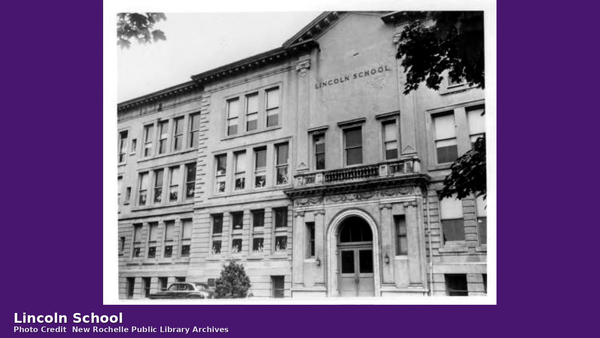
In 1961, U.S. District Judge Irving R. Kaufman ruled in Taylor v. Board of Education of the City School District of the City of New Rochelle that the school district had deliberately maintained racial segregation at Lincoln School.
The Board of Education appealed and lost. The Board later decided to close Lincoln School, and the building was demolished in 1963.
The Lincoln Attendance Zone remained.
Understanding that distinction matters. Judge Kaufman's 1961 decision did not itself order the building demolished. The litigation forced the district to end the unconstitutional system. Closing and demolishing Lincoln was part of the Board's subsequent response.
Lincoln School Desegregation Today
In January 2010, Talk of the Sound published an eight-part series examining the history of Lincoln School and the desegregation litigation.
Robert Cox conceived and developed the broader Lincoln School project, one element of which was the eight-part series researched and written by Karen Hessel and edited and published by Cox.
Part I --- Early Gerrymandering
Part III --- Frustration Grows
Part IV --- Civil Disobedience
Part V --- The Trial: Plaintiffs' Case
Part VI --- The Defense Presents and Judge Kaufman Decides
Part VII --- The Plans and the Ruling
Part VIII --- Counting Seats to Present Day
The Lincoln Community
City Convenes Lincoln Neighborhood Revitalization Summit
Why Is Barnard Elementary School Not a Neighborhood School?
The Churches of Lincoln District
Remembering the Lincoln Decision
49th Anniversary of Lincoln School Desegregation Passes Unnoticed
An Invitation: Reflections on Change --- A 50-Year Retrospective on the Lincoln School Decision
Important Open Planning Meeting for 50th Anniversary of Lincoln School Decision
Successful Kick-Off Event --- 50-Year Retrospective of Lincoln School Decision
Notes From Jan. 25 New Rochelle BOE Meeting
Leveling Lincoln
Leveling Lincoln: Special Screening of Documentary on Taylor v. Board of Education of New Rochelle
Leveling Lincoln --- Official Website
Juneteenth Screening Spotlights New Rochelle's Desegregation History
The Lincoln Attendance Zone Never Went Away
BOE Holds Meeting in Lincoln Attendance Zone
Although Lincoln School disappeared, the Lincoln Attendance Zone did not.
That unusual fact is central to the present discussion. Children continue to live within a geographic Lincoln Attendance Zone even though there is no Lincoln neighborhood school for them to attend.
2026: The Question Returns
New Rochelle BGCNR Welcomes Huguenot Academy to Remington Clubhouse
New Rochelle Schools Weigh Major Overhaul as Enrollment Declines
A Primer: Lincoln Zone, Empty Seats and No Land
The district already has historical enrollment and assignment data, maps, property records, City Hall analysis, state construction and financing information, a review of the Kaufman decision, preliminary reports, a final report and a framework identifying the obstacles that would have to be overcome.
Update it.
Expand it.
Answer the questions the facilities committee could not answer.
Determine what has changed.
But don't throw it away and start over.
The first step toward overcoming an obstacle is knowing that it is there.
Where This Goes From Here
My role in this history is included because leaving it out would leave an important part of the institutional history unexplained.
I was not merely reporting on the 2021--22 Lincoln process from outside. I had pushed to reestablish the Health & Safety Committee, worked to turn it into a functioning and continuing institution, developed and used a stakeholder-based facilities process through the Huguenot Academy work, brought the Lincoln question into the committee, proposed the scope of the work to Superintendent Raymond and chaired the committee through completion and delivery of the report.
That does not make the Lincoln project mine.
The point of doing the work was to make it useful to the people who wanted to carry the idea forward.
The 2022 report was intended to give advocates, district officials and the Board of Education a common factual starting point. Four years later, some of the information needs updating, some questions remain unanswered and circumstances have changed. But there is no reason to start again from zero.
If anyone working on this issue thinks I can be helpful, reach out. I live in Ireland now, but we do have the internet here.
Archive Note
This is a living archive. Additional historical records, district documents, photographs, maps, reporting and updated information will be added as they are located and reviewed.
Some older City School District of New Rochelle materials were originally published on district web pages that are no longer available. Where appropriate, original district documents are preserved and mirrored here so that the public record remains accessible.
Some of the original RESCUE Committee meeting packets contain large amounts of material unrelated to the Lincoln Attendance Zone review. For this archive, selected Lincoln-related documents or pages may be extracted from those larger packets and presented as separate PDFs for ease of access. These extracts do not alter the underlying documents; they reproduce the relevant pages as they appeared in the original district materials. Where an item is an extract rather than an original standalone file, it will be identified as such.