
New Rochelle’s $20 Million School Budget Hole: What Would Parkinson Think?

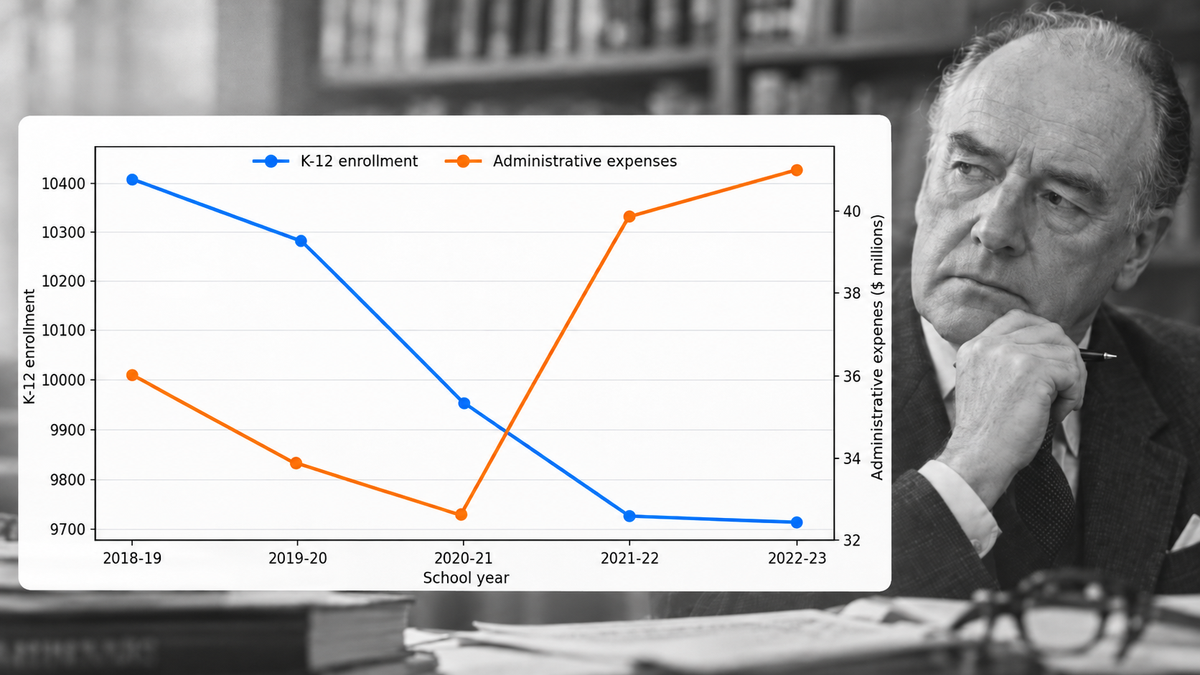
As student enrollment declines and administrative costs rise, a 70-year-old theory of bureaucratic expansion raises questions about New Rochelle's financial crisis. We're launching a long-term investigation and inviting experienced researchers, financial analysts and readers to help.
DUBLIN, IRELAND (October 9, 2026) — Readers responding to our recent reporting on the City School District of New Rochelle's spending on Shrub Oak International School have raised questions about the district's $20 million budget shortfall. Some seem to be hearing about this problem for the first time. Others want to know how the district got into this mess, whether administrative spending contributed to it, and why the district is discussing changes to educational programs when it faces significant financial constraints.
For those arriving late to this particular party, the $20 million budget hole is not new information. The district publicly announced it more than a year and a half ago. More importantly, the underlying financial problems had been developing for years.
The renewed interest in the district's finances got me thinking about something else: Parkinson's Law, the observation that bureaucracies have a tendency to expand regardless of whether the amount of work they perform actually increases.
READ: The Economist 1955: Parkinson's Law (C. Northcote Parkinson was Raffles Professor of History at the University of Singapore)
That, in turn, led me to a question I have heard repeatedly from readers but have never seen answered with a comprehensive analysis of the underlying data: Has the New Rochelle school district been expanding its administrative bureaucracy while the number of children it serves has been declining?
I decided to take an initial look. What I found was interesting enough to warrant a much larger investigation.
This article is both an introduction to that investigation and an invitation to participate in it. The project will involve collecting and analyzing years of financial, payroll, staffing and enrollment records. It may take a year or longer to complete. I am particularly interested in hearing from experienced researchers, accountants, financial analysts and people who know how to work with large government datasets.
Before getting to the numbers, some background is necessary.