A Primer: Lincoln Zone, Empty Seats, and No Land

NEW ROCHELLE, NY (September 24, 2026) - Daniel Patrick Moynihan’s line is the one this argument keeps violating: you are entitled to your own opinion, you are not entitled to your own facts.
In New Rochelle, school debates so often go off the rails because people arrive carrying different calendars. One person is still in 1961, when Lincoln School was about 94 percent Black and Judge Irving R. Kaufman ordered it desegregated. Another is still in 2012, when classrooms were tight and “overcrowded” was a fair sentence. A third is reciting a neighborhood-school slogan that treats a building on Lincoln Avenue as a moral debt, without asking who lives in the zone now, how many children there are, or whether New York State would let the District put a school on any parcel that actually exists.
This is 2026. It is not 1961. It is not 1980, when the Hispanic population of the city was still a rounding error. It is not the mid-2010s peak of enrollment.
This primer is not to tell readers what to want. It is to put the current facts in one place so the argument is about the same city.
I am writing it for that reason, not because the underlying facilities questions are new to me.
For six years I served on the district-wide health and safety committee (most as co-Chair with then-City Manager Charles B. Strome) — one of the two committees New York State requires every district to maintain. Under Commissioner’s Regulations Part 155, that body is the RESCUE committee: Rebuild Schools to Uphold Education. In ordinary conversation it is the facilities committee. Its work includes health-and-safety complaints, construction oversight, and, during a capital project, an expanded roster that includes the architect, construction manager, and contractors.
That committee’s main job in those years was oversight of the $106.5 million capital bond voters approved on May 17, 2016 (3,207 to 1,263), the package that was intended to take every building from “unsatisfactory” to “satisfactory” — and did so successfully.
The 2016 bond also explains why a new Lincoln building is not the same kind of project as the work the district already did.
Before a shovel goes in the ground, Education Law § 408 requires the Commissioner to approve the plans. That approval is what makes the spending eligible for State Building Aid. The aid itself is not a grant of half the invoice. It is a formula: aidable expenditures times the district’s building-aid ratio. “Aidable” is capped by the Building Aid Units Albany assigns to the project, which are a function of needed pupil capacity, not of how badly someone wants a building on a particular street.
For the $106.5 million reconstruction bond, that machinery worked. The work was in existing schools that already had rated capacity. Superintendent Brian Osborne told the board the State would reimburse the district at 47.8 percent. The campaign materials used 48.7 percent. On $106.5 million, the difference between those two figures is rounding. The point is the same: Albany was on the hook for roughly 48 cents of every dollar, which is why the district could sell a nine-figure bond as tax-neutral once old debt rolled off.
A new elementary school in a district that already has empty seats is a different animal. Building Aid Units are assigned against projected enrollment, district-wide. If the classrooms you already own are enough — or more than enough — to house the children the demographers say you will have, Albany does not assign new units to a building that only adds more of them. Facilities planners put it more bluntly: you do not get reimbursed for excess capacity. SED will sometimes tolerate a cushion of about 10 percent. It will not underwrite a new neighborhood school so that a corridor can have a building while Ward, Davis, Jefferson, and Trinity have rooms to spare.
That is what the facilities committee was told when City Hall-as-Lincoln-school was on the table. Reconstruction of buildings you already operate is aidable. Inventing capacity the enrollment tables do not support is a local capital project. The taxpayers carry the land, the demolition, the construction, and the debt service with no 48-cent discount from the State.
On a $40 million elementary school — a low number once you add site acquisition in a built-out zone — the 2016 ratio would have returned about $19 million. Without aid, the same building is $40 million on the local roll. That is not an argument against a neighborhood school. It is the price of building one in a district whose problem is empty seats, not missing ones.
There is a second local cost that the 2016 bond did not carry. Reconstruction happened on land the district already owned. A new Lincoln school does not. Almost every parcel in that zone is on the tax roll now — city tax and school tax. Buy it, take it for a public school, and those parcels come off both rolls. The district loses the school-tax revenue the lots were producing and still has to service 100 percent of the construction debt. The city loses its share at the same time. Eminent domain is not only a political fight over someone’s house. It is a permanent subtraction from the same levy that would be asked to pay for the building.
In 2020–2022 there was a live proposal to turn City Hall, 515 North Avenue, into a neighborhood school for the Lincoln attendance zone. The city was talking about leaving that building for a new civic complex on Harrison Street, on the Fire Station 1 site. That building was never built. The city never moved. City Hall is still City Hall.
As co-chair I organized a multi-part months-long public series on the idea. The first session was well attended. Attendance fell as the problems became harder to talk around. By the end, a couple of people were still coming. The record of those sessions is on the district site. Anyone who wants the blow-by-blow can go read it. The short version is below, with the demographic numbers the slogan fight usually skips.
I am putting the current facts in one place because that is what I do so people can argue about New Rochelle as it is, not as they remember it.
1. A Lincoln neighborhood school would not be the school Kaufman closed
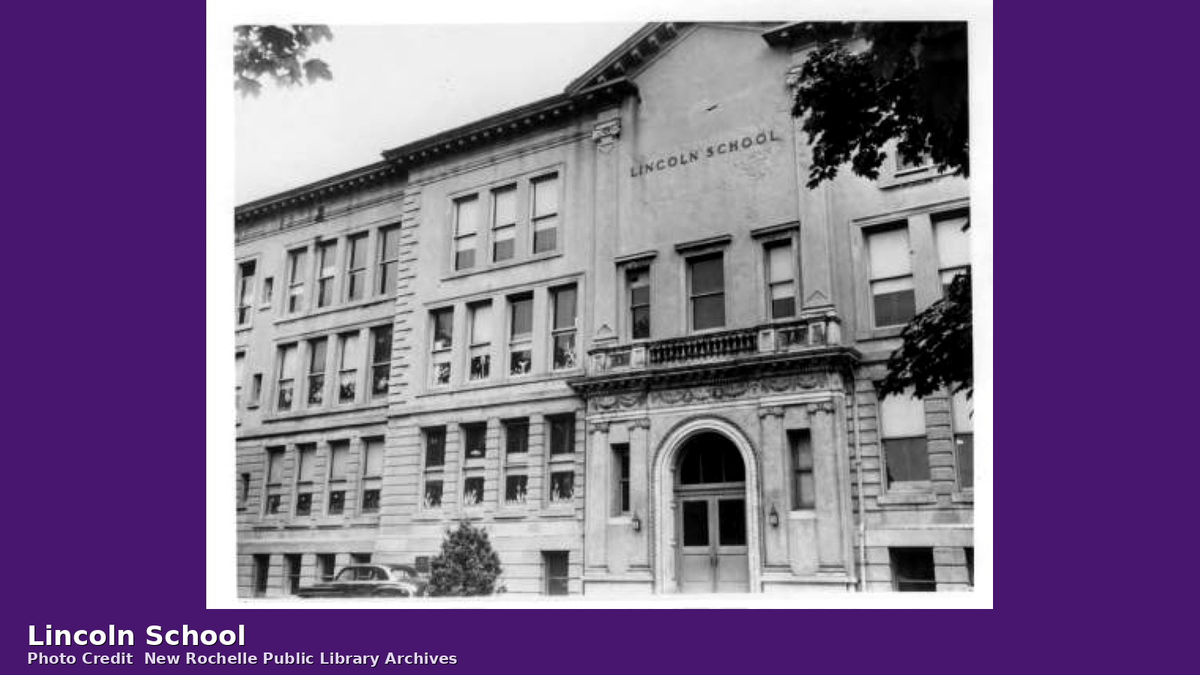
Lincoln Elementary was the neighborhood school for the Lincoln Avenue corridor. In 1960–61 it enrolled about 483 children. Contemporaneous accounts put the Black share at about 94 percent — 454 Black children and 29 white children.
Judge Irving R. Kaufman’s 1961 decision in Taylor v. Board of Education of the City School District of New Rochelle found the board had maintained that result on purpose. The zone had been gerrymandered in the 1930s. White children inside it had been allowed to transfer out until 1949. Transfers began in 1961. The building came down in 1963-64.
The zone never went away. District calendars still say that children who live in the Lincoln attendance zone are assigned a school by the superintendent’s office.
The last public count of how many such children there are is in the city’s 2015 WXY study:
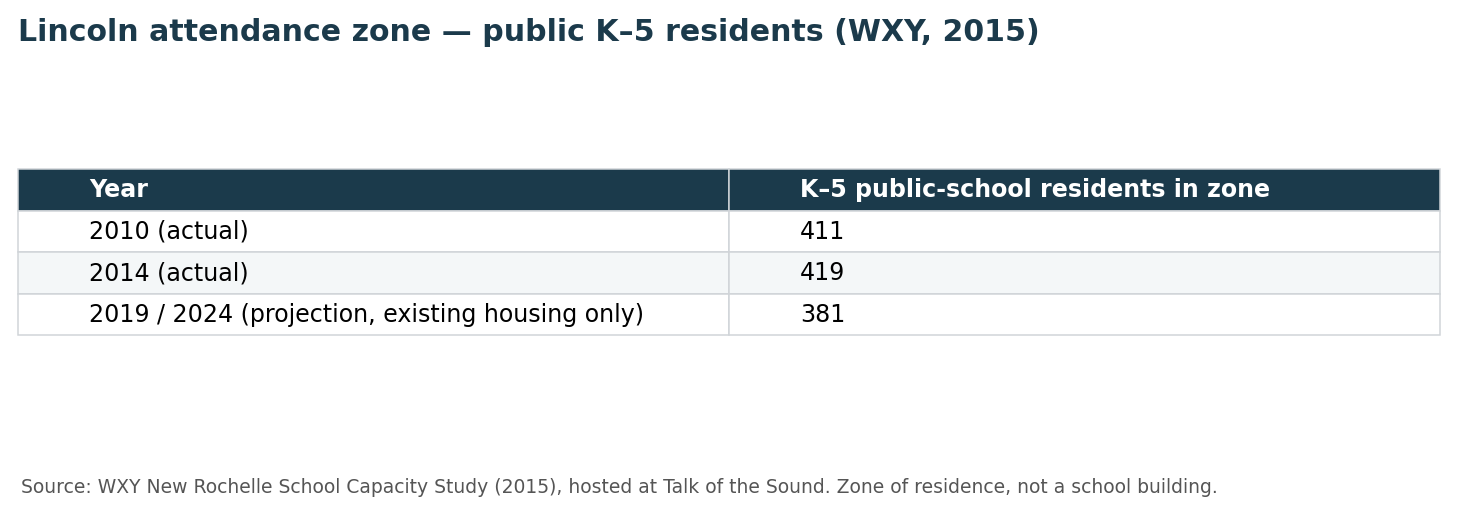
That is a small elementary school by New Rochelle standards. Ward is about 1,000. Trinity is about 840. Jefferson is about 500.
Where those children actually went is the more useful number. WXY recorded the 2014–15 choice pattern:
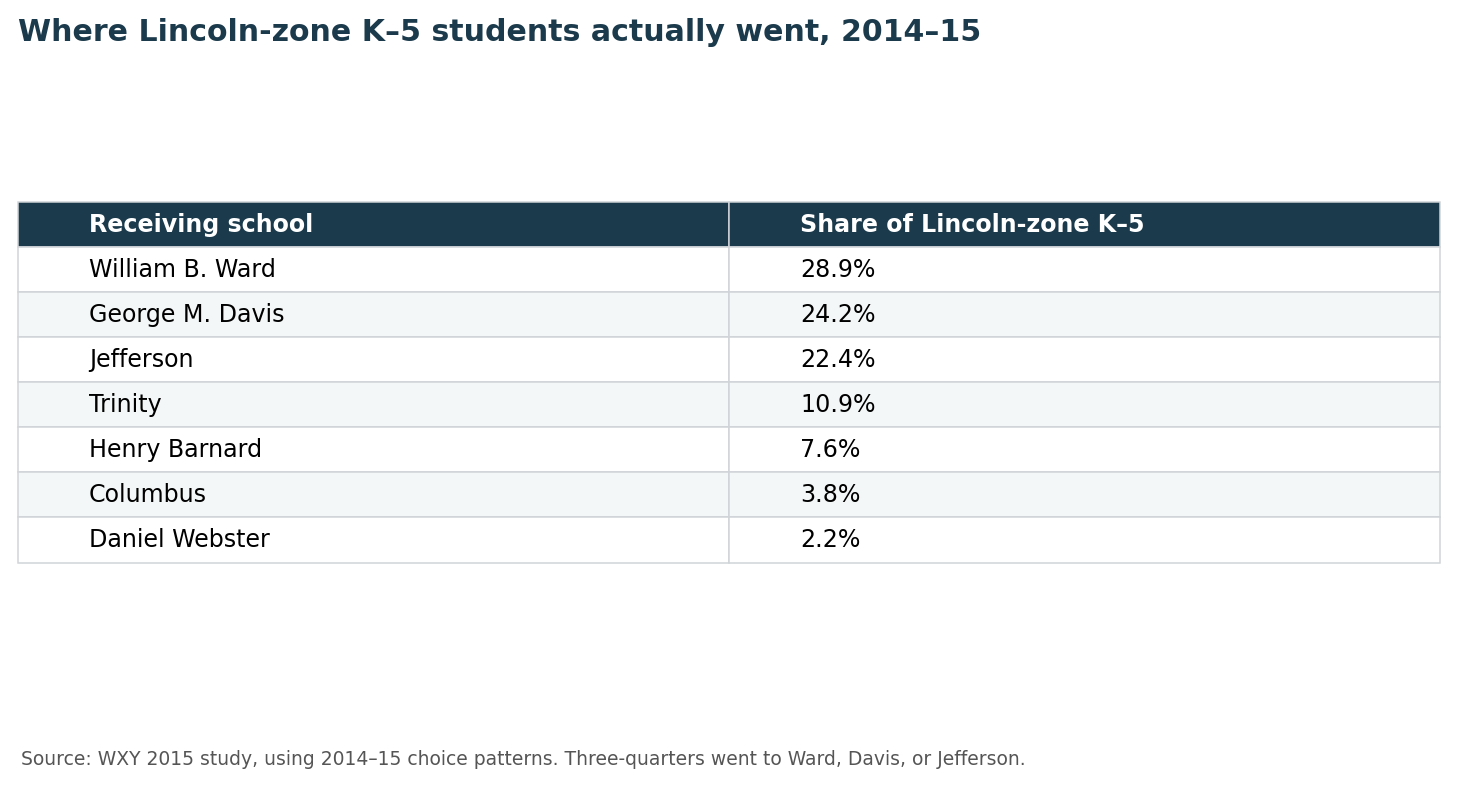
Three-quarters of Lincoln-zone elementary children were already at Ward, Davis, or Jefferson. That scatter pattern is the current system. It is not a neighborhood school.
The zone overlaps heavily with City Council District 3, the city’s designated Black opportunity district. The two maps are not the same thing. District 3 is the better-documented political geography because it was drawn and litigated as such. The 2022–23 redistricting packet is the cleanest official snapshot of District 3 adults:
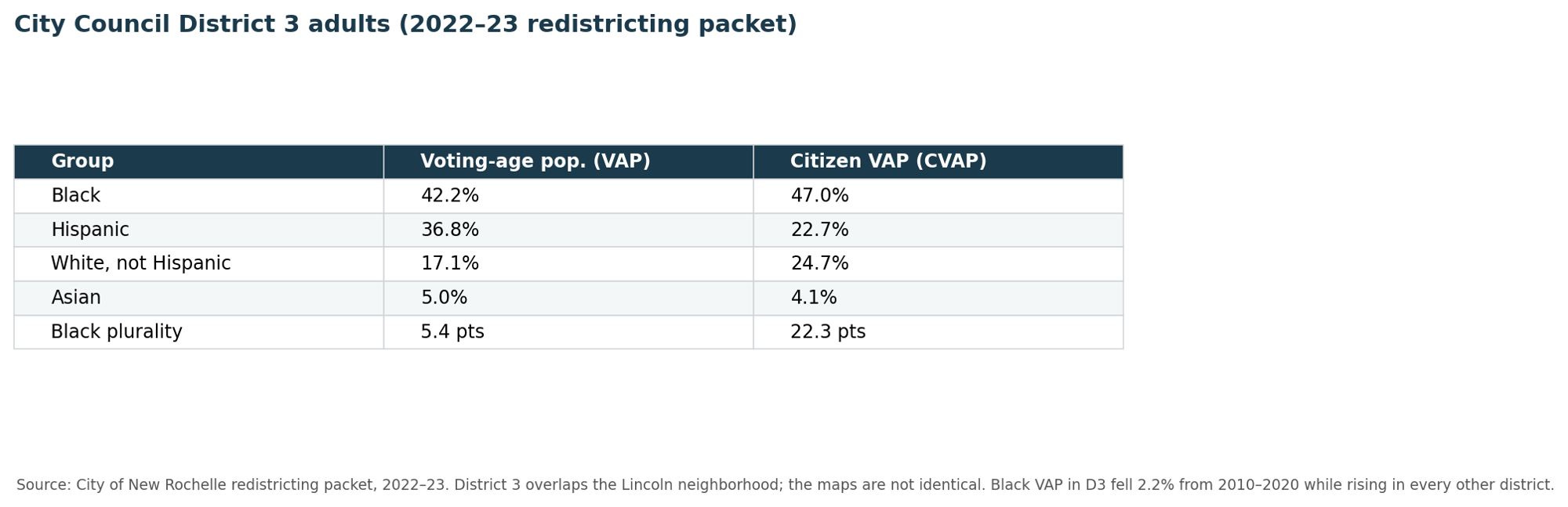
Black residents still held a plurality among citizen adults — which is why District 3 still elects as a Black opportunity seat. The same packet said that plurality was narrowing because housing in the district had become more integrated. Black voting-age population in District 3 fell 2.2 percent from 2010 to 2020 while it rose in every other district.
Schoolchildren are not the voter roll. That is the heart of the argument.
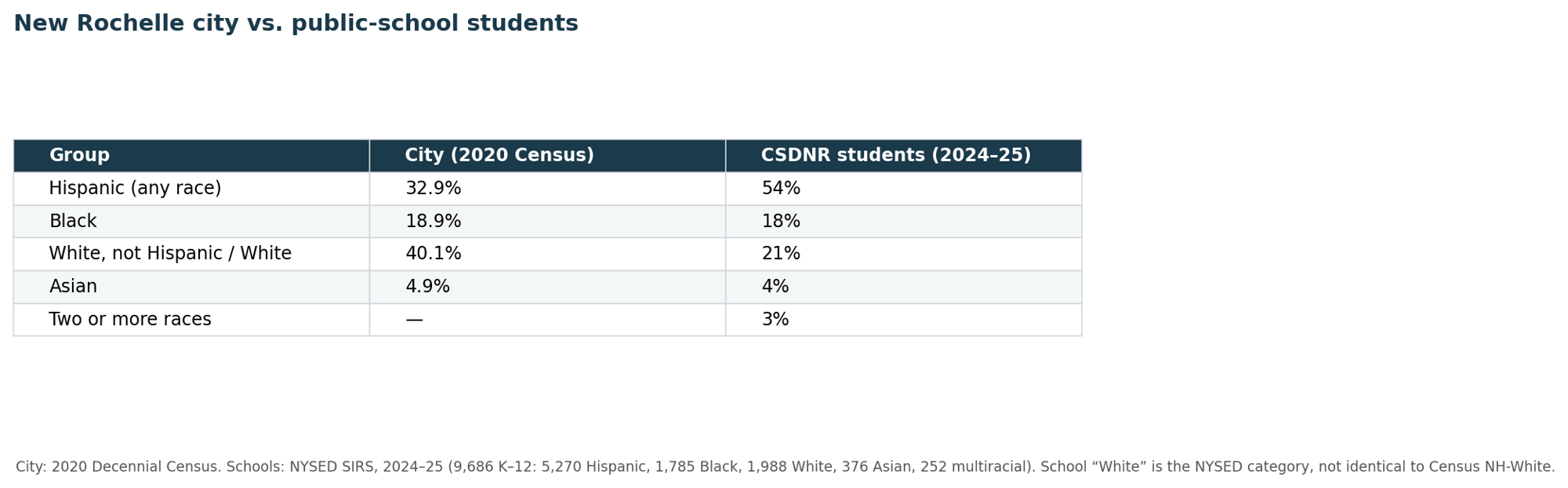
The public schools are already a different city from the Census map. Hispanic students are the largest group by a wide margin. That is the relevant comparison for “what would a new elementary school look like,” not the 1960 building and not today’s adult voter roll.
A new Lincoln school would draw from the same addresses that now feed other buildings. Those buildings are not a perfect proxy — they also serve their own neighborhoods — but they show the direction of travel.
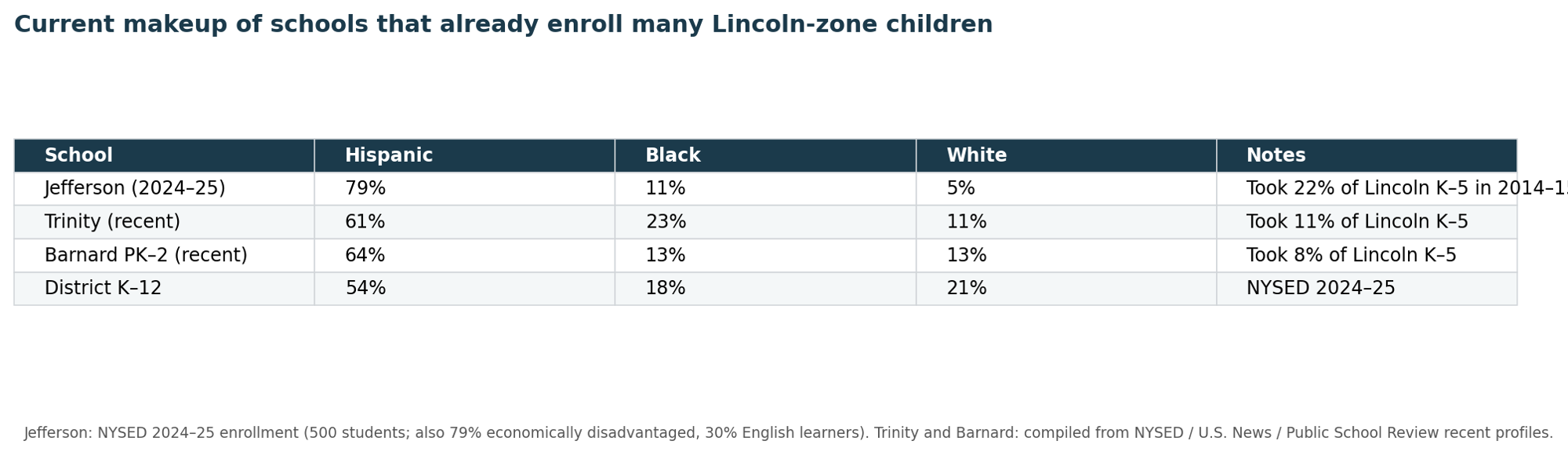
Jefferson’s Hispanic share has climbed for years. Older snapshots put it in the mid-50s. Around 2020 it was in the high 60s. It is now 79 percent. Its Black share has fallen from the high teens to about 11 percent.
The south- and west-side elementaries that already absorb Lincoln-zone children are Hispanic-majority, not Black-majority. A school whose catchment is only the Lincoln zone would sit even more tightly on the old public-housing / Lincoln Avenue corridor — the part of town that has seen the largest Hispanic in-migration and the replacement of high-rise projects with townhomes.
What the public record can support:
- In 1961 Lincoln School was about 94 percent Black. That is not in dispute.
- The zone still exists. Roughly 380–420 public K–5 children lived there a decade ago.
- Those children are already distributed across the district, mostly to Ward, Davis, and Jefferson.
- Council District 3 remains plurality-Black among citizen adults.
- Among schoolchildren citywide, Hispanic students are now the largest group, about 54 percent versus about 18 percent Black.
- The elementary schools that already enroll a large share of Lincoln-zone children are 60–80 percent Hispanic.
What the public record cannot yet prove:
- The exact Black / Hispanic / White / other split of children whose home address is inside the Lincoln attendance polygon in 2026. That file exists at central registration. It has not been published.
Until that record is published by the District, the honest statement is this:
A neighborhood school drawn on the old Lincoln zone would not recreate the 94 percent Black school of 1961. Given citywide child demographics, District 3’s narrowing Black plurality, the replacement of concentrated public housing, and the current makeup of Jefferson, Trinity, and Barnard, the more likely result is a school that is plurality- or majority-Hispanic, with a substantial Black minority — not a return of the school Kaufman ordered closed.
The civil-rights history is real. The 1961 school is gone. Pretending they are the same thing is how people talk past each other.
2. The overcrowding argument is a photograph from another decade
Twelve or fifteen years ago, “the schools are overcrowded” was a fair sentence. I was among the people saying it, because it was true. It is not a fair sentence now. The district’s own demographers have been saying so, in writing, since the mid-2010s. The public argument never updated.
Western Suffolk BOCES — the office New York districts actually hire for this work — has produced the longitudinal series.
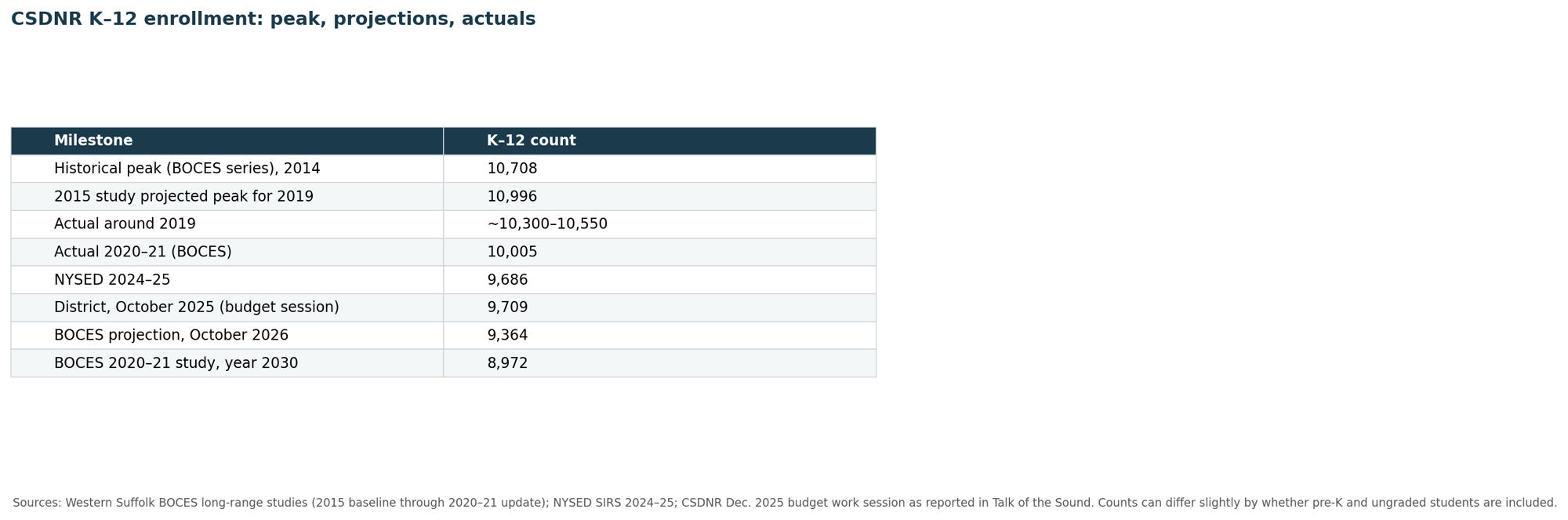
Depending on whether you count pre-K and ungraded students, that is a drop of roughly 1,000 to 1,300 children from the mid-2010s peak, on the order of 10 to 12 percent, with another several hundred baked into the next few years. There is no rebound in any of the published series.
The part that matters for facilities fights is the waterfall. BOCES generally claims a 4 percent margin of error. In New Rochelle the misses have not been random. They have been consistently on the high side — that is, the projections consistently understated the decline.
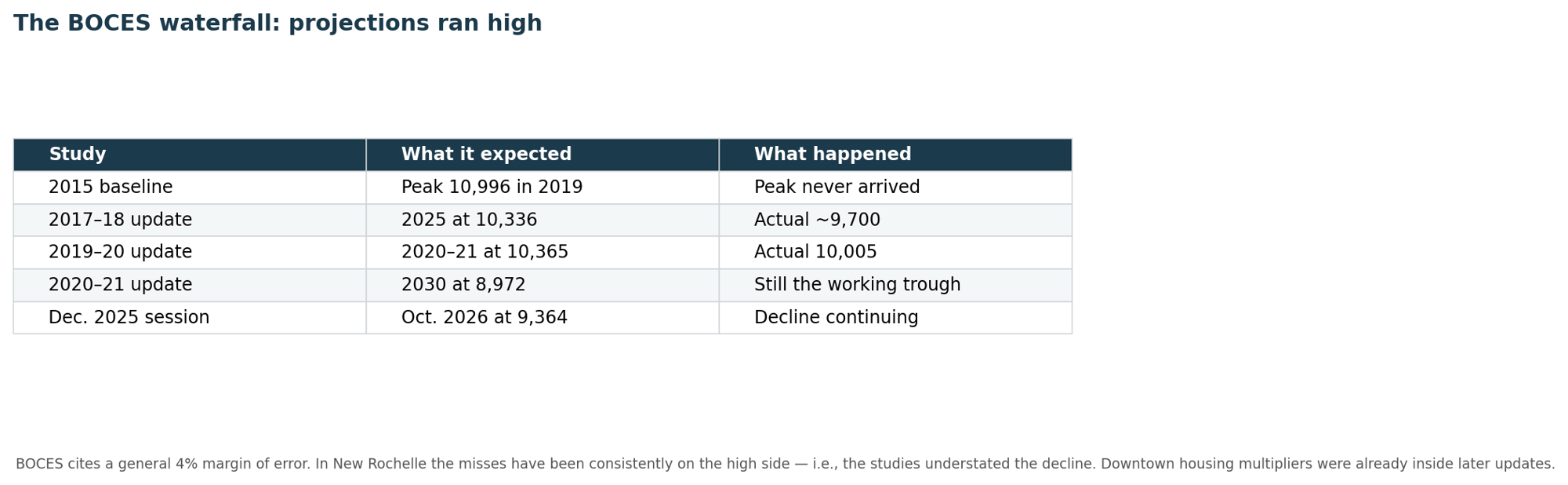
Each new update revised the future down. That is the opposite of a district that is about to run out of seats.
Downtown housing does not rescue the overcrowding story. WXY’s 2015 work, done specifically for the rezoning, used New Rochelle–specific multipliers on studio, one-bedroom, and two-bedroom buildings. The student yield is small. Those multipliers, plus immigration, are already inside the later BOCES updates. The updates still go down. Families who want three bedrooms or a yard do not absorb the bulk of the downtown tower inventory. The buildings fill. The elementary classrooms do not.
Two other drains sit on top of the birth-rate story, which is statewide.
One is private-school and out-of-district exit. The local private sector still enrolls thousands of children. About 25 percent of K–12 students in the city are in private schools, against a New York average closer to 15 percent.
The other is reputation. After a run of violent incidents at the high school — including a student homicide and a near-fatal stabbing that drew national coverage — the exit that used to concentrate after eighth grade started earlier. The parents most likely to leave are not a racial category. They are the parents, of every background, who treat school quality as non-negotiable. I call them education-sensitive parents. When they leave, the district loses both enrollment and the political constituency that keeps a system from sliding.
That is why a “Princeton Plan” — organizing elementary schools by grade band instead of by neighborhood, so that children from the North End would be sent into South End buildings, with Isaac E. Young as the middle-school destination — is not a small operational tweak. New Rochelle is a long city. The bus ride is long. The student composition of Jefferson, Trinity, and Isaac Young is not the student composition of Ward and Davis. Whatever one thinks of that as an integration strategy, the predictable response from education-sensitive North End families is exit, not enthusiasm. Exit accelerates the decline the demographers are already projecting.
The facilities implication is the one the Lincoln-school conversation keeps skipping. You do not build a new neighborhood elementary school because the system is bursting. You would be building it while the system is shrinking, and while a new charter is expected to pull still more children. Empty seats are not an argument against a neighborhood school on principle. They are an argument against pretending the 2010 capacity crisis is still the problem you are solving.
3. The site problem is not a detail. It is the project.
Even if every demographic objection vanished, the Lincoln zone still has no legal school site.
Commissioner’s Regulations § 155.1 and NYSED Facilities Planning are not vague. Unless the Commissioner grants a variance, a new elementary school or an addition needs usable acres.
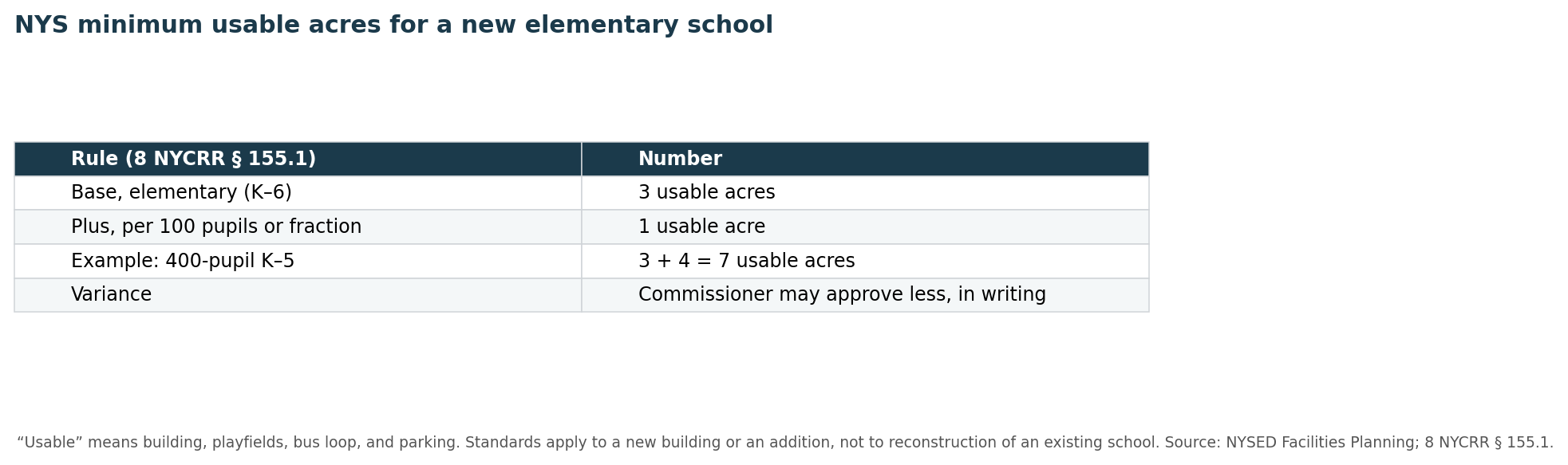
“Usable” means you can put a building, playfields, a bus loop, and parking on it. A sliver of asphalt next to a church does not count.
The Lincoln attendance zone is built out. Every block has buildings on it. Creating seven usable acres means buying something that already exists and tearing it down, or stacking so many variances that Albany is being asked to bless a school that does not meet the state’s own minimums. Variances exist. They are not a plan. They are a confession that the plan does not fit the land.
The former New York State facilities chief was, at the time of the City Hall discussions, the district’s facilities director. He walked the committee through this. Looking at a map of the zone, there is no empty seven-acre site. The vast majority of the property is residential housing. In a residential zone that is not a land-swap. It is eminent domain, or it is a variance so large it becomes the story.
That is why the substitute sites have all been square pegs.
Lincoln Park is the old school site. The Parks Department got the land when the school came down. Using the park for physical education is not the same as getting the park back. Parks is not going to hand a neighborhood park to a school district so the district can satisfy an acreage rule it cannot meet on private lots. It is also not going to let the district treat the park as an on-call play area or a substitute gym whenever the school day requires it.
More to the point, that land is dedicated parkland. In New York that status is not a courtesy. It is the public trust. Taking parkland for another use — selling it, leasing it exclusively, putting a school on it, or discontinuing it as a park — is parkland alienation. The City Council cannot do it by resolution. The school board cannot do it by vote. It requires a bill in the State Legislature and the Governor’s signature, the same process used when a municipality wants to take parkland for a road, a garage, or a casino. If federal park funds ever went into Lincoln Park, there is a second process on top of that, called conversion. “We’ll use the park” is not a site plan. It is a request for Albany to take a neighborhood park off the map.
Bethesda Baptist Church, at 71 Lincoln Avenue, was floated in 2020 as a home for the alternative high school, with Lincoln Park and the Boys & Girls Club as the gym. A family-life center is not an elementary campus. It has no outdoor program of its own. The park-across-the-street theory assumes Parks will operate as the schoolyard. That was never a serious facilities plan. It was a way to put a school-shaped object on Lincoln Avenue.
The old Boys & Girls Club building is gone. The new Remington Clubhouse is a 22,000-square-foot youth facility that has just absorbed Huguenot Academy, the district’s small alternative high school program, under a five-year lease. That returns a learning program to the corridor for the first time in decades. It is not a K–5 neighborhood school, it is not seven usable acres, and it is already spoken for during the school day.
City Hall is the cleanest illustration of why “just put it somewhere nearby” blows up. The building used to be a school. It is not in the Lincoln zone. It is in Ward. The moment you redraw lines to make City Hall a Lincoln school, you are not restoring a neighborhood school. You are inventing a new zone and taking children from someone else’s.
New Rochelle has already lived that fight. LaRuth H. Gray’s What About Barnard?: Phase II Reorganization of the City of New Rochelle School District (1978–1983) is the book of record for what happened the last time the district tried to solve isolation and declining enrollment by moving children and closing or reusing buildings. Barnard itself was among the schools closed in 1981, then later revived as the early-childhood center. The lesson from that era is not that reorganization is impossible. It is that people who think line-drawing will be “fairly straightforward” have not been in the room.
Open that box again — North End to South End, Ward children into a “Lincoln” building that is not in Lincoln, fifth-graders on a long bus to Isaac Young — and the fight will not be about 1961. It will be about whose child is being moved so that someone else’s slogan can be satisfied.
What an honest discussion would require
Four documents would change the quality of the argument overnight.
First, the district should publish the Lincoln-zone enrollment file: currently enrolled students by grade and by race/ethnicity, residence coded to the zone, no names. That is a registration extract, not a new study.
Second, the board should put the Western Suffolk BOCES series on one slide — 2014 peak, each subsequent projection, each subsequent actual — so that “overcrowded” has to survive contact with the waterfall. The 2015 study’s 10,996 and the 2020–21 study’s 8,972 for 2030 belong on the same chart as October 2025’s 9,709.
Third, anyone proposing a Lincoln school should put a parcel map on the table with usable acreage, acquisition cost, demolition cost, and a statement of whether they are asking the Commissioner for a variance. “We will use the park” is not a site. “We will use the church” is not a site. “We will use City Hall and redraw Ward” is a different project with a known history.
Fourth, anyone proposing a Lincoln school should say whether the project has — or can get — Commissioner approval that assigns Building Aid Units. If it cannot, the honest description is a 100 percent local capital project, not a replay of the 2016 bond. And it means acres coming off both the school-district and city tax rolls, which raises everybody else’s taxes.
None of that tells the board whether to build. Neighborhood schools have value that does not show up in a racial percentage. Walking to school has value. A building on Lincoln Avenue has symbolic value. Those are genuine arguments.
They are not improved by pretending the children in the zone are still the children of 1961, or that the district is still short of seats, or that seven usable acres will appear if the slogan is repeated often enough.
The frames of reference are different. The facts are not.
---
Words in Edgewise is a reader-supported publication. To support this work, consider becoming a paid subscriber.
Sources
- Taylor v. Board of Education of the City School District of New Rochelle, 191 F. Supp. 181 (S.D.N.Y. 1961); 294 F.2d 36 (2d Cir. 1961)
- WXY, New Rochelle School Capacity Study (2015)
- Western Suffolk BOCES, City School District of New Rochelle Long Range Planning Study and updates (2015; 2017–18; 2019–20; 2020–21)
- NYSED SIRS enrollment, New Rochelle City School District and Jefferson Elementary, 2024–25
- U.S. Census Bureau, 2020 Decennial Census, New Rochelle city
- City of New Rochelle, Council District redistricting packet, 2022–23
- NYSED Facilities Planning; 8 NYCRR § 155.1 (school site standards)
- NYSED, RESCUE Health and Safety Committees (Part 155.4)
- LaRuth H. Gray, What About Barnard?: Phase II Reorganization of the City of New Rochelle School District (1978–1983)
- Bond vote: May 17, 2016, $106.5 million capital improvement bond, 3,207–1,263
- CSDNR December 2025 budget work session enrollment figures, as reported
- Lohud / Patch reporting on the 2020 Bethesda Baptist alternative-campus proposal
- District calendars: Lincoln attendance zone assignment language