New Rochelle’s Ethics Board: What the Law Says, What City Hall Does, and What the Public Can Find Out

DUBLIN, IRELAND (October 17, 2026) — Following my examination of the city’s Board of Ethics, I am pursuing three additional lines of inquiry: how the board applies its own rules, how it handles and disposes of complaints, and whether it maintains the records that would allow the public to evaluate its performance.
In my previous article about New Rochelle’s Board of Ethics, I described how a question from Michael Cammer, a recently appointed member of the city’s Civilian Complaint Review Board, led me to examine the lack of transparency surrounding the municipal body responsible for enforcing ethical standards. Cammer wanted to know whether an ethics complaint had been filed against City Council Member Albert Tarantino and, if so, what the allegations concerned. I thought his questions were reasonable, so I agreed to see what I could find out.
Cammer was perfectly capable of submitting his own Freedom of Information Law (FOIL) request, of course, but there’s nothing unusual about a request like his. Readers frequently contact me with questions about government records, and for one reason or another, I end up submitting the requests on their behalf. Perhaps it’s because people know how many FOIL requests I file in the course of my reporting. Whatever the reason, I don’t mind. Submitting a straightforward request through the city’s online system takes me less than a minute, so when someone asks for help obtaining a public record, I’m generally happy to oblige.
In this instance, I simply forwarded Cammer’s June 23 email through the city’s FOIL system, adding two questions of my own:
“Is there an ethics complaint filed against Al Tarantino?”
“Can I get a copy?”
The request, assigned No. 26-1334, reproduced Cammer’s original email in full, as shown below.
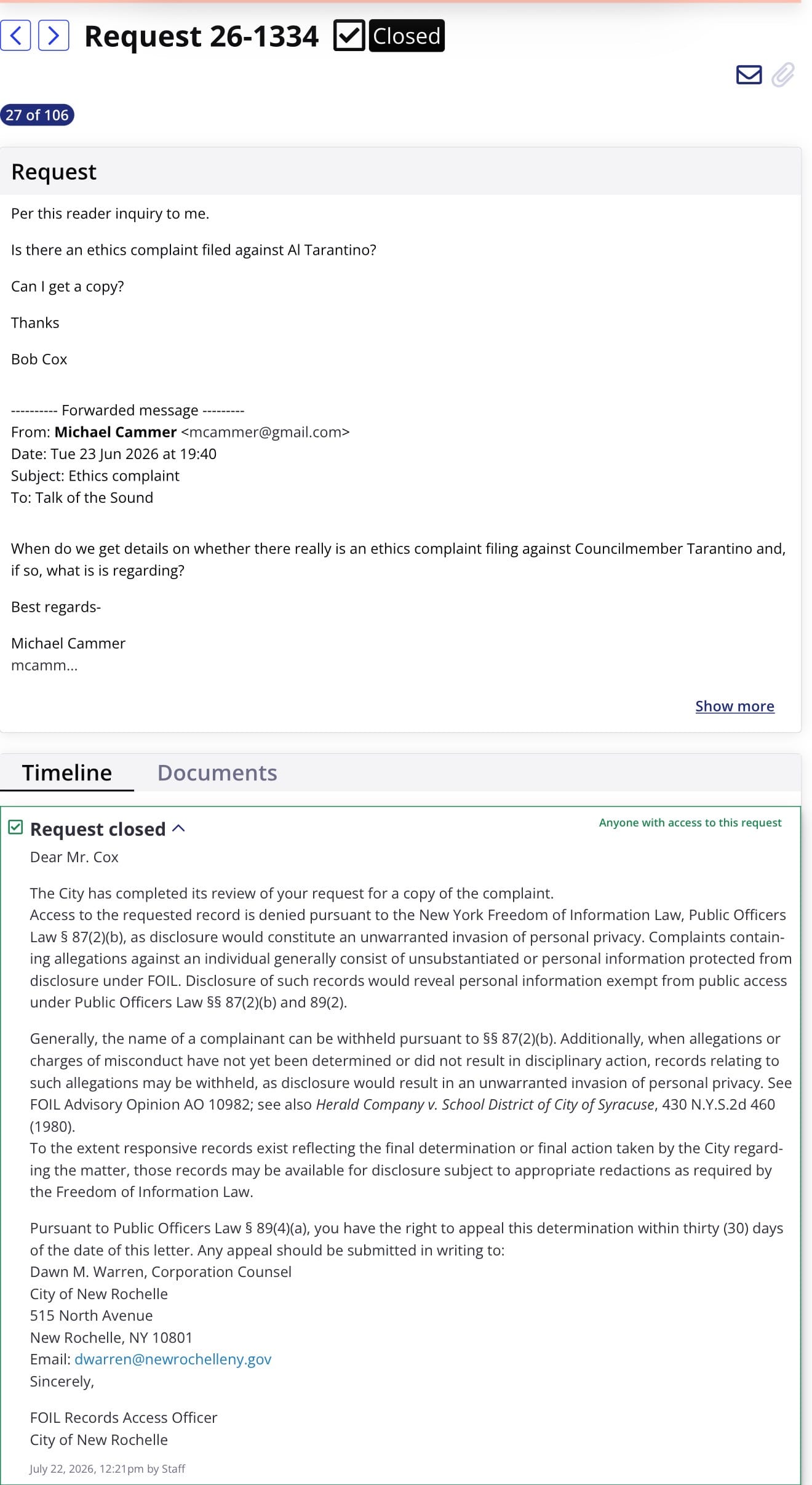
On July 22, the city denied access to the complaint, citing the personal privacy exemption under Public Officers Law § 87(2)(b). The response is worth examining alongside New Rochelle’s ethics code because it demonstrates how the city actually applies FOIL to Board of Ethics records, notwithstanding provisions of its ordinance purporting to restrict access.
This is part of the same examination of municipal ethics oversight that I discussed in my previous article. There are two related questions: whether the city is complying with state transparency laws, and whether the Board of Ethics is following New Rochelle’s own requirements governing its operations. There is also the practical question of how those requirements are applied to actual complaints, something I have encountered repeatedly through my own dealings with the board since 2021.
What the City Actually Said About the Tarantino Complaint
The July 22 response stated that the city had completed its review of my request for a copy of the complaint and was denying access because disclosure would constitute an unwarranted invasion of personal privacy.
The city’s explanation was that complaints containing allegations against identifiable individuals generally involve unsubstantiated or personal information protected under FOIL. It cited Public Officers Law §§ 87(2)(b) and 89(2), along with a Committee on Open Government advisory opinion and a 1980 court decision involving the Syracuse school district.
There is a legitimate basis for protecting certain allegations of misconduct from disclosure, particularly before an investigation has been completed. An ethics complaint is an accusation, not a finding of wrongdoing, and public officials are entitled to appropriate privacy and due-process protections.
But the city’s response is significant for what it says about the relationship between FOIL and New Rochelle’s ethics ordinance.
Section 33-18(A) of the City Code begins with the words “Notwithstanding the provisions of Article 6 of the Public Officers Law” and then identifies limited categories of Board of Ethics records available for public inspection. Article 6 is FOIL.
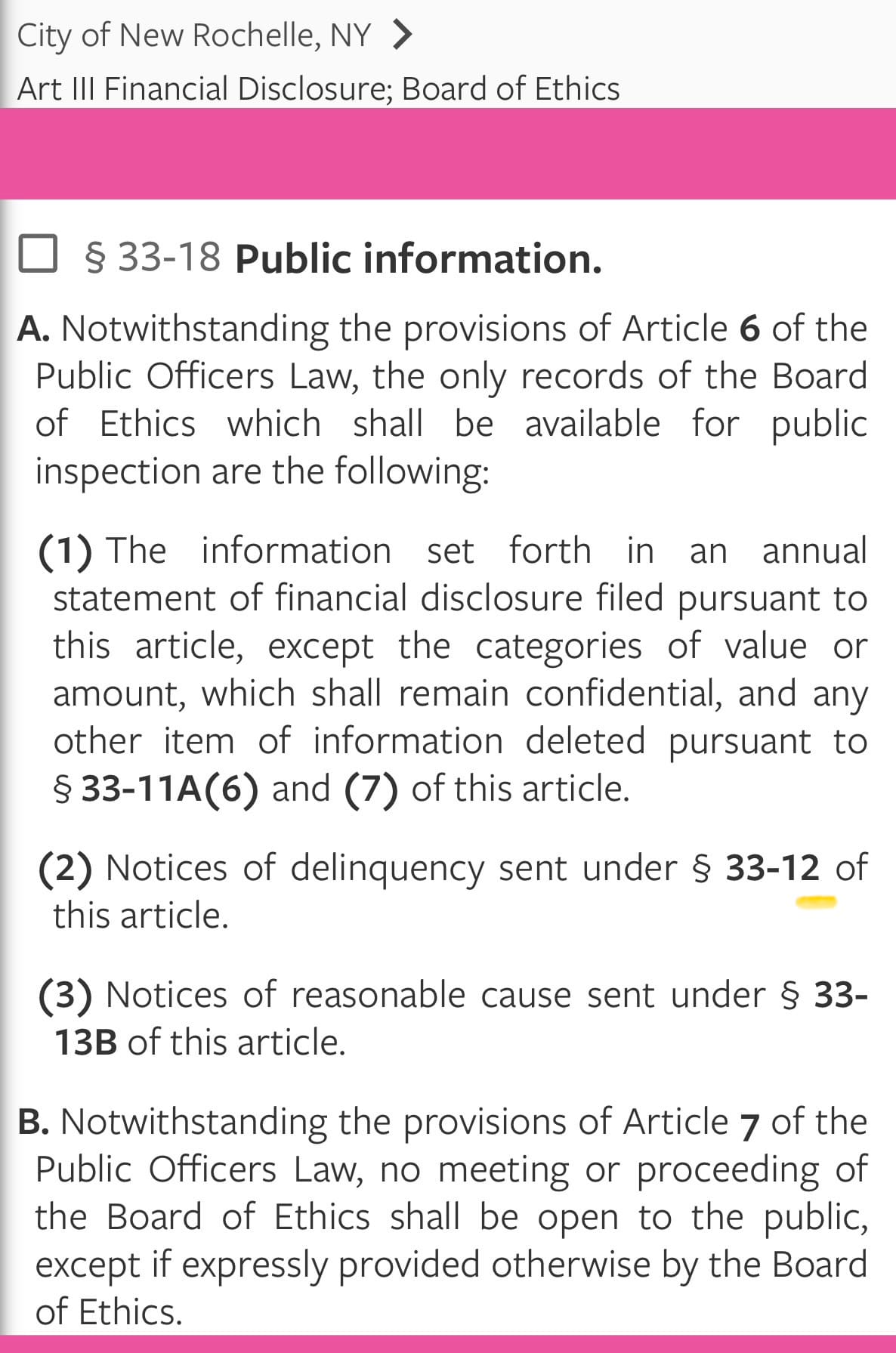
Read literally, the ordinance purports to restrict access to Board of Ethics records beyond the limitations contained in state law. Yet when the city actually processed my request, it did not cite that provision or claim that the Board of Ethics was exempt from FOIL. Instead, it relied on an exemption established by FOIL itself.
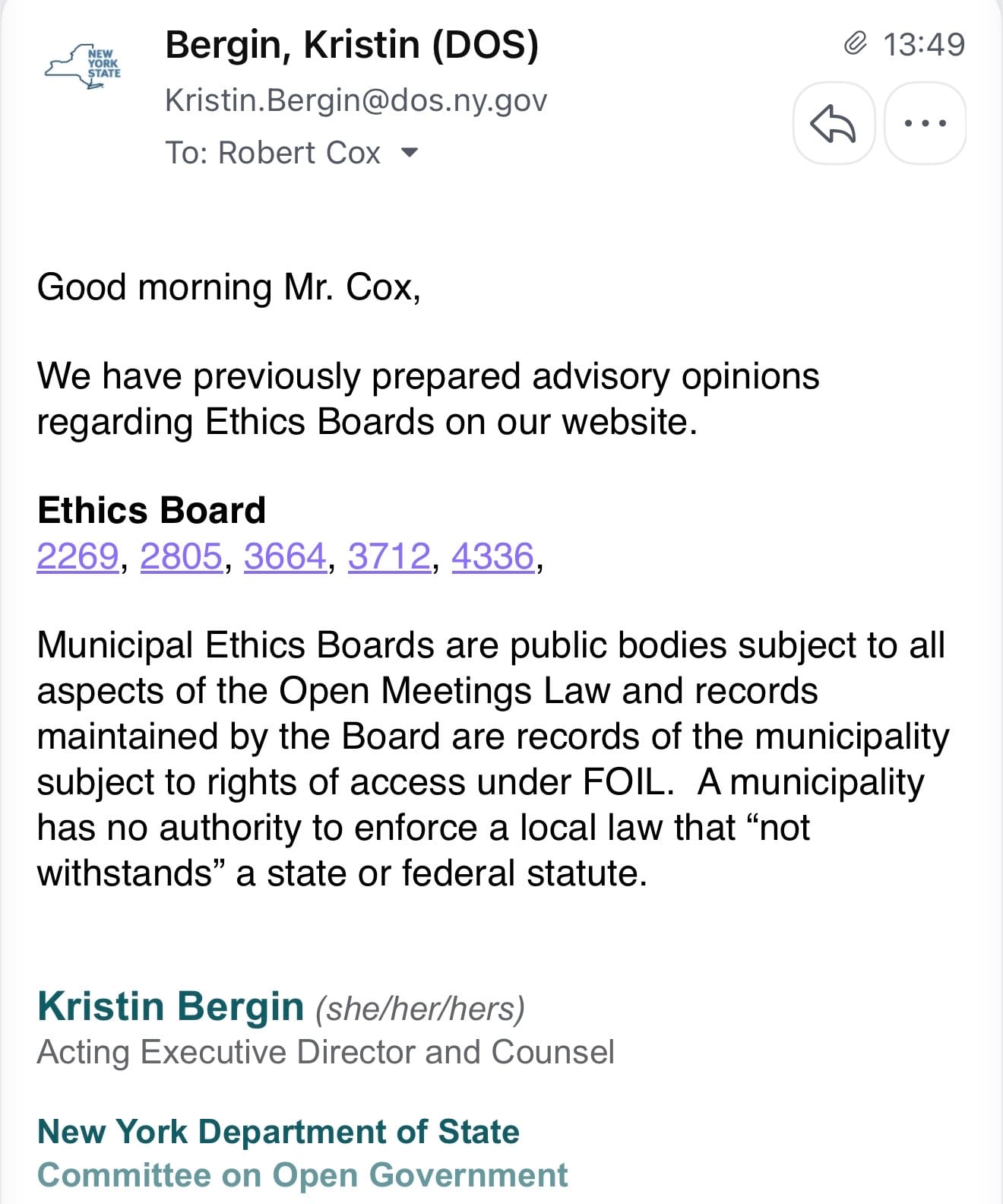
That distinction is consistent with the response I subsequently received from Kristin Bergin, Acting Executive Director and Counsel of the New York State Committee on Open Government. On October 16, Bergin confirmed that municipal ethics boards are subject to FOIL and the Open Meetings Law and that municipalities cannot enforce local ordinances inconsistent with state or federal law.
In other words, New Rochelle’s FOIL officer appears to be applying the state’s public-access framework even though the city’s ethics code still contains language purporting to override it.
That does not establish whether the particular complaint should have been disclosed. An agency can be subject to FOIL and still properly withhold records that qualify for a statutory exemption. But it does illustrate the difference between what New Rochelle’s ordinance purports to authorize and the legal standards its records-access personnel actually apply.
There was another important passage in the city’s response:
“To the extent responsive records exist reflecting the final determination or final action taken by the City regarding the matter, those records may be available for disclosure subject to appropriate redactions as required by the Freedom of Information Law.”
That language deserves attention because it raises a broader question about what the public can learn concerning the disposition of ethics complaints.
What Constitutes a Final Action?
An ethics complaint can be resolved in several ways. The Board of Ethics may determine that it lacks jurisdiction, dismiss a complaint without conducting an investigation, decline to pursue allegations that do not warrant further inquiry, investigate and find that a violation has not been established, or investigate and sustain allegations of misconduct. A complaint might also be withdrawn, referred elsewhere or otherwise closed.
These outcomes are not interchangeable. A dismissal without investigation does not establish that the subject did nothing wrong. A finding that allegations were not sustained does not necessarily mean they were unfounded. Conversely, a determination that an ethics violation occurred carries an entirely different significance from the existence of an unsubstantiated complaint.
When the city’s FOIL response refers to records documenting a “final determination or final action,” I read that language to encompass any formal decision that disposes of a complaint, whether or not an investigation resulted in a finding of misconduct.
If the board receives a complaint, considers it and decides not to pursue the matter further, that decision brings the proceeding to an end. In an ordinary administrative sense, the complaint has been disposed of.
Whether a record documenting that disposition must be disclosed is a separate question. FOIL’s privacy exemptions may still apply, and the circumstances surrounding the particular complaint matter. But the city’s own response acknowledges that at least some records of final actions may be available, subject to appropriate redactions.
This distinction connects directly to my earlier discussion about public accountability and confidentiality. I believe ethics investigations should generally remain confidential while pending, but there should be a meaningful framework governing disclosure of final outcomes. Officials who are the subjects of complaints should be permitted to request the release of final determinations, particularly when allegations were not sustained, while substantiated violations involving elected officials should ordinarily be disclosed regardless of consent.
That approach would require carefully constructed protections for due process, personal privacy, complainants, witnesses and other confidential information. The boundaries should be discussed openly rather than assumed to be obvious.
The broader issue is that the public should have some means of understanding how ethics complaints are handled and resolved without automatically exposing everyone involved in an unsubstantiated allegation.
When an Elected Official Invokes a Confidential Ethics Opinion
There is another problem with the secrecy surrounding New Rochelle’s Board of Ethics, one that goes beyond whether a complaint against an elected official was sustained, dismissed or never investigated. What happens when an elected official invokes the authority of the Board of Ethics to justify participating in government decisions, but neither the official nor the board will produce the supposed advisory opinion? Are residents simply expected to accept the official’s characterization of what the board decided? And what if no such opinion exists?
These are not hypothetical questions. They arise from the conduct of Councilmember Sara Kaye in connection with Sustainable Westchester, a subject I have covered extensively over the past three years. I have no intention of recounting that entire history here. My concern is what the episode reveals about the transparency, accountability and credibility of New Rochelle’s ethics oversight, and how that secrecy can affect the functioning of the City Council and administration.
Some background is necessary to understand the stakes. New Rochelle was a founding member of Sustainable Westchester, the nonprofit organization that operated the Westchester Power Community Choice Aggregation program. Under that program, tens of thousands of New Rochelle residents and businesses were automatically enrolled in electricity supply contracts unless they affirmatively opted out. Instead of choosing to purchase electricity through a third-party supplier, consumers were placed in the program by default and had to take action to remove themselves. Con Edison continued delivering electricity and collecting delivery charges, but the electricity supply portion of participating customers’ bills was governed by contracts arranged through Westchester Power.
The financial stakes were enormous. Over approximately a decade, electricity supply purchases involving New Rochelle ratepayers were worth an estimated hundreds of millions of dollars. That figure represents the overall value of the electricity purchased, not the additional costs incurred by consumers. A subsequent independent statewide evaluation of Community Choice Aggregation programs found that participating consumers collectively paid approximately $116 million more for electricity supply than they would have paid through their default utilities between 2019 and the third quarter of 2025. The evaluation also identified serious problems with consumer notification, disclosure of higher electricity prices and compliance with program requirements. Department of Public Service staff concluded that the programs had failed to deliver their promised consumer benefits and recommended that the Public Service Commission discontinue Community Choice Aggregation statewide.
The evaluation did not provide a municipality-by-municipality breakdown of those additional costs. Nevertheless, New Rochelle was one of the largest municipalities participating in Westchester Power, the original Community Choice Aggregation program in New York. Given the statewide findings and the scale of New Rochelle’s participation, it is reasonable to estimate that local ratepayers collectively paid millions of dollars more than they would have paid through ordinary utility service, although individual customers may have saved money depending on when they participated. The precise amount attributable to New Rochelle remains unknown. These were not abstract disputes about whether an elected official should leave the room during a City Council meeting. They involved legislation and contracts affecting tens of thousands of residents and businesses, hundreds of millions of dollars in electricity purchases, and potentially millions of dollars in additional costs to New Rochelle consumers. That is why the integrity, independence and transparency of the city’s ethics oversight mattered so much.
On October 30, 2023, I filed an ethics complaint against then-Mayor Noam Bramson and Councilmember Kaye for participating in City Council decisions involving Sustainable Westchester while both served on the nonprofit’s board of directors. On December 1, 2023, the Board of Ethics issued its determination addressing those conflicts. Corporation Counsel Dawn Warren subsequently obtained an outside legal opinion from Darius P. Chafizadeh of Harris Beach, dated December 31, 2023, explaining the implications of the officials’ failure to disclose their interests and recuse themselves.
In a February 7, 2024, memorandum to the City Council, Warren explained that the earlier Sustainable Westchester agreements were null, void and wholly unenforceable because of the failures to disclose and recuse. She advised that Kaye was required to recuse herself from consideration of a replacement agreement. Warren even excluded Kaye from distribution of the memorandum because of her conflict.
What followed was a lengthy public disagreement over Kaye’s obligation to recuse herself. Throughout 2024, she repeatedly left City Council proceedings involving Sustainable Westchester while simultaneously insisting that she saw no legal basis for recusal. I documented five meetings in an August 2024 article, including a May 14 meeting when Warren told the council that Kaye could remain because Sustainable Westchester was only a discussion item, notwithstanding the earlier Harris Beach opinion addressing participation in discussions as well as votes. Kaye continued challenging the recusal requirement afterward.
During Citizens to Be Heard on October 8, 2024, I addressed Kaye directly and challenged her to articulate the legal basis for her position rather than repeatedly declaring that she disagreed with the requirement.
Then something changed. Or at least Kaye claimed it had.
On April 8, 2025, Kaye submitted a written statement to City Clerk Kim Jones, requesting that it be incorporated into the City Council’s official record. She declared:
To ensure full transparency, I sought an advisory opinion from the Ethics Board. The Board advised that I publicly disclose my role, but I am not required to recuse myself from voting on matters relating to Sustainable Westchester. In accordance with that guidance, I submit this disclosure for the record.
At the April 15 City Council meeting, Kaye proceeded to participate in a matter involving Sustainable Westchester. Her statement was included with the official council records. The advisory opinion itself was not. There was no mention of it by Kaye or anyone else, she read a brief statement disclosing she was on the board of Sustainable Westchester then voted.
Think about what that means. In December 2023, the Board of Ethics had addressed conflicts arising from Kaye’s participation in Sustainable Westchester matters. An outside attorney had analyzed the legal consequences. In February 2024, Corporation Counsel had relied on that analysis to advise that previous contracts were unenforceable and that Kaye was required to recuse herself. For more than a year, Kaye had repeatedly objected to those restrictions while generally complying with them.
Now Kaye was claiming without evidence that the Board of Ethics had given her permission to participate.
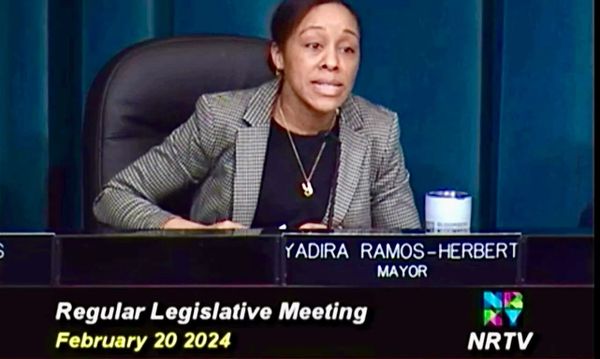
Nobody at the council table on April 8 or April 15 publicly explained what had changed. Mayor Yadira Ramos-Herbert did not announce that she had reviewed the opinion. Corporation Counsel Warren did not explain whether she had reconsidered her February 2024 advice, or why. No member of the administration publicly confirmed the opinion’s existence, described its reasoning or explained how it could be reconciled with the earlier legal conclusions. There was no public acknowledgment that the city’s previously stated interpretation of its conflict-of-interest requirements had changed.
What makes this especially troubling is that there was a straightforward way to handle the situation without publicly disclosing a confidential advisory opinion. Mayor Ramos-Herbert, as the council’s presiding officer, could have stopped the proceedings and asked City Clerk Kim Jones, who also served as clerk to the Board of Ethics, to establish the basic administrative facts. Had Kaye submitted a request for an advisory opinion? Had that request been transmitted to the Board of Ethics? Had the board responded? Had an advisory opinion been issued and transmitted to Kaye? Jones could have confirmed those facts without disclosing a word of the opinion’s substance. At least the public would have known that the document Kaye claimed to possess actually existed and had been issued through the city’s official ethics process.
Jones was not some unrelated administrative official. As clerk to the Board of Ethics, she was the normal channel of communication between elected officials seeking advisory opinions and the board responsible for issuing them. She was also sitting at the council table when Kaye invoked the board’s authority. If Kaye had requested and received an advisory opinion through the ordinary process, Jones would have been the official through whose office those communications normally passed. Yet Jones offered no public confirmation that any such opinion existed.
The mayor could then have turned to Corporation Counsel Warren. Had Warren reviewed the opinion? Did she agree that it permitted Kaye to participate in Sustainable Westchester matters? Was Warren withdrawing or modifying the legal advice she had given the council in February 2024? What was the city’s legal position going forward? Warren could have explained the operative guidance without disclosing confidential communications or privileged legal analysis. Indeed, given that Warren had obtained the earlier Harris Beach opinion, advised that existing Sustainable Westchester contracts were unenforceable and repeatedly directed Kaye to recuse herself, she should have been the person communicating any subsequent change in the city’s legal position to the council.
Instead, none of that happened publicly. The mayor did not initiate such an inquiry. Jones, the official responsible for the administrative communications of the Board of Ethics, did not publicly authenticate the existence of the purported opinion. Warren, the city’s chief legal officer, offered no public explanation for what appeared to be a reversal of the position she had previously advanced and enforced. The only person describing the purported opinion and its implications was Kaye herself, the elected official who stood to benefit from its interpretation. She did so silently by sending an email to the clerk that was not introduced or discussed during the public meeting. She then participated in the council’s business, while the public was left without any independent confirmation of the legal authority she claimed.
I tried several ways to obtain that confirmation.
On April 28, 2025, I wrote to the city regarding the official council minutes, requesting that Kaye’s underlying request and the advisory opinion she claimed to have received be included in the record. I also asked the city to address the discrepancy between her April 8 request to have her statement placed in the minutes and how the statement ultimately appeared in the council materials. I received no response.
On April 29, I wrote directly to Kaye, asking her to provide her request to the Board of Ethics and the resulting advisory opinion. She did not respond.
I also filed a Freedom of Information Law request for the records. On May 9, City Clerk Jones denied the request, invoking FOIL’s exemption for certain intra-agency materials. The city maintained that denial when I challenged it.
Separately, on May 8, I asked the Board of Ethics to exercise its authority under Section 33-16 of the City Code, which expressly permits the board to publish advisory opinions with the requesting person’s name and other identifying details removed. Jones confirmed that my request had been distributed to the board.
On May 29, the board declined. Its response, signed by three board members, invoked confidentiality provisions of the City Code as well as legal exemptions concerning intra-agency communications and attorney-client privilege. The letter provided no copy of the purported opinion, no summary of its operative conclusions and no independent confirmation that an opinion had actually been issued.
One word in the board’s response deserves particular attention: “purportedly.” The board referred to the advisory opinion it had “purportedly” issued to Kaye. Purportedly? This was not a journalist describing an unverified document. This was the very body that supposedly issued it. Was the board declining to acknowledge that an opinion existed? Was it distancing itself from Kaye’s characterization of what the opinion said? Was it suggesting that no such opinion had been issued? Or was this simply a lawyer’s way of avoiding any representation about the underlying facts? The letter provided no way to distinguish among those possibilities.
And that leads to an even more fundamental question: What if an elected official can simply announce that a secret ethics opinion authorizes her to participate in government business, and the city has no public procedure for establishing whether the opinion even exists?
Consider the situation. An elected official publicly claimed that the Board of Ethics had reversed the guidance governing her participation in municipal decisions involving a nonprofit organization on whose board she served. She produced no opinion. She ignored a direct request for it. Corporation Counsel, who had previously established and publicly enforced the recusal requirement, offered no public explanation. The clerk to the Board of Ethics, who was present and would ordinarily have been involved in transmitting advisory-opinion requests and responses, offered no public confirmation. When I sought the opinion through FOIL, the city refused to release it. When I asked the board to publish a redacted version, it declined, using language that did not even establish whether the document existed.
Perhaps the board issued an opinion exactly as Kaye described. Perhaps it issued an opinion that Kaye misunderstood or misrepresented. Perhaps no advisory opinion was issued at all. After all these inquiries, the public has no independent basis for determining which explanation is correct.
This is why the transparency problem is not limited to whether the public can read confidential ethics opinions. It extends to whether the public can establish that such opinions exist, whether they have been properly issued and whether the city’s legal officers have reviewed and accepted their implications for the conduct of government business.
The Board of Ethics is not merely an administrative body that receives complaints and occasionally advises public officials. Its decisions can affect whether elected representatives participate in deliberations, cast votes and exercise authority over contracts involving substantial public and private expenditures. Its advice can have consequences far beyond the individuals who request it.
There is a legitimate public interest in protecting confidential complainants, personal information and the integrity of investigations. But those considerations are different from allowing an elected official to invoke an undisclosed advisory opinion as affirmative authority for governmental action while denying the public any meaningful opportunity to establish what the board actually decided.
I am not suggesting that every confidential ethics request must automatically become public. I am suggesting that when an elected official publicly relies on an ethics opinion to justify participating in official business, the board should have a mechanism for authenticating that opinion and making its operative conclusions and reasoning available, subject to appropriate redactions. The administration should likewise have a procedure for ensuring that its chief legal officer publicly communicates any change in the city’s legal position resulting from such guidance.
That obligation should not depend on whether the official finds disclosure politically convenient. Nor should the public have to accept the official’s unsupported characterization of an opinion that no one else in city government will publicly acknowledge.
Confidentiality should not be permitted to serve as both a sword and a shield for public officials or the Board of Ethics itself.
That is the institutional failure illustrated by the Kaye episode. The question is no longer simply whether one council member should have recused herself from one discussion or vote. It is whether the public can trust a system in which the legal authority governing elected officials’ participation in consequential decisions can apparently change without any publicly available explanation, verification or accountability.
A New FOIL Request for the Tarantino Disposition
With those questions in mind, on October 17 I submitted another FOIL request specifically seeking records documenting the final disposition of the ethics complaint submitted against Tarantino in June 2026.
Unlike my original request, which sought a copy of the complaint itself, this request concerns what the Board of Ethics ultimately did with the matter. I asked for any final determination, decision, resolution, dismissal, closure notice or other record documenting the board’s disposition, whether or not a formal investigation was conducted.
I also requested any written notification communicating the final action to the complainant, Tarantino, the City Clerk, Corporation Counsel or another city official. The request includes existing minutes, motions, votes, resolutions, administrative case-status records and documents establishing when the board closed, dismissed, declined to investigate or otherwise resolved the matter.
I expressly excluded confidential investigative deliberations and underlying evidentiary materials. Where records contain information properly exempt from disclosure, I requested appropriate redactions and production of the remaining material.
I quoted the city’s own July 22 response concerning records of final determinations and actions, explaining that I was now specifically requesting the records the city had identified as potentially available.
The distinction is important. My first request asked what the complaint alleged. My new request asks what the government did about it. Those are different questions, with potentially different answers under FOIL.
If the city produces a final determination or closure record, it may help explain how the Board of Ethics disposes of complaints and what documentation accompanies those decisions. If the city withholds such records, its response should identify the legal basis. And if no disposition record exists, that would raise a separate question about how the board documents the conclusion of matters brought before it.
Whatever the response, it should provide another piece of information about how New Rochelle’s ethics enforcement system operates in practice.
The Rules on Paper and the Rules in Practice
My examination of the city’s ethics code also raises questions about the board’s actual procedures, including requirements that I myself had not followed when submitting complaints over the years.
Since 2021, I have filed multiple ethics complaints against New Rochelle public officials. I identified myself, signed my submissions, provided supporting documentation and made clear that I was personally responsible for the allegations. In several instances, the board considered the complaints and issued written determinations.
What I did not do until this summer was include a sworn verification.
Section 33-13(A) of the City Code refers to the board receiving a sworn complaint alleging an ethics violation. Although I had been submitting signed complaints under my own name, I had not been including the formal sworn statement contemplated by the ordinance.
For years, this did not become an issue. The city accepted and processed my complaints without asking me to supply a sworn verification. No one informed me that a submission was procedurally defective or required amendment before the Board of Ethics could act.
When I reviewed the ordinance more closely over the summer, I recognized that the missing verification could potentially provide a reason for the board not to proceed with a complaint. I decided there was no reason to leave that opening. Since then, I have included a sworn statement with every new ethics complaint and intend to continue doing so.
I mention this not to complain about the city’s handling of my earlier submissions, but because it illustrates the difference between the formal requirements contained in the ethics code and the manner in which the board appears to administer them.
The ordinance also allows the Board of Ethics to initiate investigations on its own authority, rather than solely in response to sworn complaints. That may provide a legitimate procedural basis for considering information received in other forms.
Nevertheless, there are reasonable questions about how these provisions are applied. Does the board require sworn verification from some complainants but not others? Does it have a process for correcting procedural deficiencies? Does it distinguish between accepting a complaint for preliminary review and formally initiating an investigation? Are those procedures written down, and are they available to the public?
I do not object to reasonable flexibility. Allowing someone to correct a technical defect seems preferable to dismissing an otherwise legitimate complaint over a missing formality. But the rules should be clear and consistently administered.
Residents should not need years of experience dealing with the Board of Ethics to understand what is required to file a complaint.
When Does the Board Actually Meet?
Another issue concerns the board’s meetings and the records documenting its official activities.
As I described in my previous article, New Rochelle’s Board of Ethics webpage states that public meetings will be posted on the city’s main calendar. Yet I have been unable to identify the kinds of meeting notices, agendas and minutes ordinarily associated with municipal boards and commissions.
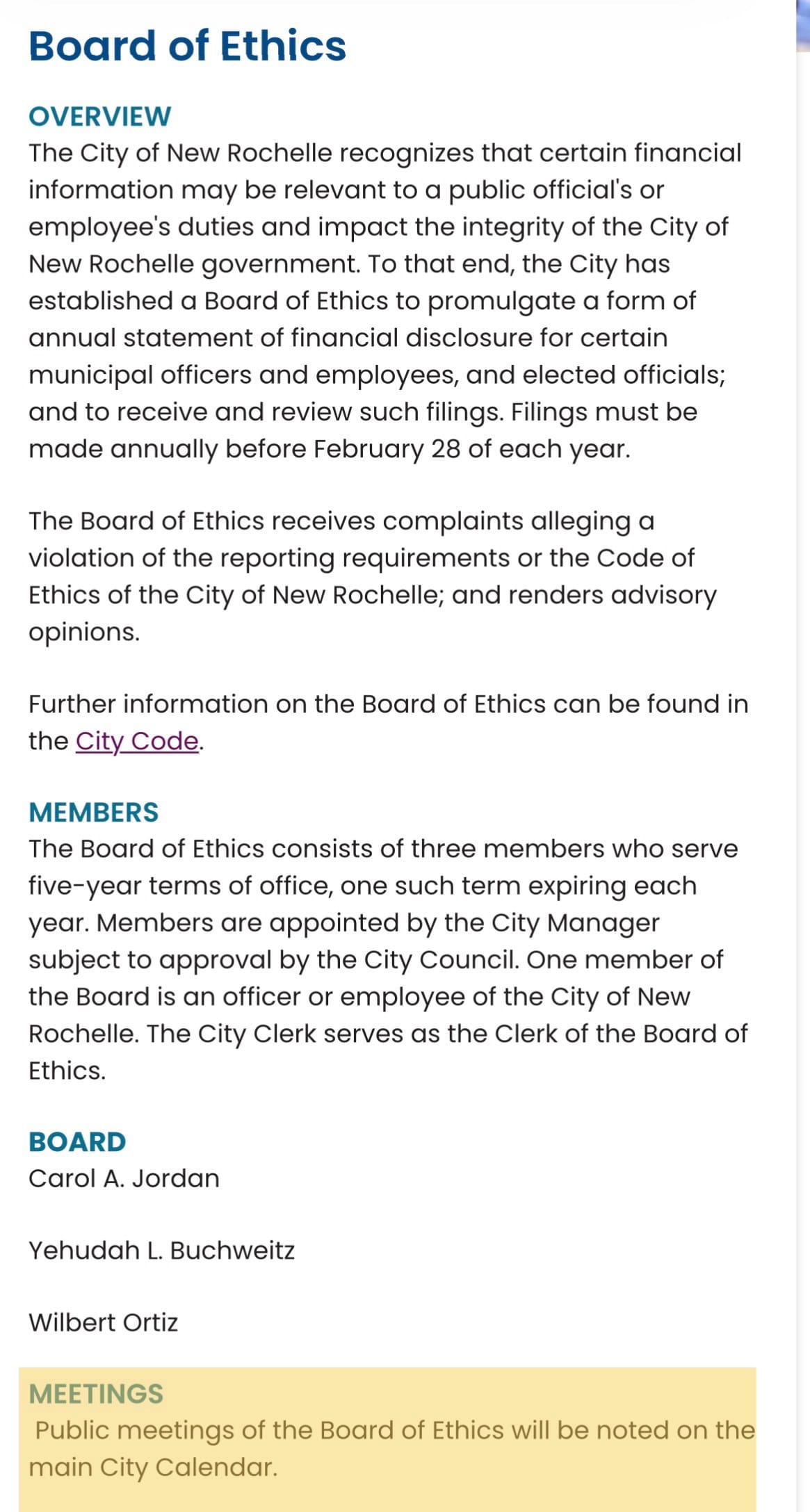
When I followed up on one of my pending ethics complaints in September, City Clerk Kim Jones, who also serves as clerk of the Board of Ethics, told me that the board had scheduled another meeting to discuss complaints.
That was useful information, but it did not establish when the meeting would occur, who would attend, whether there would be a quorum or what records would document the board’s actions.
The Committee on Open Government has made clear that municipal ethics boards are public bodies subject to the Open Meetings Law. Certain discussions may properly take place in executive session, and particular matters may qualify for statutory exemptions. But those provisions do not create a blanket exemption from the law.
That raises questions about what administrative records the Board of Ethics maintains, even when the substance of its proceedings is confidential.
On October 17, I submitted a FOIL request seeking records concerning every Board of Ethics meeting held, scheduled, postponed or canceled during the 2026 calendar year. The request also covers any meetings already scheduled for the remainder of the year.
I requested meeting notices, calendars, scheduling correspondence, invitations, agendas, attendance records, quorum documentation, minutes, motions, resolutions, votes and records concerning executive sessions.
I also sought the board’s rules and procedures for scheduling meetings, determining quorums, preparing minutes and documenting official actions.
The request deliberately excludes the substance of individual ethics complaints, confidential investigative records and personal financial information. Where responsive administrative records contain protected information, I asked the city to redact that information and disclose the nonexempt portions.
The purpose is straightforward. I want to establish when the Board of Ethics meets, how meetings are arranged, who participates, whether a quorum is present and what records document the board’s proceedings.
These are ordinary questions about the administration of a governmental body. They do not require access to confidential allegations or investigative deliberations.
I also asked the city to prioritize readily available meeting schedules, notices, attendance records, agendas and minutes, with the remaining records produced on a rolling basis.
The resulting documents should provide a clearer picture of how the board actually operates. If the records exist, they may establish a chronology of meetings and official actions. If they do not exist, that would raise additional questions about how the board documents its activities.
The Annual Reports Already Required by the Ethics Code
There is a related provision of New Rochelle’s ethics ordinance that deserves particular attention because it concerns precisely the kind of accountability I advocated in my previous article.
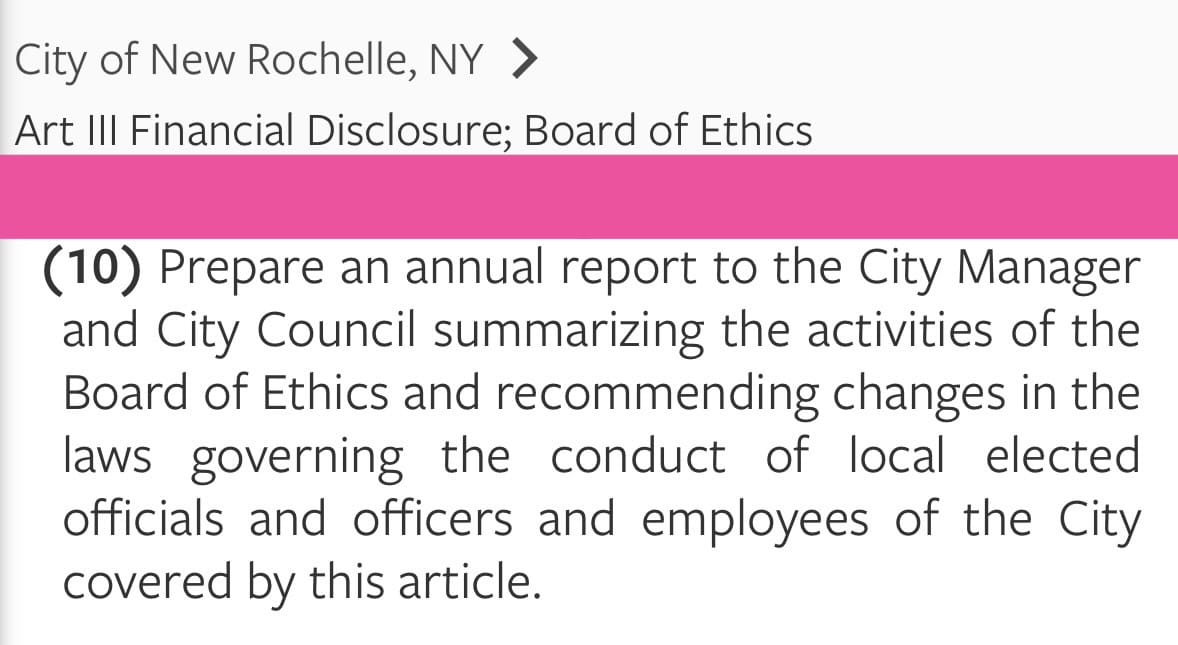
Section 33-11(A)(10) requires the Board of Ethics to prepare an annual report to the City Manager and City Council summarizing its activities and recommending changes in the laws governing the conduct of municipal officials and employees.
That requirement already exists in New Rochelle’s law. It is not something the City Council would need to create from scratch.
The ordinance does not expressly require the report to be published online or contain the comprehensive statistical information I have proposed. But it does require the Board of Ethics to provide an annual accounting of its activities to the city’s executive and legislative leadership.
That raises several straightforward questions. Have those annual reports been prepared? Were they submitted to the City Manager and City Council? What information did they contain? Did the board recommend changes to the city’s ethics laws? And if these reports have existed for years, why are they not readily accessible to residents?
I have not located them.
I therefore submitted a separate FOIL request seeking the annual reports for the 10 completed calendar years from 2016 through 2025, together with records documenting their submission to the City Manager and City Council.
I also requested earlier reports, going back as far as they exist, if they are maintained in a readily accessible location and can be conveniently retrieved.
For any year in which the city cannot locate an annual report, I asked it to identify the specific year and, to the extent its records establish it, indicate whether the report was never prepared or simply could not be found.
There are important distinctions among those possibilities. A report that exists but was never publicly posted presents one accountability issue. A report prepared but not submitted to the City Manager and City Council presents another. A statutory reporting requirement that has simply gone unfulfilled would raise a more fundamental question about the board’s compliance with its own governing ordinance.
The annual-report provision is particularly relevant to my proposed reforms because it establishes that New Rochelle has already recognized the importance of having the Board of Ethics account for its activities.
I believe that obligation should be expanded into a standardized public statistical report documenting meetings, attendance, financial disclosure compliance, advisory opinions, complaints, investigations, final dispositions and processing times, with appropriate safeguards for confidential information.
But the starting point is determining whether the existing annual-report requirement has been followed.
Two Different Standards of Accountability
What interests me about these questions is that they involve two different sets of obligations, both of which deserve attention.
The first comes from state law. New Rochelle’s Board of Ethics is subject to FOIL and the Open Meetings Law, notwithstanding provisions of the city’s ordinance purporting to override them. The Committee on Open Government has confirmed that principle and supplied advisory opinions explaining how confidentiality and public-access requirements apply to municipal ethics boards.
The second comes from New Rochelle’s own ethics code. The city has established requirements concerning the submission and consideration of complaints, the board’s procedures, particular official determinations and annual reports to the City Manager and City Council.
My experience with sworn complaints demonstrates that the board’s actual practices may not always follow the literal requirements of the ordinance. The city’s July FOIL denial, meanwhile, suggests that its records-access procedures recognize state transparency requirements more accurately than the language of its own ethics code.
Neither observation establishes whether the board is consistently complying with all its obligations. But they raise questions that can be tested against the records the city maintains.
That is the purpose of the three new FOIL requests. One seeks the annual reports that the board is already required to prepare. Another seeks administrative records documenting its meetings and official proceedings during 2026. The third seeks records documenting the final disposition of the Tarantino ethics complaint.
Together, they should help establish what the Board of Ethics has actually been doing, how it documents its work, what information it provides to the officials responsible for overseeing municipal government and how its decisions are recorded and communicated.
I am not asking the city to disclose confidential investigative files or expose individuals to unsubstantiated allegations. I am asking it to account for the administration of a public body responsible for enforcing ethical standards.
What Comes Next
In my previous article, I proposed that New Rochelle overhaul its ethics code, using the city’s newer Civilian Complaint Review Board as a model for public meetings, annual reporting, public education, accessible complaint procedures and mandatory training.
Those proposals remain important. But the examination of existing law and actual practice adds another dimension to the discussion.
Before deciding what additional accountability measures should be adopted, the City Council ought to understand whether the Board of Ethics is satisfying the obligations already imposed on it by state and local law.
The annual reports should help establish what the board has told the City Manager and City Council about its activities over the past decade. The 2026 meeting records will help establish when it convenes, how its meetings are administered and what records it maintains. The request for records documenting the Tarantino disposition addresses a related question: what documentation exists when the board brings an individual ethics matter to a conclusion?
Those records may answer some questions while raising others. That is the nature of examining a governmental system whose activities have long been difficult for the public to observe.
There is a larger principle involved. Transparency is not simply a matter of granting or denying an individual records request. It also requires clear procedures, consistent application of rules, reliable recordkeeping and meaningful reporting about how public authority is exercised.
That obligation is especially important for a municipal body entrusted with enforcing ethical standards.
Michael Cammer’s original question concerned a particular complaint against a particular elected official. The city’s response raised broader questions about what information the public may obtain concerning ethics complaints and their disposition. Those questions lead naturally to the board’s procedures, its meetings and the annual reports it is supposed to prepare.
I intend to pursue those questions through the three records requests now pending and through discussions with officials familiar with the board’s operations.
The question is not simply whether New Rochelle’s Board of Ethics is enforcing the rules governing everyone else. It is whether the public can determine that the board itself is following the rules governing its own operations.