Why Is New Rochelle Holding Its State of the City Address So Far From Most of Its Residents?

85.6% of New Rochelle Residents Live Within Two Miles of City Hall, Compared With Just 10% Within Two Miles of Mayor Ramos-Herbert’s Chosen Venue at the JCC; 39,927 v 4,219 live within a 20 minute walk.
DUBLIN, IRELAND (October 17, 2026) — I was on the City of New Rochelle website Saturday when I noticed a banner advertising Mayor Yadira Ramos-Herbert’s upcoming State of the City address, scheduled for October 27 at JCC Mid-Westchester. The banner invited members of the public to RSVP. I wasn’t planning to attend, since I live in Ireland, but I was curious about the arrangements, so I clicked on the banner to see what the city was asking people to do.
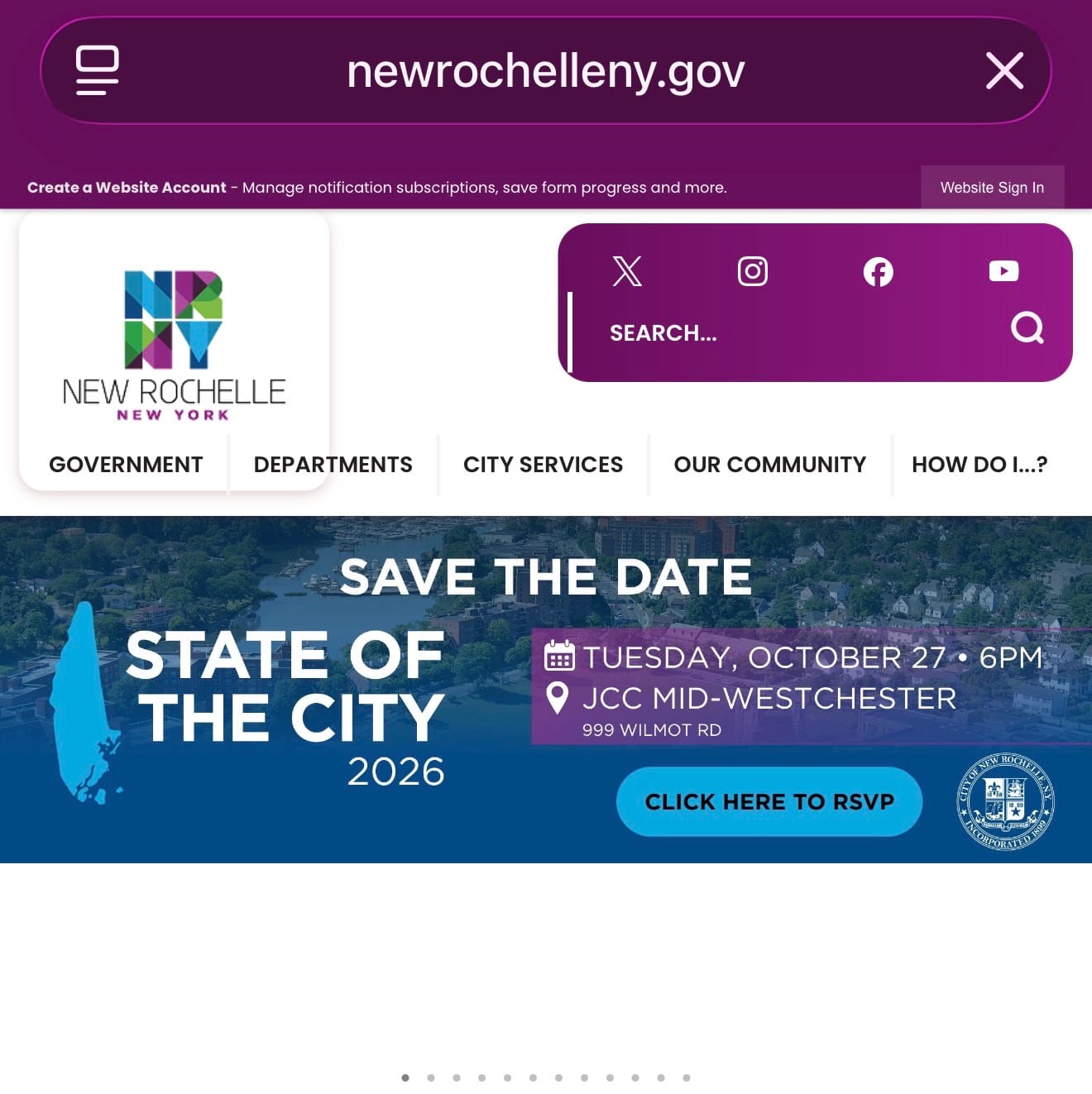
What began as a casual click led me to a series of questions about personal privacy, public access, taxpayer expenses and Mayor Ramos-Herbert’s decision to hold her annual address at a private facility on the northern edge of New Rochelle rather than at City Hall, a centrally located public building with an auditorium that has served the same purpose for decades. What initially caught my attention was the amount of personal information the city wanted from anyone submitting an RSVP. But as I began looking into the arrangements, I discovered something considerably more significant.
An analysis of municipal boundaries and U.S. Census data estimates that 50.1 percent of New Rochelle residents live within one mile of City Hall, compared with just 5.3 percent within one mile of JCC Mid-Westchester. Expanding the radius to two miles produces an equally dramatic disparity: 85.6 percent of New Rochelle residents live within two miles of City Hall, compared with just 10 percent within two miles of the JCC.
Those numbers deserve some context. An average adult walking at approximately 3 mph can cover one mile in about 20 minutes, making that distance a useful proxy for the proximity of residents who might attend on foot. The calculations use straight-line distances, so actual walking routes may be longer, but the geographic comparison is nonetheless striking. Mayor Ramos-Herbert has chosen to hold her State of the City address at a location where roughly one in ten New Rochelle residents live within two miles, rather than at a publicly owned auditorium where more than eight in ten residents live within the same distance.
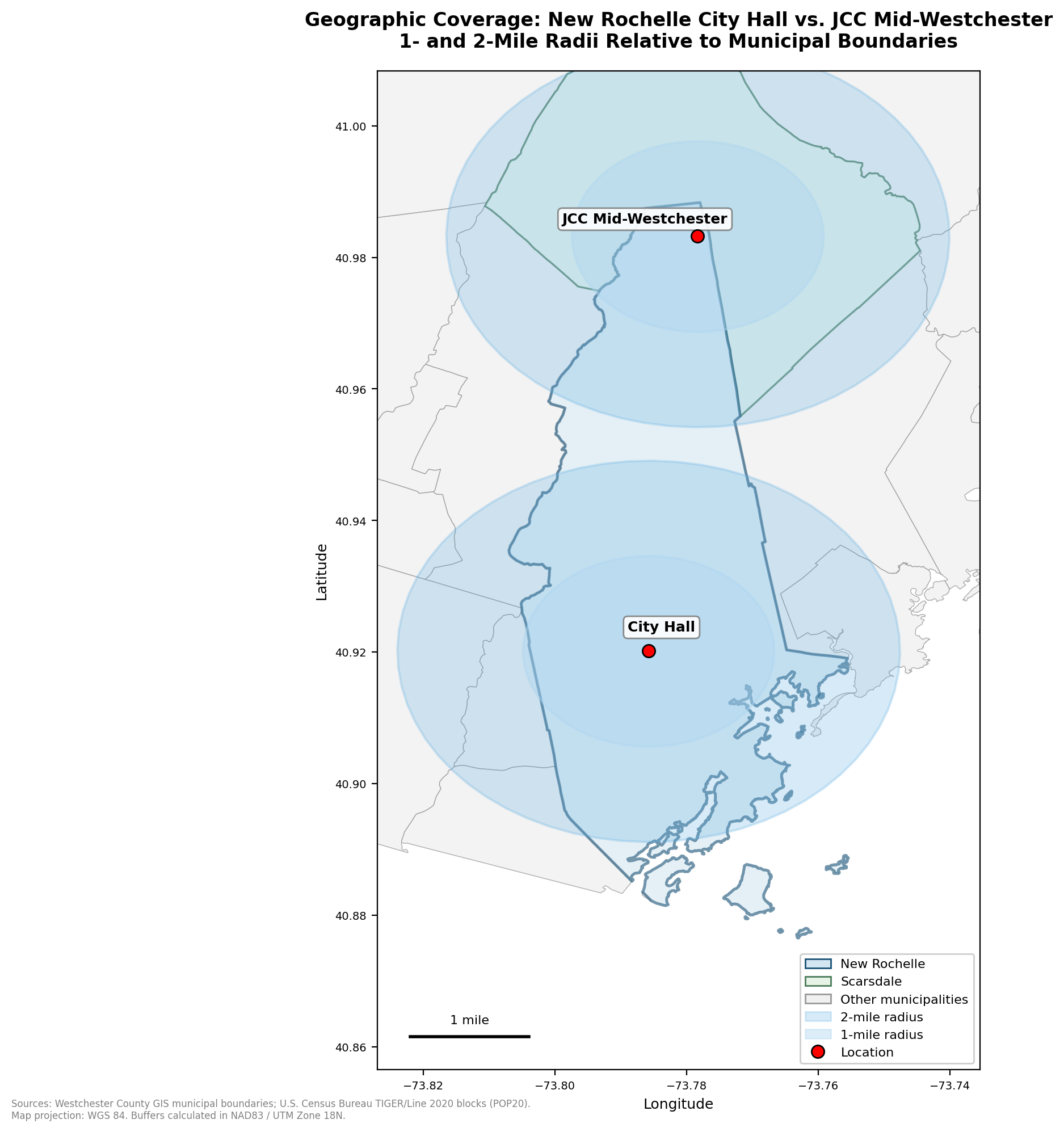
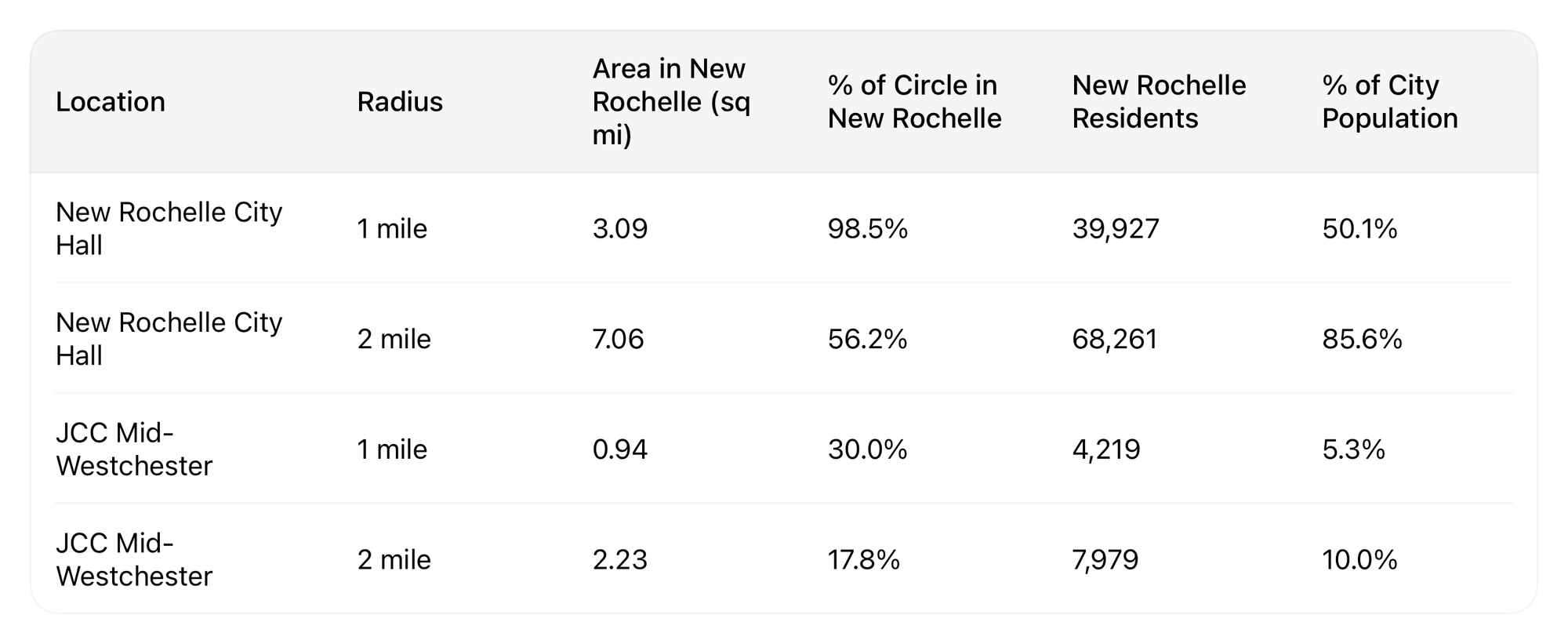
The underlying analysis used Westchester County’s official municipal boundaries and 2020 U.S. Census block population data. Census blocks intersecting the circles were apportioned according to the percentage of each block’s geographic area falling within the circle, a consistent method that provides population estimates rather than exact household counts. The calculations estimate that 39,927 New Rochelle residents live within one mile of City Hall, compared with 4,219 within one mile of the JCC. At two miles, the corresponding estimates are 68,261 residents near City Hall and 7,979 near the JCC, out of the city’s official 2020 population of 79,726.
The municipal boundaries help explain the extraordinary difference. Nearly the entire one-mile circle surrounding City Hall, 98.5 percent, falls within New Rochelle, compared with just 30 percent of the equivalent circle surrounding the JCC. At two miles, 56.2 percent of the circle around City Hall lies within city limits, compared with 17.8 percent around the JCC. The JCC is physically located in New Rochelle, directly along the Scarsdale border, even though its official mailing address is 999 Wilmot Road, Scarsdale, NY 10583. Much of the land surrounding the facility is therefore in Scarsdale and other neighboring municipalities, rather than in New Rochelle.
Geography is not the same thing as accessibility, but it is an important starting point. City Hall is situated closer to downtown and the more densely populated neighborhoods of southern and central New Rochelle, where there are more apartment buildings, multifamily homes and smaller residential properties. The northern neighborhoods surrounding the JCC have generally larger residential lots and lower population density. Residents in the more densely populated parts of the city may also face greater obstacles to traveling across town because they lack cars, depend on public transportation or have limited financial resources.
That raises a basic question: Why has Mayor Ramos-Herbert chosen to hold an event intended for New Rochelle residents at a location so geographically removed from most of them when she has a centrally located, publicly owned auditorium available at City Hall?