The Public’s Right to Know: New Rochelle’s FOIL Stonewall — Part VI

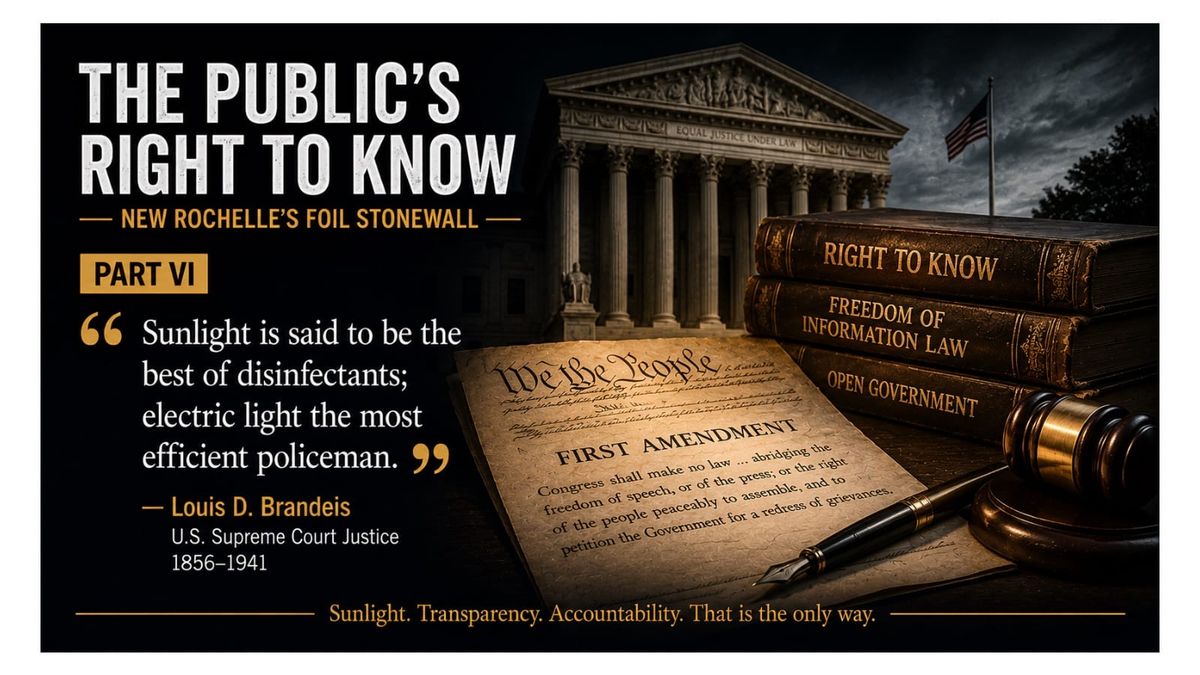
See You in Court
DUBLIN, IRELAND (October 15, 2026) — This is Part VI in a multi-part series.
Over the first five installments of this series, I have examined what happened when I sought public records from the City of New Rochelle. The requests involved different subjects, different City departments and different administrative histories, but they eventually raised a common question: What happens when a government agency refuses to reconsider a request for records because it believes the requester should have gone to court over an earlier request?
That question is now before the New York State Supreme Court in Westchester County.
On August 10, 2026, I filed an Article 78 proceeding against the City of New Rochelle, City Manager Wilfredo Melendez and City Clerk Kim Jones. The case, Cox v. City of New Rochelle, Index No. 70555/2026, challenges 24 administrative determinations issued by Melendez on May 20, 2026, denying appeals of FOIL requests I had submitted earlier that month.
I am representing myself. The City is represented by its Corporation Counsel’s Office. The proceeding is assigned to Justice Erin M. McGoey.
Why I Went to Court
The Freedom of Information Law gives members of the public the right to request government records, subject to statutory exemptions. Agencies are required to respond within prescribed periods, and requesters who are denied access have administrative appeal rights. When that process fails to resolve a dispute, an Article 78 proceeding provides a means of seeking judicial review.
I have used FOIL for years as part of my reporting on New Rochelle government. Some requests produce records relatively quickly. Others result in lengthy exchanges over the scope of a request, the adequacy of a search, claimed exemptions, missing documents or the time needed to assemble a production.
The requests examined in this series had histories extending back to earlier years. In some instances, I believed records remained missing from productions. In others, requests had been acknowledged but never substantively resolved. Some involved disagreements over the City’s electronic searches or its estimates of how many potentially responsive records existed.
By May 2026, I wanted to bring these matters back before the City through its NextRequest records portal. I submitted 24 requests derived from earlier FOIL matters. Some sought records covering expanded periods or categories; others revisited records I believed remained outstanding. They were related to earlier requests, but that did not necessarily make them identical copies.
The City’s responses brought the dispute into focus.