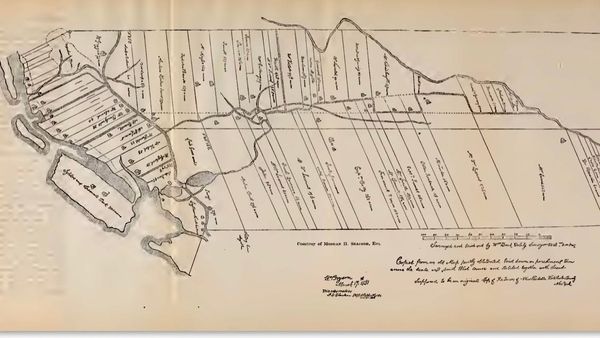
The Great Wall Street Journal Hoax of New Rochelle— Part I: How a Housing Miracle Was Built on Cherry-Picked Rent Data

An examination of nearly a decade of Apartment List data challenges the statistics used to portray New Rochelle as a national model for lowering rents.
DUBLIN, IRELAND (October 26, 2026) — For more than a year, New Rochelle has been celebrated as a rare American success story: a city that welcomed thousands of new apartments, cut through government red tape and somehow managed to bring rents down while housing costs soared almost everywhere else.
The narrative first gained national attention through research published by the Pew Charitable Trusts in 2023 and 2024, which portrayed New Rochelle as a model for using increased housing construction to restrain rents. The Wall Street Journal amplified that narrative in 2025, presenting the city as a rare success story in America’s housing affordability crisis. Together, the reports helped establish New Rochelle as an example for politicians and housing advocates seeking to demonstrate that reducing barriers to construction could bring housing costs down.
There is just one problem.
When the same rental data is examined over the full period of New Rochelle’s downtown redevelopment, rents did not fall. They rose nearly 20 percent.
That finding comes from an independent examination of Apartment List data covering January 2017 through May 2026, conducted for this investigation by a professional real estate data journalist hired by Talk of the Sound who obtained the underlying figures directly from Apartment List.
The results raise fundamental questions about how New Rochelle’s supposed housing miracle became accepted as fact, why influential publications selected particular periods to measure rental changes, and whether the resulting narrative accurately describes what happened in the city.
They also raise questions about what reporters actually saw when they visited New Rochelle, particularly the construction cranes that became a recurring symbol of the city’s supposedly unstoppable development boom.
The Numbers That Launched a Housing Miracle
On August 5, 2025, Wall Street Journal reporter Rebecca Picciotto published an article titled “How an NYC Suburb Is Actually Managing to Bring Rents Down.” (free version here.)
The article described New Rochelle as an exception to the national housing crisis. While rents in New York City and several neighboring communities had increased by 25 percent or more since 2020, Picciotto reported that median rents in New Rochelle had risen just 1.6 percent over the same period.
The Journal also highlighted a more striking statistic: New Rochelle rents had declined 2 percent between 2020 and 2023.
The apparent explanation was straightforward. In December 2015, New Rochelle adopted a sweeping rezoning plan known as the Downtown Overlay Zone, allowing developers to build thousands of apartments under a streamlined approval process. The city designated RXR as its master developer, offered financial incentives and dramatically reduced the time required for certain development approvals.
By the time of the Journal’s article, more than 4,500 housing units had reportedly been completed, with thousands more proposed or in the development pipeline.
For proponents of deregulating housing construction, New Rochelle appeared to offer compelling evidence that allowing developers to build more apartments could bring rents down.
But Picciotto was not the first to tell that story.
In April 2023, the Pew Charitable Trusts published “More Flexible Zoning Helps Contain Rising Rents,” which presented New Rochelle alongside Minneapolis, Portland, Oregon, and Tysons, Virginia, as communities where zoning changes had helped restrain rent growth.
Pew used Apartment List data to report that New Rochelle rents increased 12 percent between January 2017 and January 2020, then declined 5 percent between January 2020 and February 2023.
Pew’s analysis attributed the subsequent slowdown in rent growth to the construction of new housing.
A November 2024 Pew article returned to New Rochelle, again presenting its development program as a successful approach to increasing housing supply and containing rents.
By August 2025, the Journal was presenting a similar conclusion to a much larger national audience.
But what happens when the measurement period changes?
A Different Picture Emerges
Apartment List maintains a well-regarded historical database of estimated median rents. Its methodology tracks rental transactions while adjusting for changes in the composition of available housing, making it possible to compare rental trends over time without simply measuring the asking rents of newly constructed luxury buildings.
For this investigation, we obtained Apartment List data covering New Rochelle and several surrounding markets. Our analysis examined monthly rental figures from January 2017 through May 2026.
The starting point was deliberate.
New Rochelle approved its Downtown Overlay Zone in December 2015. RXR broke ground on its first major project, 360 Huguenot, in November 2016, although leasing did not begin until June 2019.
January 2017 therefore provides a starting point after the adoption of the redevelopment plan but before the first major RXR apartment project began adding completed units to the rental market.
The endpoint was also straightforward. This reporting began during the summer of 2026, and May was the most recent month available when the data was obtained. Additional monthly observations have since become available, but the May 2026 endpoint takes the analysis well into the current year.
The resulting numbers tell a different story.
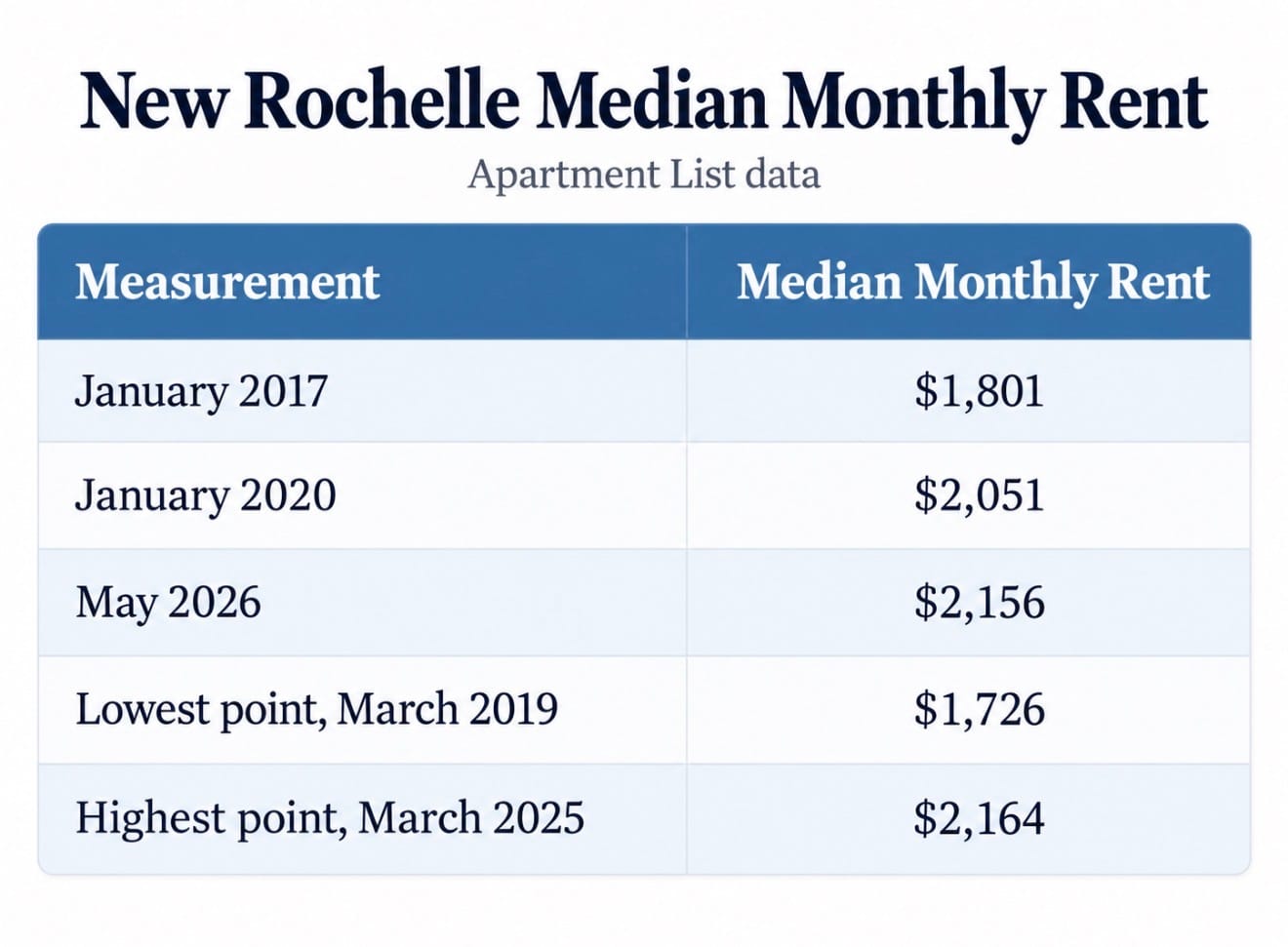
From January 2017 through May 2026, New Rochelle’s median monthly rent increased from $1,801 to $2,156.
That is an increase of $355 a month, or 19.71 percent.
Even beginning in January 2020, the baseline emphasized in the Wall Street Journal’s reporting, rents increased approximately 5.1 percent through May 2026.
Neither comparison shows rents falling.
The difference becomes even more apparent when looking at the lowest and highest monthly figures in the dataset. New Rochelle’s median rent reached $1,726 in March 2019 and climbed to $2,164 in March 2025, a difference of $438, or approximately a 25.4 percent increase.
That comparison is not offered as the definitive measurement of New Rochelle’s rental performance. Selecting the lowest and highest months would be another form of cherry-picking if used to describe the entire redevelopment period.
Instead, it illustrates precisely why the selection of beginning and ending dates matters.
The same rental database can produce dramatically different impressions depending on which observations are selected.
Why 2020?
The central question is not whether the Wall Street Journal and Pew accurately calculated the changes within their selected periods. It is why those periods were emphasized, and whether they provide a fair representation of New Rochelle’s rental market.
Pew’s April 2023 analysis ended in February 2023 because that was the latest period available for its research. Its report also acknowledged that New Rochelle rents had risen before 2020. The Journal’s August 2025 article, however, was published more than two years later, when the post-2023 rental recovery was already part of the historical record.
The Journal did report that rents had increased 1.6 percent since 2020. Nevertheless, its headline promised a story about bringing rents down, and the article emphasized the 2 percent decline between 2020 and 2023.
The longer history is particularly important because 2020 was not an ordinary year in New Rochelle.
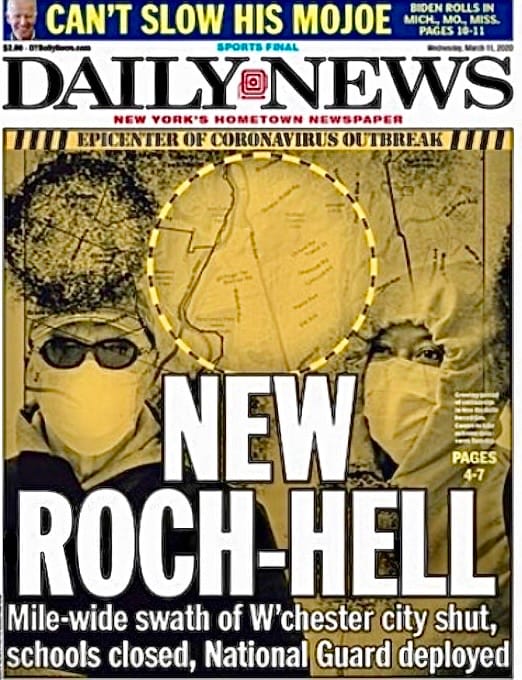
In March 2020, New Rochelle became one of the country’s earliest centers of the COVID-19 pandemic. The city attracted national attention as authorities established a containment zone and deployed the National Guard. Businesses, schools and everyday life were disrupted in ways that were extraordinary even by the standards of the early pandemic.
The city’s rental market was therefore exposed to a major external shock just as its downtown apartment construction program was gathering momentum.
Whether the pandemic, changes in demand, the opening of new buildings or some combination of factors explains the movement in rents requires additional examination. A decline beginning around 2020 cannot simply be assigned to new construction without considering those competing explanations.
The longer dataset also places New Rochelle’s performance in a regional context.
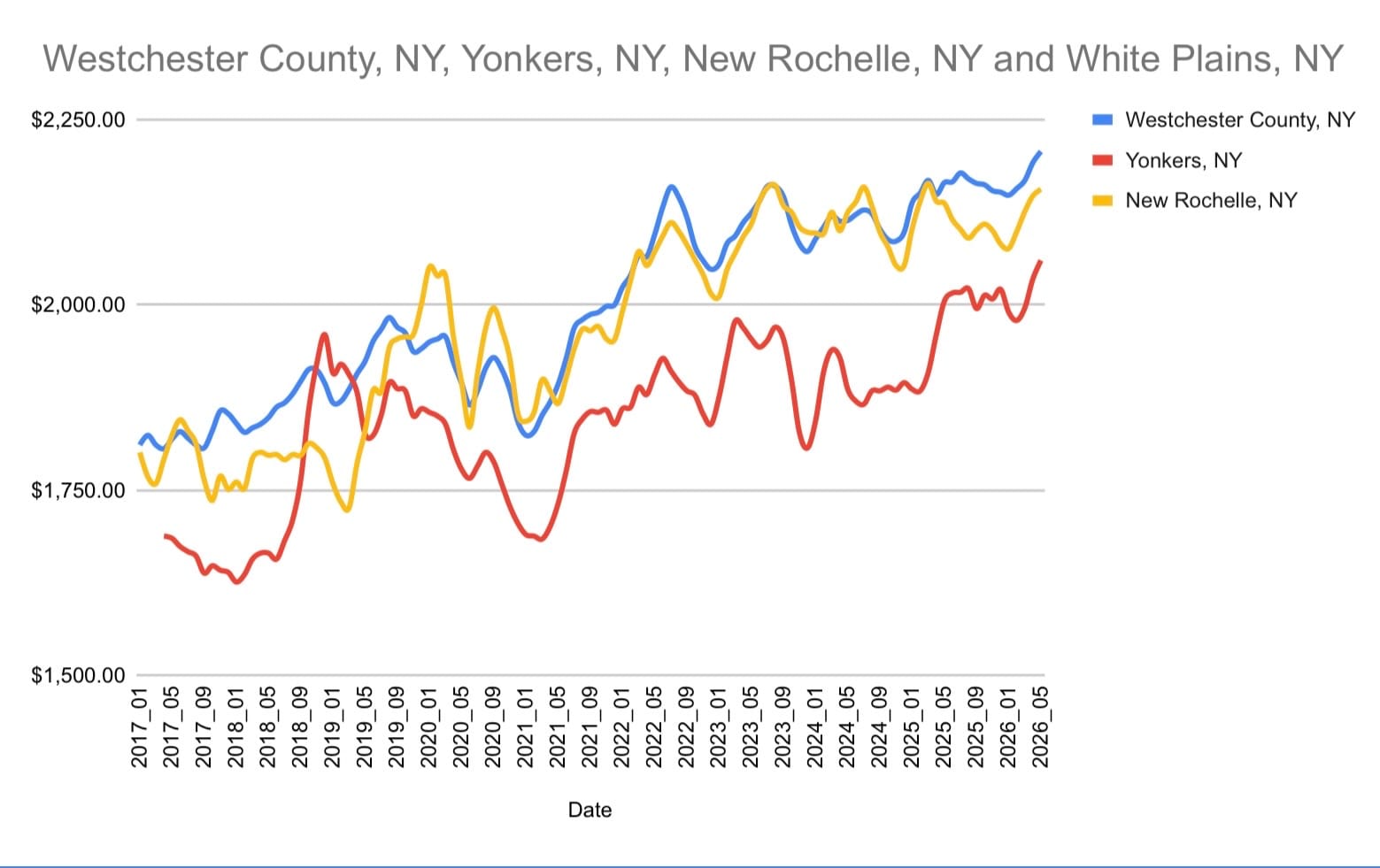
Between January 2017 and May 2026, Apartment List recorded rent increases of approximately 21.9 percent across Westchester County and 22 percent in Yonkers, compared with 19.7 percent in New Rochelle.
New Rochelle therefore experienced somewhat slower rent growth than those two benchmarks. That difference may be relevant evidence in evaluating whether increased housing supply moderated rental inflation.
But slower rent growth is not the same thing as falling rents. Nor does a difference between communities, by itself, establish which government policy caused it.
That distinction has largely disappeared from the public narrative celebrating New Rochelle’s housing miracle.
Where Have All the Cranes Gone?
The rental statistics are not the only aspect of New Rochelle’s national publicity that deserves scrutiny.
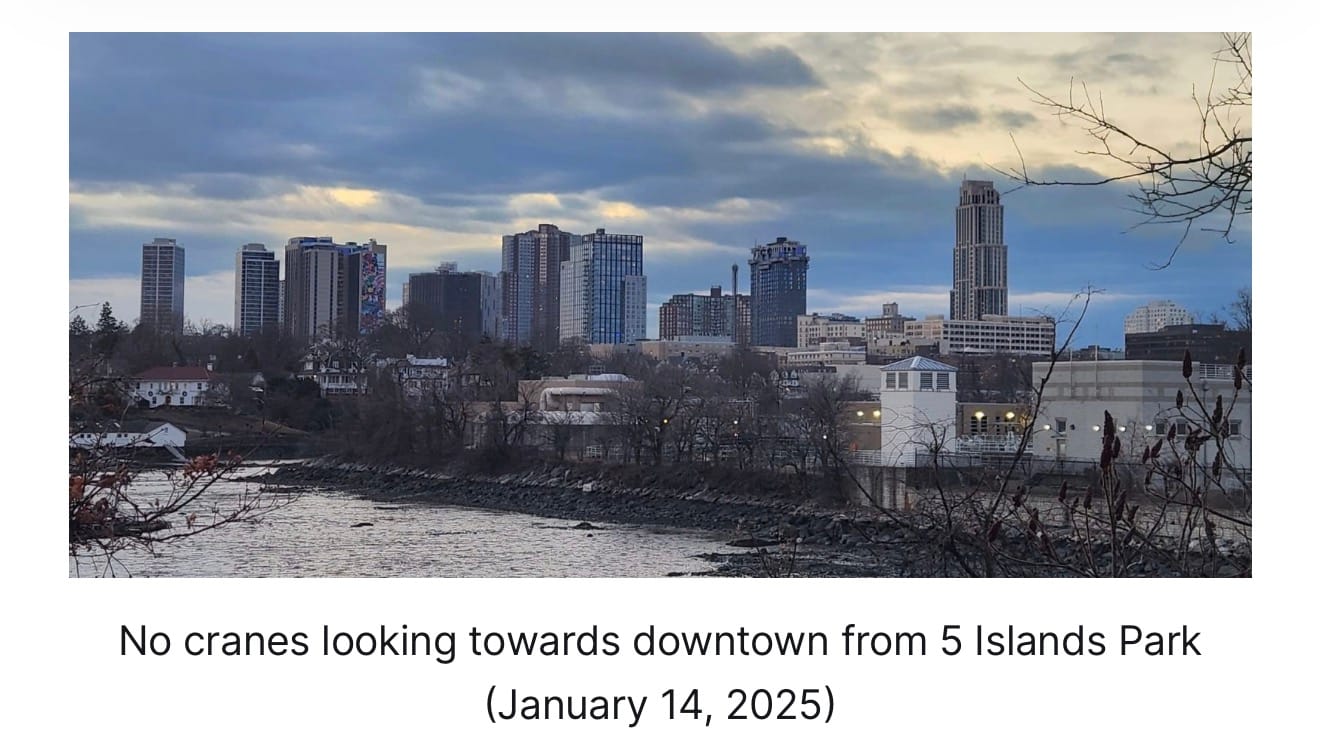
Construction cranes became an important visual symbol of the city’s transformation. But descriptions of cranes operating across downtown New Rochelle in 2025 are difficult to reconcile with the available building records and photographic evidence.
In her May 8, 2025, State of the City address, Mayor Yadira Ramos-Herbert twice referenced cranes as evidence of continuing development.
First, she told her audience there were “cranes in the sky, scaffolding on the ground,” as she described the downtown building boom. Later, addressing residents outside the downtown area, she suggested that they might feel the cranes and construction were taking place in someone else’s neighborhood.
Three months later, following publication of her Wall Street Journal article, Rebecca Picciotto appeared on the Journal’s August 20 podcast, where she described arriving in New Rochelle by train and seeing construction sites throughout the area, including “these empty lots with cranes.”
But where were these cranes?
In response to a Freedom of Information Law request seeking every crane permit issued by the New Rochelle Building Department from 2015 through 2026, the city produced 40 distinct permit records. Curiously, none of the records supplied predates 2020, even though cranes were used during the earlier phases of downtown redevelopment, including construction of RXR’s 360 Huguenot.
Most of the records concern routine operations such as rooftop air-conditioning replacements, temporary equipment lifts, generator installations, facade maintenance and utility work. Others involve locations outside the downtown redevelopment area.
After separating those activities from major downtown building construction, three permits stand out.
Two were issued in 2022 for tower cranes: one at 26 South Division Street and another at 500 Main Street. Both identify specific Liebherr tower-crane models.
The third was issued June 5, 2025, for 455 Main Street, the Stella Phase II development subsequently renamed Rose on Main, at Main Street and North Avenue. That permit was classified by the Building Department as “Crane/Boom Truck” and described lifting operations associated with erecting the building. Unlike the 2022 permits, it did not identify a tower crane.
Other 2025 permits covered temporary lifting operations, including a stiffleg derrick at 506 Main Street used to position swimming pool sections.
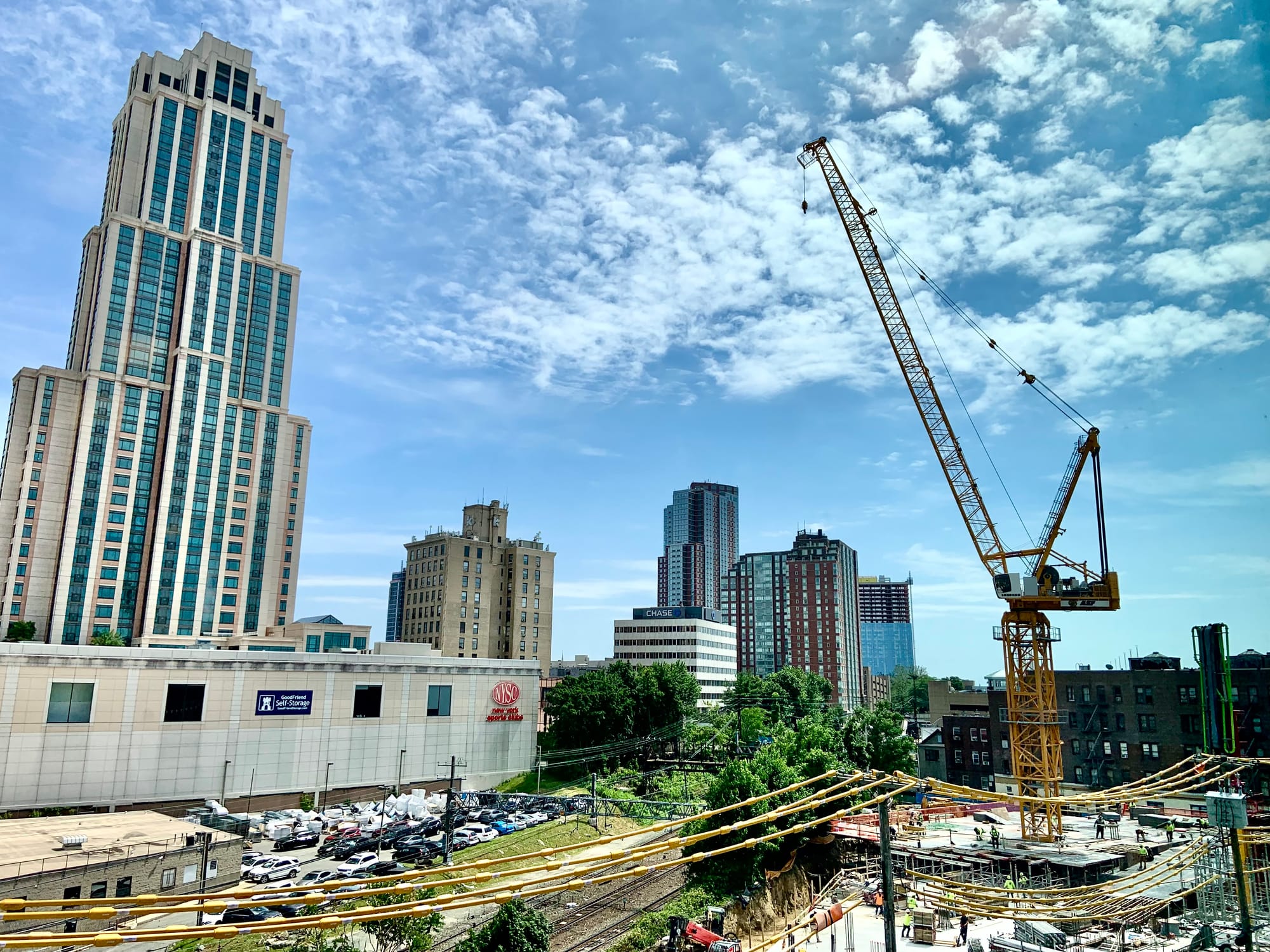
The distinction matters because tower cranes are the large, fixed cranes that rise above construction sites and become prominent features of a city’s skyline. Temporary mobile lifting equipment does not demonstrate the same level of sustained high-rise construction activity.
My own observations while in New Rochelle during 2025, together with photographs I commissioned of the downtown skyline, found no tower cranes operating. Those observations are consistent with what I have seen over the past several years, as the intense construction activity that once transformed the skyline diminished.
The evidence raises an obvious question: If there were no tower cranes operating in downtown New Rochelle in 2025, what exactly were the mayor and the Wall Street Journal reporter talking about?
Who Was Selling the Story?
There is another reason to scrutinize how New Rochelle’s redevelopment has been presented to the national media.
The city’s public relations operation has previously worked directly with Wall Street Journal reporters to shape coverage of its downtown development program.
Records obtained under the Freedom of Information Law concerning the Journal’s August 2023 article, The Suburb That Defied Nimby, show that the city’s public relations firm, Marino, pitched the story, helped coordinate the reporter’s visit and arranged access to selected sources.
Former Mayor Noam Bramson participated in those arrangements, including efforts to recruit a favorable resident interview (Stanley Bernstein).
In one particularly revealing communication, Bramson discussed the possibility of providing that resident with talking points or guidance before speaking with the reporter.
Those records establish that the city was not merely responding to an independent inquiry. Its representatives were actively working to secure favorable national coverage and influence which people the reporter would encounter.
That history does not establish that Marino, RXR or another outside party supplied the Apartment List comparisons used by Pew or Picciotto in 2025. It does, however, make the origin of those comparisons an important reporting question.
Who first selected the rental periods that became central to the housing miracle narrative? Who presented those figures to reporters, researchers and housing advocates? And did anyone examine the complete historical data before treating a temporary decline as evidence of a lasting policy success?
Those questions become particularly important when the resulting coverage is later used to support policy changes far beyond New Rochelle.
A Downtown Redevelopment Plan Becomes a Housing Policy Triumph
New Rochelle’s redevelopment program was not originally conceived primarily as an experiment in lowering rents.
When the Downtown Overlay Zone was adopted in 2015, the central objective was downtown revitalization: attracting investment, creating a more active business district, expanding the tax base and reversing decades of economic stagnation.
Housing construction was an important means of achieving those objectives, not necessarily the ultimate goal.
Bramson acknowledged that distinction in an April 2, 2025, appearance on The Housing Problem podcast, explaining that the initiative began with downtown redevelopment and revitalization, with housing serving as one of the engines for accomplishing it.
That historical context matters because the redevelopment program can be judged against several different objectives. A city might successfully attract private investment, add housing and expand its tax base without demonstrating that its policies caused rents to decline.
Likewise, thousands of new apartments do not automatically establish that a downtown has become economically vibrant, that longtime residents are better off or that housing has become broadly affordable.
Those are separate questions, requiring separate evidence.
Yet the national story increasingly reduced New Rochelle’s experience to a simple proposition: The city cut regulations, developers built apartments, and rents went down.
The actual record is more complicated.
The Difference Between a Good Story and the Full Story
None of this establishes that building more housing is bad policy or that increasing supply cannot moderate rent growth.
There is substantial economic reasoning behind the proposition that adding housing can relieve pressure on prices, particularly when new homes are being built in markets where demand exceeds available supply.
But a policy argument is not a substitute for examining what happened in a particular community.
New Rochelle began its downtown redevelopment initiative in 2015. The first major RXR development began construction in 2016 and leasing in 2019. Over the following years, thousands of new apartments came online.
A reasonable assessment of the program’s effect on rents would examine the market before those buildings opened, follow the subsequent construction and rental trends, compare New Rochelle with relevant regional markets, and investigate other factors that might explain changes in demand.
That is the purpose of the January 2017–May 2026 analysis.
It reveals that median rents increased nearly 20 percent during the period. Beginning instead in January 2020 produces a smaller increase through May 2026, while selecting the 2020–2023 window produces the temporary decline emphasized by Pew and the Wall Street Journal.
All three results can be mathematically accurate.
They cannot all convey the same understanding of what happened.
For readers of the Wall Street Journal, New Rochelle was presented as a community that had discovered a magic elixir for how to bring rents down. For elected officials and housing advocates, that story offered a powerful example to promote.
But for renters in New Rochelle, the longer history tells a different story.
The city built thousands of apartments. Its median rents rose. And the celebrated decline depended heavily on which years someone chose to measure.
That is not proof of a housing miracle. It is a demonstration of how a carefully selected statistic can become a national narrative.
In the coming installments of this series, we will explain what we mean by hoax: how questionable Wall Street Journal reporting, built around cherry-picked rental statistics and a reporter’s dubious account of construction cranes scattered across downtown New Rochelle, became the foundation for a political narrative promoted by Mayor Yadira Ramos-Herbert, other city officials and, eventually, New York Gov. Kathy Hochul. We will examine how those officials used the Journal’s reporting to claim New Rochelle had discovered a magic formula for lowering rents, what the evidence actually establishes, and how a misleading account of the city’s redevelopment became a celebrated model for housing policy across New York state and the country.
RELATED
The Great Wall Street Journal Hoax of New Rochelle
This article was prepared with the assistance of AI tools under the direction and editing of Robert Cox.
Have information about this story? Email robertcox@talkofthesound.com (preferred) or contact via WhatsApp: +353 89 972 0669.