The Great Wall Street Journal Hoax of New Rochelle — Part II: The Rent Data is Not for Downtown

DUBLIN, IRELAND (October 26, 2026) — Remember those rental statistics that supposedly proved New Rochelle had discovered the secret sauce to bringing down housing costs? The numbers promoted by the Pew Charitable Trusts and the Wall Street Journal that helped turn New Rochelle into a celebrated national model for solving America’s housing affordability crisis?
It turns out there is something even more troubling about those numbers than the cherry-picked dates examined in Part One of this investigation. The rental statistics used to celebrate New Rochelle’s downtown development aren’t even specific to downtown New Rochelle.
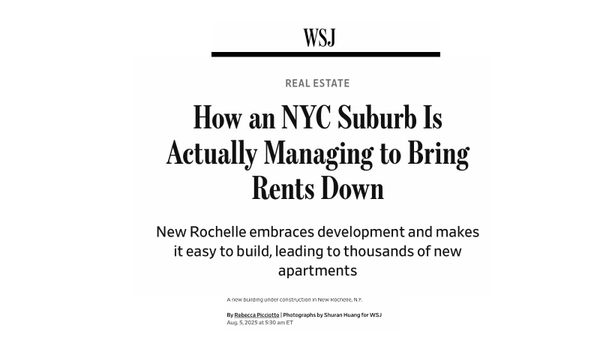
That’s right. The Wall Street Journal devoted its August 5, 2025, article to celebrating New Rochelle’s Downtown Overlay Zone, the high-rise apartment buildings constructed under that redevelopment program and the supposedly remarkable effect all that new housing had on rents. But the Apartment List data used to support that narrative measures median rents across the entire City of New Rochelle, not specifically the downtown area where those buildings were constructed.
The distinction is not trivial. It goes to the heart of what readers were being told about the city’s supposed housing miracle.
New Rochelle’s Downtown Overlay Zone, adopted in December 2015, covers a defined area where officials sought to encourage large-scale redevelopment. The program transformed portions of downtown with thousands of new apartments, many in high-rise buildings promoted as evidence of the city’s success.
Apartment List, however, does not provide a downtown New Rochelle rent series in the city-level figures used by Pew and the Journal. Its methodology is designed to estimate median rents across the broader rental market, including neighborhoods far beyond the boundaries of the Downtown Overlay Zone.
In other words, the buildings being celebrated and the rental market being measured are not the same geographic area. The statistics do not tell us what happened to rents specifically within the Downtown Overlay Zone, much less what happened to rents in the new apartment buildings at the center of the Journal’s story.
This does not establish that new downtown apartments had no effect on rents elsewhere in New Rochelle. Adding housing in one part of a city can influence prices throughout a broader market, but demonstrating that relationship requires evidence connecting the downtown construction program to changes in citywide rents. Simply showing that rents changed across New Rochelle and then crediting the Downtown Overlay Zone for those changes does not establish cause and effect.
And this comes on top of what Part One established. When Apartment List’s historical figures are examined from January 2017 through May 2026, New Rochelle’s median monthly rent increased from $1,801 to $2,156, an increase of nearly 20 percent. The supposedly miraculous decline depended on selecting a much narrower period, beginning in 2020 and ending before subsequent rent increases.
The Wall Street Journal’s account therefore raises two fundamental questions about its statistical foundation: Why were those particular dates emphasized, and why were citywide rental figures presented as evidence of the success of a downtown redevelopment program?
The more closely one examines the numbers behind New Rochelle’s housing miracle, the less miraculous the story becomes. That raises a larger question about how this narrative became so widely accepted in the first place.
For part of the answer, we need to go back to 2023.
On August 16, 2023, the Wall Street Journal published an article by Maggie Eastland titled “The Suburb That Defied Nimby.” The story presented New Rochelle as a community that had overcome political opposition, regulatory delays and other obstacles that frequently prevent suburban housing development.
New Rochelle had streamlined its approval process, attracted developers and added thousands of apartments downtown. The article described the city as a potential model for other communities confronting housing shortages, with then-Mayor Noam Bramson declaring that New Rochelle had developed a model that could be replicated elsewhere.
To the ordinary reader, the article appeared to be an independent examination of a noteworthy development in the American housing market. But documents I obtained from New Rochelle under the New York Freedom of Information Law reveal what was happening behind the scenes.
The story did not begin with a reporter independently discovering New Rochelle’s redevelopment program. It began with a pitch from Marino, the city’s public relations firm, followed by an extensive effort to arrange interviews, coordinate a downtown walking tour and identify residents who would speak favorably about the city’s transformation.
On July 27, 2023, Tom Corsillo, then a senior vice president at Marino, emailed New Rochelle officials with news that the firm’s earlier efforts had paid off.
“The Wall Street Journal circled back to us about our pitch from a few months back,” Corsillo wrote. “They’re ready to do the story on New Rochelle’s economic development progress.”
That email establishes that Marino had pitched the Journal months earlier and that the newspaper had returned to pursue the proposed story. The public relations firm’s involvement, however, did not end when a reporter expressed interest.
In the same email, Corsillo explained that the reporter wanted to interview city representatives, RXR executives, perhaps another developer and residents, including both longtime and newer residents. Corsillo proposed organizing a walking tour, an arrangement the reporter welcomed, allowing the city and its representatives to coordinate interviews around a guided visit downtown.
The subsequent correspondence shows city officials working closely with Marino to arrange the visit and prepare the material the reporter would receive. On July 31, Deputy City Manager Adam Salgado forwarded the arrangements to Bramson, explaining that the mayor could join representatives of Marino and the city in accompanying the reporter on a downtown tour.
Salgado also explained that Marino would prepare talking points for the visit. The city was not simply opening its doors to a reporter; its officials and public relations representatives were organizing how New Rochelle’s redevelopment would be presented.
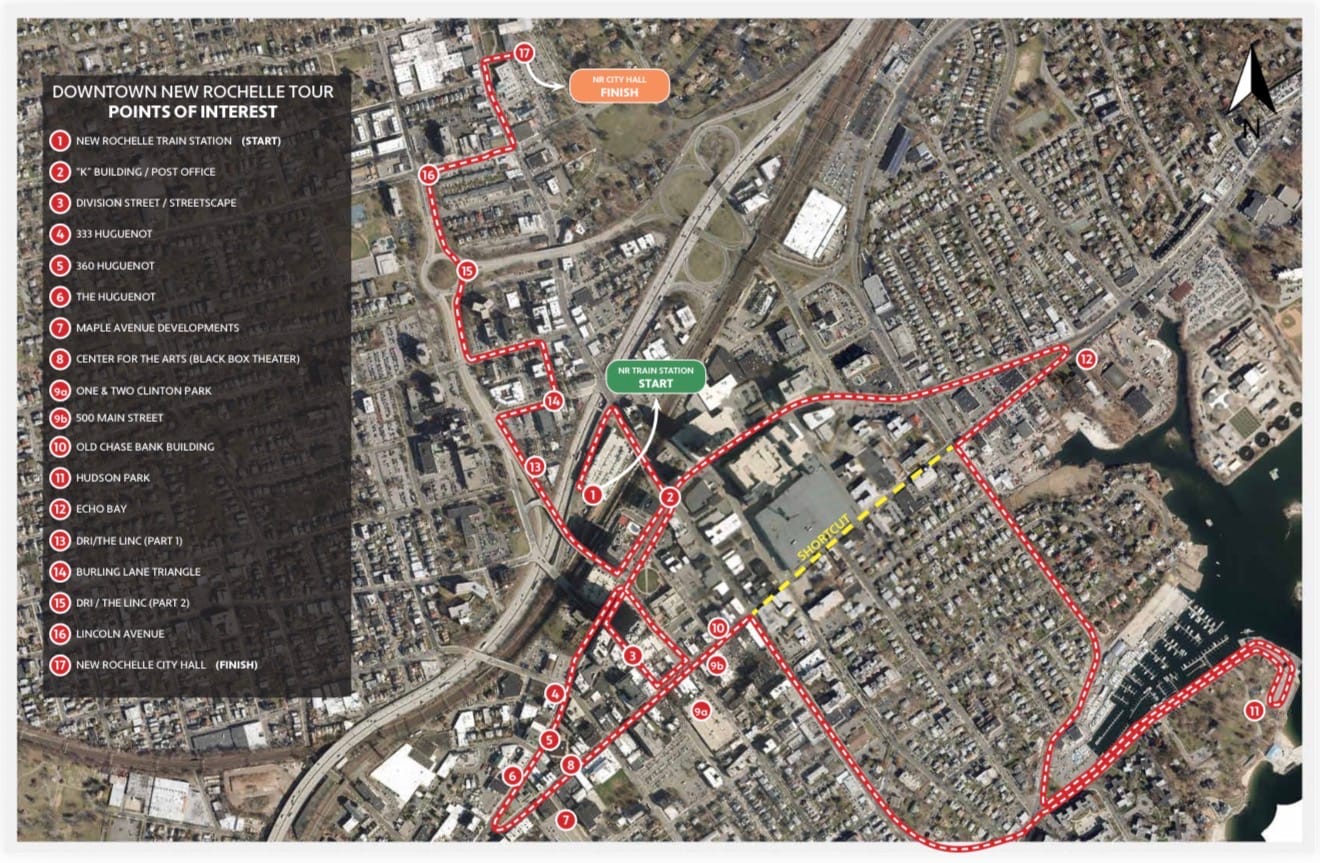
The city also had a map. In an August 1 email, Jorge Ventura Ovalles told the group that officials had previously used an attached downtown tour map to guide visits, suggesting Anderson Plaza as an additional possible stop.
The records show an organized media visit involving a public relations firm, senior city officials, a planned walking route, prepared talking points and interviews with people selected or recommended through City Hall. None of that is inherently unusual for a government seeking favorable coverage, but it is important context for understanding how the Journal came to report on New Rochelle.
What happened next is considerably more revealing.
The reporter wanted to interview residents, including someone who had lived in New Rochelle long enough to compare the downtown before and after redevelopment. Such a source could give readers a perspective different from those of elected officials and developers with obvious interests in promoting the project.
On August 1, Corsillo explained that the Journal was looking for two residents: a longtime resident who could discuss the city’s evolution and a newer resident living in one of the apartment buildings. City officials discussed identifying someone at RXR’s One Clinton Park, while Bramson agreed to find a longtime resident.

The next morning, August 2, Bramson emailed the group with his candidate: Stanley Bernstein, an attorney who had lived in New Rochelle for 31 years, commuted through the train station and strongly approved of the changes downtown.
Bramson had already spoken with Bernstein and confirmed that he was willing to be interviewed. Then the mayor added a parenthetical observation that deserves particular attention.
“He is very happy to comment for the WSJ,” Bramson wrote. “(And is also willing to accept talking points, if we want to give him any.)”
Bramson went further, asking whether Bernstein was the sort of person the Journal wanted and how the newspaper would contact him. The mayor wanted to know so that he could provide Bernstein with “instructions/guidance” before the interview.
Consider what was happening. A Wall Street Journal reporter wanted a longtime resident’s perspective on whether New Rochelle’s redevelopment had improved the community. The mayor supplied someone he knew approved of the changes, discussed the possibility of giving him talking points and offered to provide guidance before the resident spoke with the reporter.
These were not suggestions from the reporter. They came from the mayor whose redevelopment policies were the subject of the article.
The documents do not establish that Bernstein actually received talking points or repeated anything he was instructed to say. They do establish that the mayor raised the possibility and offered to prepare him for his contact with the Journal.
And Bernstein made it into the published story.
In the Journal’s August 16 article, Bernstein appeared as a longtime homeowner who had initially doubted New Rochelle’s ability to attract major downtown investment. After witnessing the redevelopment, however, he was presented as someone impressed by what had occurred.
“I wasn’t optimistic that people were going to invest billions into downtown,” Bernstein told the Journal. “It worked. The entire downtown has been transformed.”
It was an effective quotation, reinforcing the article’s central argument. The reader encountered a longtime resident who had apparently overcome his initial skepticism after witnessing New Rochelle’s success, providing what appeared to be independent confirmation of the claims made by the mayor and developers.
What the reader did not know was that Bernstein had been recruited by Bramson, who had already described him as someone who strongly approved of the development program and was willing to accept talking points.
That does not mean Bernstein’s opinion was insincere. He may well have believed every word he said, and the records do not establish otherwise. But knowing how he came to be interviewed changes the context in which his remarks should be understood.
A mayor praising his own redevelopment program is an interested party, something readers can readily recognize. A longtime resident describing a change of heart carries a different kind of credibility, particularly when readers are unaware that the resident was recruited by the same political leadership being praised.
The Journal’s story gave New Rochelle something enormously valuable: favorable national recognition in one of the country’s most influential newspapers. It presented the city as an example of how suburban communities could overcome opposition to housing construction and attract billions of dollars in private investment.
The published article included comments from Bramson, RXR executives, housing experts and residents. It described how New Rochelle had streamlined zoning and environmental approvals, worked with developers and overcome obstacles that frustrated housing construction elsewhere.
Behind that finished article was a months-long public relations effort. Marino had pitched the Journal, arranged access to city officials, helped organize a walking tour and coordinated potential interview subjects. Bramson personally recruited a supportive resident and offered to provide talking points or guidance before the interview.
The FOIL records document how the city sought to influence the presentation of its redevelopment program in the national media. They also establish that the newspaper’s favorable coverage followed a deliberate effort by New Rochelle’s representatives to secure it.
Emergence of the New Rochelle Model
Two years later, the Wall Street Journal returned to New Rochelle with a new and more consequential claim about the city’s housing success. But between the two articles, something interesting happened that raises questions about what had become known as the “New Rochelle model.”
The August 2023 Journal article marked the emergence of a framing that would become increasingly prominent in the years that followed. Then-Mayor Noam Bramson declared, “We have a model that can be replicated,” referring to New Rochelle’s approach to downtown redevelopment. That model combined a master developer, form-based zoning and streamlined environmental review, an approach developed under the leadership of Development Commissioners Michael Freimuth and his successor, Luiz Aragon. Bramson championed their work politically and became its most prominent public spokesman, receiving considerable credit for a redevelopment strategy that had been developed and implemented by others.
On April 2, 2025, just four months before the Journal published its second article, Bramson appeared on The Housing Problem, a podcast hosted by Rafael Cestero and Kirk Goodrich. The hosts treated him as a central figure in New Rochelle’s redevelopment success and asked about the possibility of other communities replicating the city’s approach. His answer was revealing.
Bramson acknowledged that, to the best of his knowledge, no other community had adopted the New Rochelle model. completely. Other municipalities had implemented elements of the approach, he explained, but he could not identify one that had combined all three components. Asked why the complete New Rochelle model had not been replicated, Bramson admitted he did not know.
The admission was striking when measured against his declaration to the Wall Street Journal two years earlier. Nearly a decade after New Rochelle adopted the Downtown Overlay Zone, the former mayor who had promoted the redevelopment strategy as replicable could not identify another municipality that had actually replicated it.
Bramson made another important acknowledgment during the podcast. New Rochelle’s redevelopment initiative had not originally been conceived as a housing affordability program. Its purpose was downtown redevelopment and revitalization, with housing construction serving as one of the engines for accomplishing those broader objectives. The city sought to attract investment, stimulate commercial activity and expand its tax base.
Those observations provide essential context for the claims that followed. The original New Rochelle model was a particular approach to redeveloping a struggling downtown, not a demonstrated formula for reducing rents across an entire municipality. And according to Bramson himself, other communities had not reproduced the complete strategy.
Nevertheless, on August 5, 2025, the Wall Street Journal published Rebecca Picciotto’s article, “How an NYC Suburb Is Actually Managing to Bring Rents Down,” presenting New Rochelle as evidence that increasing housing supply by removing development barriers could produce lower rents.
Picciotto also suggested that the approach was spreading beyond New Rochelle. Her examples included California’s changes to environmental review requirements, Oregon’s housing legislation and federal proposals involving tax incentives and expedited approvals. But none of those examples established that another municipality had replicated the New Rochelle model — a combination of a master developer, form-based zoning and streamlined environmental review.
That distinction is significant. Adopting an individual regulatory reform is not the same as reproducing an entire redevelopment strategy. Yet the meaning of the so-called New Rochelle model was becoming increasingly elastic, expanding from a specific set of local development arrangements into a broad endorsement of policies intended to encourage housing construction.
The evolution went beyond how the model was described. The 2023 Journal article had focused on how New Rochelle overcame political and regulatory obstacles to get apartments built. Picciotto’s 2025 article advanced a more ambitious claim, presenting New Rochelle as evidence that the resulting increase in housing supply had actually brought rents down.
A city can successfully attract developers and construct thousands of apartments without proving that its policies reduced rents. The first achievement can be demonstrated through construction records, approvals and completed buildings, while the second requires careful analysis of rental trends, geographic coverage and other factors affecting housing demand.
There is another possibility that received little consideration in the housing-miracle narrative. Even if rents had declined, why should that necessarily have been celebrated as proof of successful housing policy rather than examined as a potential sign of weaker-than-expected demand? New Rochelle’s new downtown buildings were marketed as luxury housing, with first-rate amenities and views of Long Island Sound and the Manhattan skyline, in one of the most affluent counties in the United States. Lower rents in such properties might benefit tenants, but they could also reflect developers struggling to achieve their anticipated market rates.
Distinguishing between those explanations would require examining occupancy, leasing performance, concessions and rental trends in the new buildings themselves. A decline in rents is not, by itself, sufficient to determine whether construction successfully improved affordability or developers encountered a weaker market than expected.
Yet by 2025, the story of a city that had figured out how to get apartments built had become the story of a city that had figured out how to bring rents down. The statistics used to support that transformation deserve considerably more scrutiny than they received.
The distinction between the two Wall Street Journal articles is important. The FOIL records establish how the 2023 article was pitched and coordinated, but they do not establish that Marino arranged the 2025 article or supplied Picciotto with the Apartment List statistics she used. Nor do they establish who originally selected the rental comparison periods emphasized by Pew and the Journal.
Those questions remain unanswered (and I asked!) What the records demonstrate is that New Rochelle officials and their public relations firm had already undertaken a deliberate effort to secure favorable national coverage of the city’s redevelopment program, two years before the housing-miracle narrative became a prominent argument for changing housing policy.
By August 2025, the Journal was no longer simply reporting that New Rochelle had discovered how to clear red-tape to build more apartments. It was reporting that the city’s approach had produced an extraordinary result in a country struggling with housing affordability: rents that had actually gone down. And it was suggesting that elements of that approach were spreading elsewhere, despite Bramson’s acknowledgment just four months earlier that he knew of no community that had replicated the New Rochelle model.
Part One of this investigation demonstrated how selecting particular dates could turn a longer-term increase in rents into a story about declining rents. The additional geographic problem examined here is equally important: The Apartment List figures used to celebrate downtown redevelopment were not measurements of downtown rents at all. They measured the broader New Rochelle rental market, without isolating the developments supposedly responsible for the reported changes.
The 2023 FOIL records provide another piece of the picture, revealing how New Rochelle’s favorable national publicity had previously been cultivated through a coordinated and even “rigged”!public relations campaign. The April 2025 podcast supplies another revealing moment in that history, exposing the distance between what the original redevelopment strategy actually involved and the increasingly expansive claims made on its behalf.
Together, these findings raise questions not only about the statistics, but about the process through which New Rochelle became a celebrated example for journalists, housing advocates and elected officials. Who first selected the numbers? Who decided which comparisons mattered? Who presented New Rochelle as evidence that eliminating regulatory obstacles could bring rents down? And how carefully did those repeating the claims examine the underlying data?
Those questions matter well beyond New Rochelle because the housing miracle did not remain a local story. The claims circulated through national publications, research organizations, housing policy discussions and political speeches, gaining authority as they were repeated. Along the way, the so-called New Rochelle model increasingly became shorthand for a housing affordability success that the underlying statistics did not establish.
The next installment will examine how New Rochelle’s purported success spread across New York and the country, and how a redevelopment program originally intended to revive one suburban downtown became a national argument for changing the rules governing housing construction.
RELATED
The Great Wall Street Journal Hoax of New Rochelle
This article was prepared with the assistance of AI tools under the direction and editing of Robert Cox.
Have information about this story? Email robertcox@talkofthesound.com (preferred) or contact via WhatsApp: +353 89 972 0669.