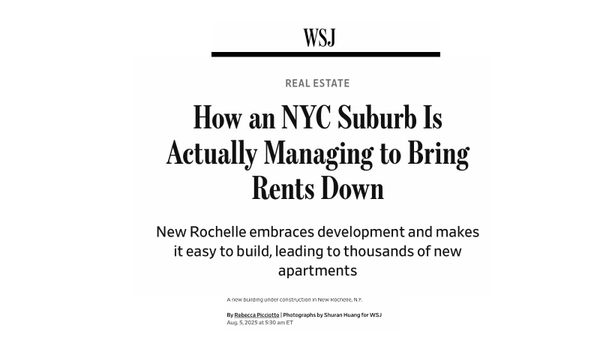
The Great Wall Street Journal Hoax of New Rochelle — Part III: How a Housing Miracle Became National Conventional Wisdom

DUBLIN, IRELAND (October 27, 2026) — Within 48 hours of The Wall Street Journal publishing an article celebrating New Rochelle as a rare American city that had managed to bring rents down by building thousands of apartments, the story was being repeated by other news organizations, promoted on national television and presented as evidence that a particular approach to housing policy could succeed where others had failed.
Over the following year, the same rental statistics would appear in real estate industry publications, think tank commentaries, housing-policy discussions and the public statements of elected officials. New Rochelle would win a national award for housing affordability, while commentators urged cities across the country to follow its example.
The numbers were remarkably consistent. New Rochelle rents had increased just 1.6% since 2020, according to the Journal, and had actually declined 2% between 2020 and 2023. By comparison, rents in New York City and neighboring markets had risen substantially, while national rents had recorded double-digit increases.
There was just one problem with the expanding chorus of praise. Repeating the same statistics did not make them more reliable, establish that downtown construction caused the reported changes or resolve the fundamental geographic mismatch at the center of the original reporting.
As Parts I and II of this series documented, the Apartment List figures were citywide median rents, not rents specifically in New Rochelle’s Downtown Overlay Zone. The Journal had presented those figures as evidence of the success of a development program concentrated in a relatively small part of the city.
The newspaper’s August 5, 2025, article did not create the favorable narrative surrounding New Rochelle’s redevelopment program. The Pew Charitable Trusts had promoted similar conclusions beginning in 2023, while city officials and their public relations representatives had worked to attract favorable national coverage.
What the Journal provided was something particularly valuable to advocates of the city’s approach: a prominent national newspaper report declaring that New Rochelle had achieved what much of the country desperately wanted — lower rents.
The Story Spreads Almost Immediately
The first wave of coverage arrived before readers had much opportunity to examine the Journal’s underlying statistics.
On August 5, 2025, the same day Rebecca Picciotto published “How an NYC Suburb Is Actually Managing to Bring Rents Down,” New York University’s Urban Lab posted a summary presenting New Rochelle as an example of how increasing housing supply could reduce rents.
The university-affiliated website repeated the Journal’s figures: 4,500 new apartments completed, another 6,500 planned or in the pipeline, and median rents increasing only 1.6% over five years. It described New Rochelle’s experience as a model that could be followed nationally.
The following day, CRE Daily, a commercial real estate publication, published “New Rochelle Rents Fall as Suburb Leads Housing Growth,” by Nina Dale.
The August 6 report explicitly attributed its development figures to the Journal and repeated both the 1.6% rent increase and the 2% decline between 2020 and 2023. It described New Rochelle as a community that had embraced development rather than resisting it, producing thousands of apartments while keeping rental costs in check.
The conclusion went beyond describing New Rochelle’s experience. It suggested that other cities could achieve similar results by removing obstacles to private development.
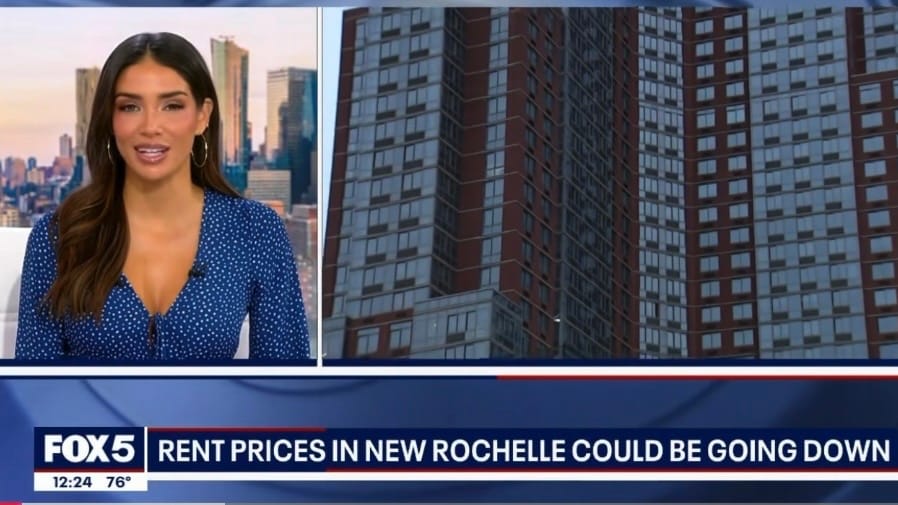
On August 7, FOX 5 New York broadcast a report by Richard Giacovas examining New Rochelle’s supposed success in holding down rents. The television report repeated the 2% decline between 2020 and 2023 and featured Mayor Yadira Ramos-Herbert and Houlihan Lawrence real estate broker Vincent Caiola.
The mayor discussed the number of buildings the city had approved and the apartments that had been completed. The report treated the increase in housing supply as the explanation for New Rochelle’s comparative rental performance and suggested that the city’s approach could serve as a model elsewhere.
Other real estate publications, including GlobeSt and BiggerPockets, also carried favorable accounts of the city’s development program. The coverage brought the same general argument to readers interested in real estate investment, commercial development and housing policy.
By the end of that first week, the Journal’s account was no longer confined to the newspaper’s readership. The same figures were circulating among developers, investors, policy advocates and television audiences.
The repeated coverage created an appearance of broad agreement, although several of the publications were reporting the same original findings rather than conducting independent examinations of New Rochelle’s rental market.
From Newspaper Article to National Television
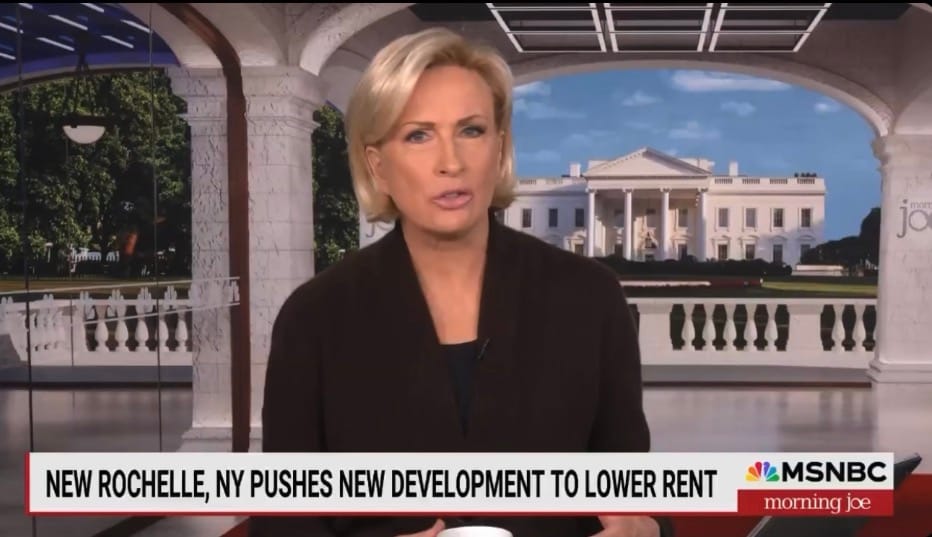
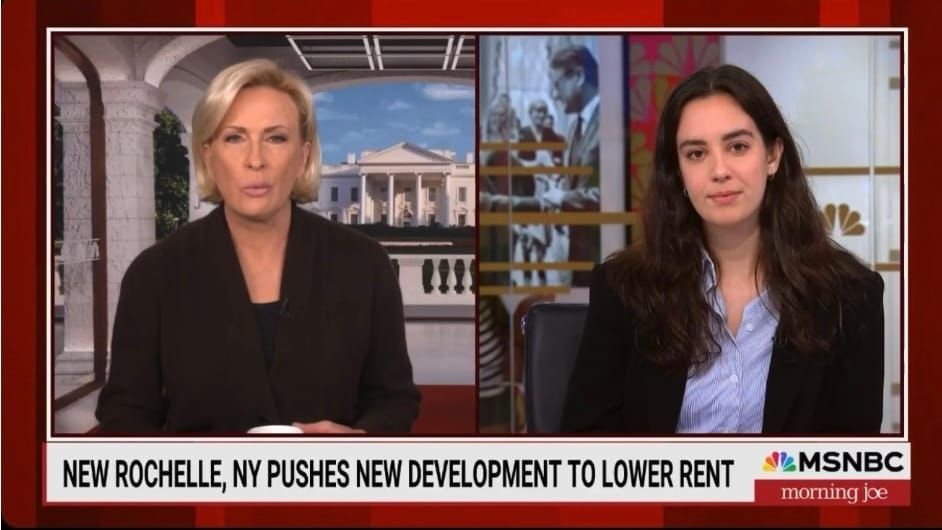
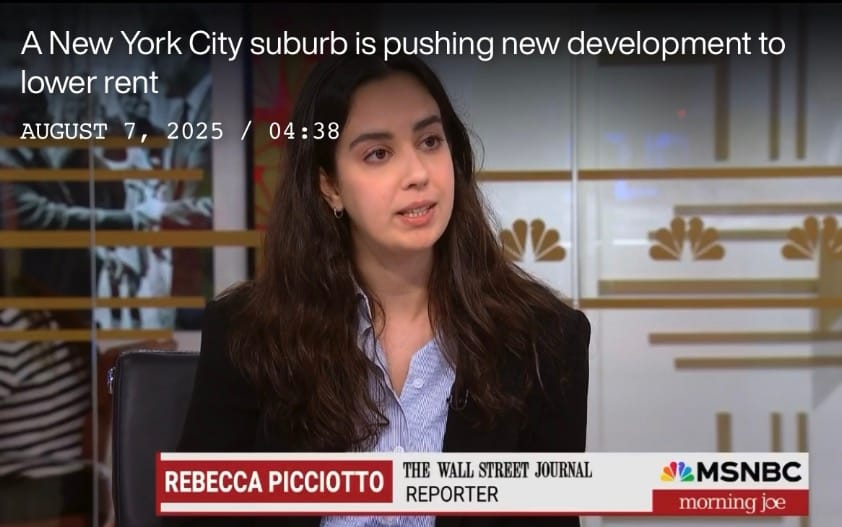
Picciotto also appeared on MS NOW’s “Morning Joe” with Mika Brzezinski to discuss her reporting, giving the New Rochelle story another national audience.
The interview was revealing, particularly when the conversation moved from rental statistics to the mechanics of New Rochelle’s redevelopment program.
Asked how the city had achieved its supposed success, Picciotto gave a straightforward explanation: New Rochelle had built more housing by making development faster, easier and less expensive. She described the regulatory barriers that discourage construction elsewhere and contrasted those obstacles with New Rochelle’s more predictable approval process.
The conversation turned to California, Oregon and proposed bipartisan federal housing legislation. Picciotto suggested that these developments demonstrated how New Rochelle’s approach was being adopted elsewhere.
There was a significant distinction missing from that discussion.
The New Rochelle model, as originally developed and implemented under Development Commissioners Michael Freimuth and Luiz Aragon, was not merely a general philosophy favoring increased housing supply. It involved a specific combination of a master developer, form-based zoning and a generic environmental review conducted in advance of individual construction projects.
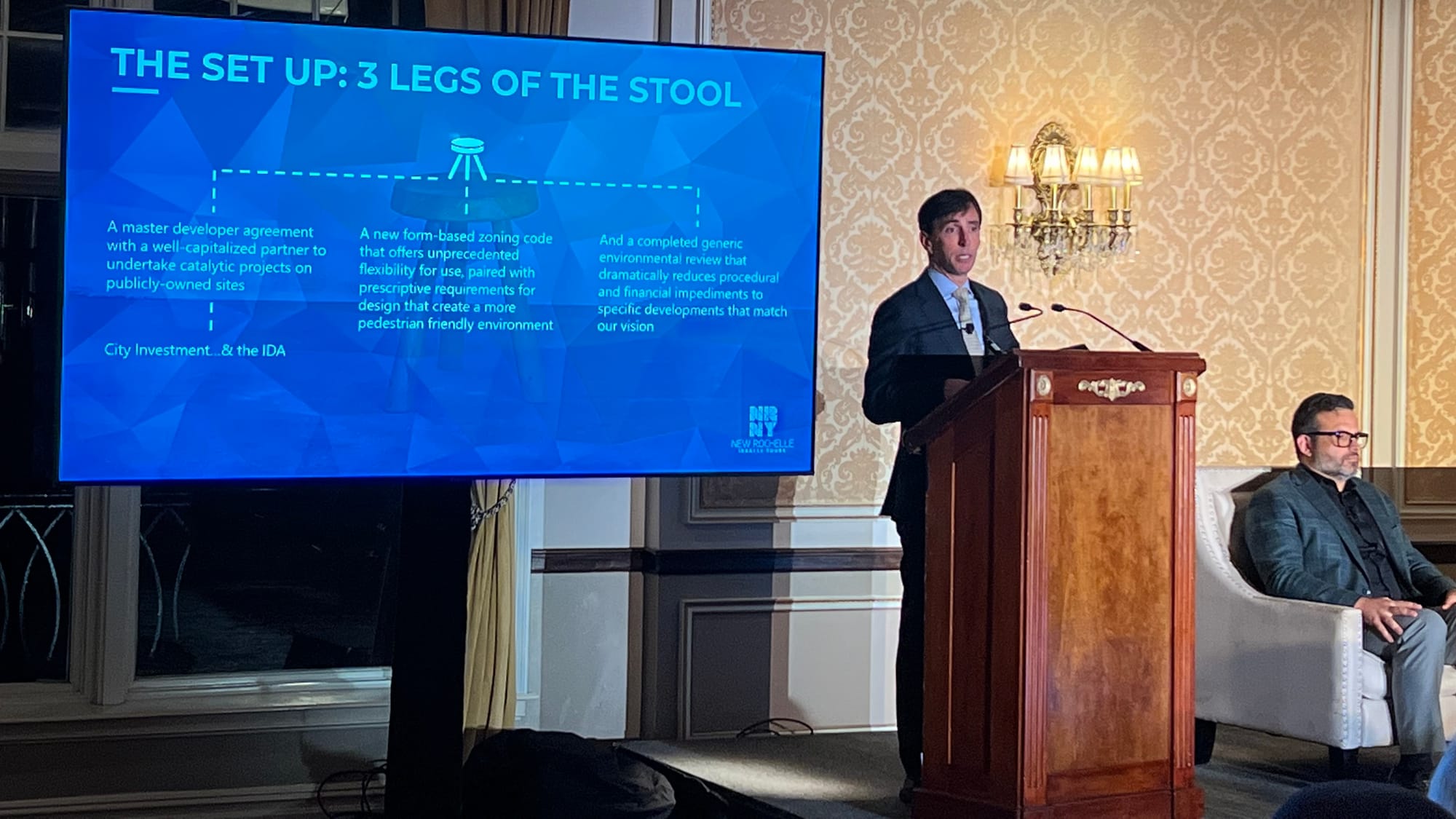
That environmental review (the “third leg”) was one of the program’s defining features. Instead of requiring every qualifying development to undertake its own full environmental impact study, New Rochelle evaluated the anticipated cumulative effects of the downtown redevelopment program at the outset.
When an interviewer specifically asked Picciotto about environmental review, however, she responded that New Rochelle was still conducting such reviews but expediting them.
Her explanation described part of the city’s streamlined approval process but did not clearly distinguish the original generic environmental review from subsequent approvals for projects that complied with it.
That distinction matters because the program’s original structure was considerably more specific than the broad deregulatory philosophy being presented as its national legacy.
Neither the California reforms, Oregon legislation nor proposed federal housing measures cited in the interview established that another jurisdiction had replicated New Rochelle’s complete three-part redevelopment program.
Former Mayor Noam Bramson had acknowledged as much during an April 2, 2025, appearance on “The Housing Problem,” a podcast hosted by Rafael Cestero and Kirk Goodrich. Asked about replication of New Rochelle’s approach, Bramson said that, to his knowledge, no other municipality had adopted the entire model, although some had implemented individual elements.
Four months later, the Journal’s reporting was being used to suggest that the New Rochelle approach was spreading across the country.
The meaning of the “New Rochelle model” had begun to change. What once described a particular downtown redevelopment mechanism increasingly became shorthand for building more housing, reducing regulation and expecting market forces to restrain rents.
Those are related ideas, but they are not the same thing.
A National Argument Takes Shape
The Journal’s findings also found an audience among organizations and commentators already advocating changes to housing regulations.
The American Enterprise Institute published commentary contrasting New Rochelle’s development-friendly approach with the housing policies advocated by New York City political figures. The argument presented New Rochelle as evidence that increasing supply was preferable to attempting to control rents through direct government intervention.
The Better Cities Project likewise published an article explaining how New Rochelle had rewritten the housing-development playbook.
Its account repeated the Journal’s 1.6% and 2% figures, cited the thousands of apartments completed and proposed, and held up the city’s streamlined approval process as a lesson for other municipalities.
The Better Cities Project had an established interest in New Rochelle long before Picciotto’s story appeared.
In 2021, it published a detailed case study co-authored by Salim Furth, then affiliated with the Mercatus Center at George Mason University, and Philip Wharton, a former RXR executive who had participated in the city’s redevelopment effort.
That earlier report praised the city’s master developer arrangement and generic environmental review as innovations that made development more predictable. It also promoted the model to municipal leaders elsewhere.
The distinction is important. Better Cities did not discover New Rochelle through the Journal’s 2025 reporting. It had been promoting the city’s redevelopment strategy for years.
What changed after August 2025 was the availability of a widely circulated national newspaper story that appeared to supply statistical confirmation of the economic argument.
The same pattern emerged in a June 5, 2026, New York Post opinion article by Howard Husock, which urged political leaders in New York City and Los Angeles to follow New Rochelle’s housing lead.
Husock repeated the now-familiar rental comparisons, including the 2% decline between 2020 and 2023, while advocating a faster development-approval process.
By that point, the story was functioning as more than an account of one city’s experience. New Rochelle had become an example used to argue for particular housing policies in municipalities thousands of miles away.
The Mayor Calls a Newspaper Article a Study
New Rochelle’s elected officials were not merely passive beneficiaries of this national attention.
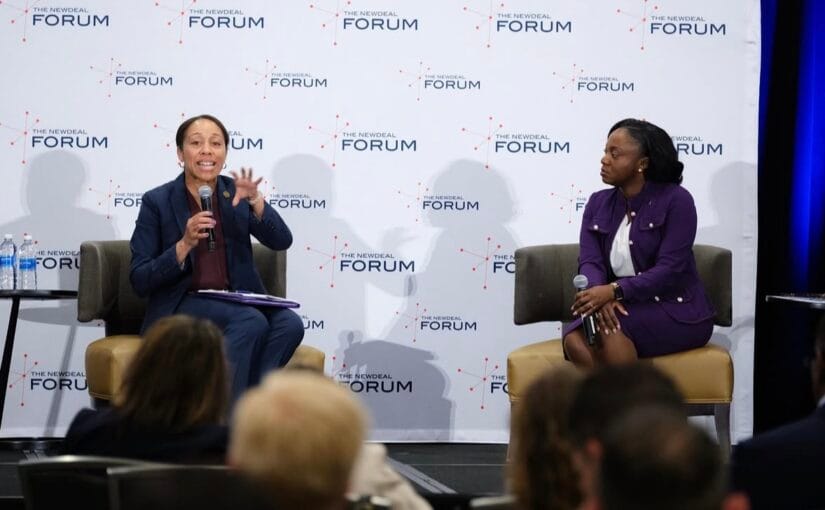
On May 4, 2026, Mayor Ramos-Herbert appeared at the NewDEAL Forum Ideas Summit in Raleigh, North Carolina, where she promoted the city’s downtown development strategy during a discussion about housing affordability.
As Talk of the Sound reported on May 10, Ramos-Herbert cited what she described as an August 2025 Wall Street Journal “study” finding that New Rochelle rents had declined approximately 2% while rents in surrounding communities increased by double digits.
The characterization was significant.
The Journal had published a reported newspaper feature relying on rental data and interviews. It had not produced an independent academic study establishing that New Rochelle’s downtown redevelopment program caused rents to decline.
Nevertheless, the article was now being invoked by the city’s mayor as a study demonstrating that the New Rochelle model worked.
Ramos-Herbert credited increased supply with producing benefits for residents and described the city’s development program as a successful response to housing affordability pressures. Her presentation carried the argument beyond New Rochelle to an audience of elected officials from other jurisdictions.
The sequence had come nearly full circle. City officials promoted their redevelopment program to journalists, journalists reported favorable statistics about the program, and the mayor subsequently cited that journalism as independent confirmation of the program’s success.
That does not mean the original reporting was fabricated or that everyone repeating it knew of the statistical limitations. It does mean that the repeated references cannot be treated as separate confirmations of the underlying claims.
A National Prize for Housing Affordability
The clearest example of the narrative acquiring institutional authority came in May 2026, when Ivory Innovations recognized New Rochelle as a winner of its national Ivory Prize in the Policy and Regulatory Reform category.
Ivory Innovations, a housing-affordability initiative associated with the University of Utah’s David Eccles School of Business, recognized New Rochelle’s downtown development program alongside other housing innovations.
https://youtu.be/yYv-iMA0Lnw
Its published account praised the city’s zoning reforms, streamlined permitting and construction of thousands of apartments. It credited the program with restraining rental growth compared with surrounding markets.
Then came the numbers.

Ivory Innovations repeated the same comparisons featured in the Journal’s August 2025 article: New Rochelle median rents had risen only 1.6% since 2020, compared with increases exceeding 25% in some neighboring markets, and had declined approximately 2% between 2020 and 2023.
The figures had become part of the published explanation accompanying a national award for housing-policy innovation.
An emotional Ramos-Herbert welcomed the recognition, describing the city’s policies as an example of how increased supply, zoning changes and development incentives could improve affordability.
The award gave New Rochelle something more durable than another favorable news article. It provided an institutional endorsement that the city and its supporters could cite in future presentations, publicity and policy discussions.
But the underlying questions remained unanswered. The rental comparisons still concerned the entire city rather than the downtown development area, and the figures did not establish how much of the change in rents was attributable to the Downtown Overlay Zone.
A national award could recognize New Rochelle’s genuine achievements in accelerating construction and changing its zoning system. That recognition did not independently prove the broader claim that the program had caused market rents to fall.
A Different Set of Numbers Emerges
By the summer of 2026, Pew was continuing to promote New Rochelle as a model for communities seeking to address housing costs.
In articles published July 31 and August 4, Pew connected the city’s experience with the newly enacted 21st Century ROAD to Housing Act, presenting New Rochelle as an example of the local reforms that could help fulfill the federal legislation’s objectives.
But Pew was now emphasizing a different measurement.
It reported that inflation-adjusted rents in New Rochelle had declined 13% between 2017 and 2023.
That is a legitimate way to examine rental costs and deserves consideration alongside nominal-dollar comparisons. Inflation can erode the purchasing-power value of rents even when the dollar amount tenants pay is increasing.
The distinction is not trivial. Using the Apartment List data obtained for this investigation, New Rochelle’s median monthly rent increased from $1,801 in January 2017 to $2,156 in May 2026, a nominal increase of approximately 19.7%.
When those same observations are adjusted for inflation using the national Consumer Price Index, however, the comparison changes substantially. The January 2017 rent was equivalent to approximately $2,485 in May 2026 dollars, meaning inflation-adjusted rents declined approximately 13.3% over the full period.
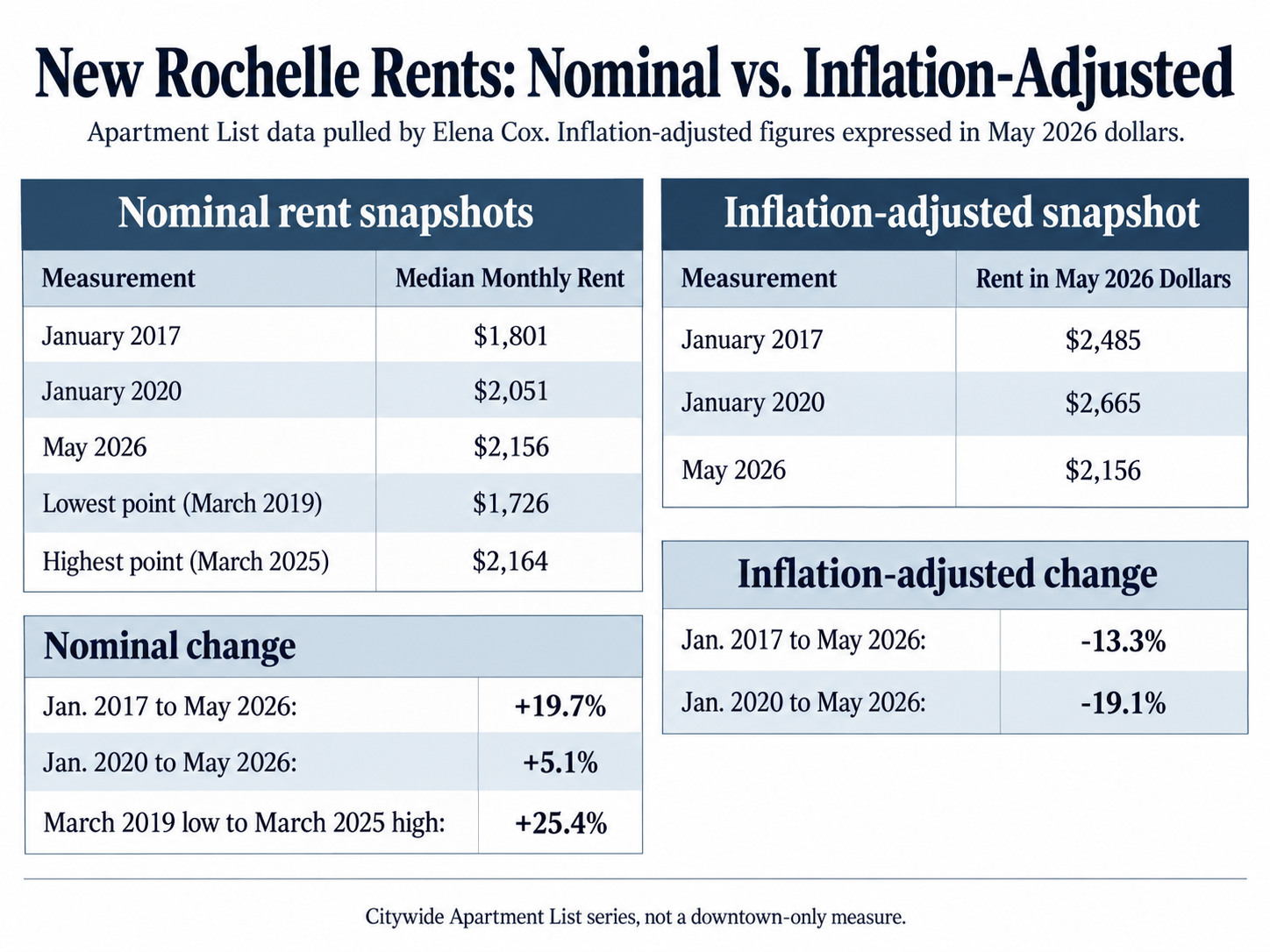
Beginning in January 2020, the nominal increase through May 2026 was approximately 5.1%, while the inflation-adjusted change was a decline of approximately 19.1%.
The adjustment demonstrates why nominal and inflation-adjusted comparisons must not be confused. It also shows that the two measurements can describe different aspects of the same rental market without either being inherently invalid.
But Pew’s 2026 reports raised another question. Why was the organization still emphasizing a period ending in 2023 when substantially newer rental data was available?
There was also the question of comparison markets. Inflation-adjusted rental declines in New Rochelle would be more informative if measured alongside the same inflation-adjusted series for Westchester County, Yonkers and other nearby communities.
Most importantly, a decline in inflation-adjusted rents does not by itself establish that downtown construction caused the change.
Pew’s newer presentation was more sophisticated than the repeated nominal-rent comparisons, but it did not resolve the fundamental problem of identifying the actual effects of the redevelopment program.
Not Everyone Accepted the Miracle
The favorable coverage did not go entirely unchallenged beyond this reporter.
On September 2, 2025, New RoAR News published an opinion article by Shaun Wayawotzki, co-chair of the residents’ organization NewRo Enough is Enough, questioning whether New Rochelle was truly experiencing the rental affordability success portrayed in the Journal.
The article examined U.S. Census Bureau figures rather than relying exclusively on Apartment List.
Using American Community Survey median gross rent data, the analysis found that New Rochelle rents increased approximately 19% between 2020 and 2023, compared with 17% across Westchester County and 23% nationally.
Those census figures measure rents differently from Apartment List’s modeled series, so they cannot simply be substituted for the Journal’s data. Nevertheless, they offered a competing picture of rental costs during the same period.
The article also examined the affordability of apartments in newly constructed buildings, distinguishing between market-rate housing and apartments reserved for households meeting income eligibility requirements.
That distinction had been largely absent from the national celebration of New Rochelle’s housing miracle.
Building apartments can increase supply. Requiring developers to set aside income-restricted units can provide housing opportunities for qualifying households. A slowdown in rental increases may indicate improved market conditions for tenants.
But those are three different outcomes, and demonstrating one does not automatically establish the others.
The New RoAR News analysis showed that the Journal’s interpretation was being questioned locally almost immediately, even as the more favorable version of the story circulated nationally.
Why Did the Analysis Stop in 2023?
There is another question that emerges from the national celebration of New Rochelle’s housing miracle: Why did so many organizations and public officials continue citing rental statistics ending in 2023 when newer information was available?
The Pew Charitable Trusts published its original analysis in April 2023, using Apartment List data through February of that year. At the time, that was a reasonable endpoint. But when The Wall Street Journal published its New Rochelle article in August 2025, it prominently repeated a 2% rental decline between 2020 and 2023, even while citing a separate comparison showing rents had increased 1.6% since 2020.
The more revealing question is what happened after the period Pew originally examined. By August 2025, more than two years had passed since Pew’s analysis ended. By October 2026, that gap had grown to more than three and a half years.
For this investigation, Talk of the Sound obtained Apartment List’s underlying monthly rental data through May 2026. Using Pew’s February 2023 endpoint as the starting point produces a different picture of New Rochelle’s more recent rental performance.
In February 2023, New Rochelle’s median monthly rent was $2,048. By May 2026, it had increased to $2,156, a nominal increase of 5.3%. Rents reached $2,164 in March 2025, the highest nominal figure in the entire dataset covering January 2017 through May 2026.
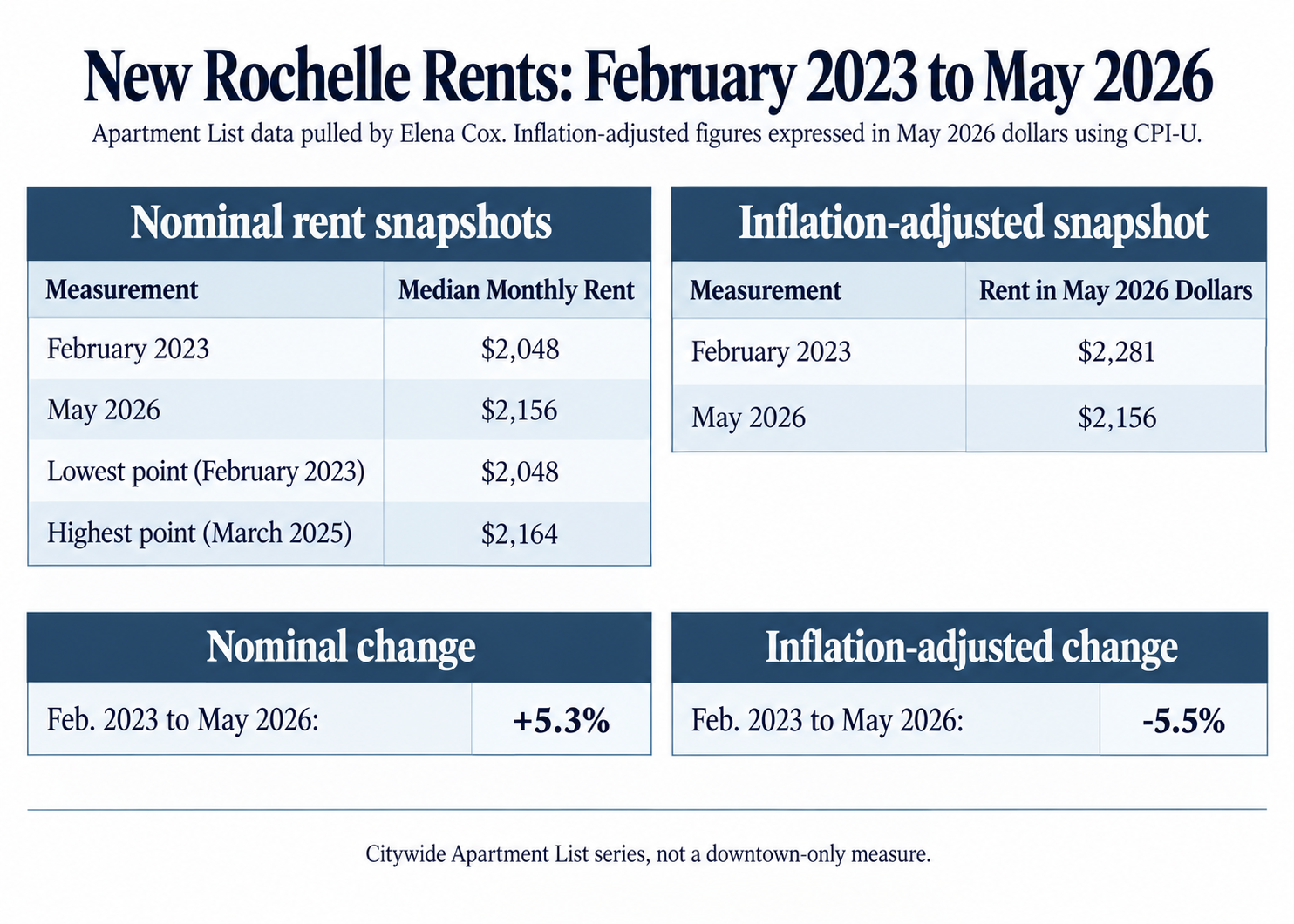
Adjusting for inflation changes the interpretation. Using the national Consumer Price Index, the February 2023 rent was equivalent to approximately $2,281 in May 2026 dollars. On that basis, inflation-adjusted rents declined approximately 5.5% through May 2026, even though the actual dollar amount of monthly rent increased.
Both findings matter. New Rochelle tenants faced higher nominal rents in May 2026 than in February 2023, but those rents had not kept pace with general inflation. That is a more complete account than simply repeating a nominal rent decline that ended years earlier.
The larger issue is not which measurement produces the most favorable headline. It is whether the people promoting New Rochelle as a national housing model examined the full available record, applied consistent measures and distinguished changes in rental prices from evidence that the city’s downtown redevelopment program caused those changes.
The February 2023-to-May 2026 comparison is particularly relevant because it covers the years during which New Rochelle’s housing miracle acquired national prominence. It includes the August 2025 Wall Street Journal article, the subsequent television coverage, the favorable policy commentary and the recognition the city received in 2026.
Yet the nominal rental decline from 2020 to 2023 remained a recurring feature of the story, even as the same underlying dataset showed that rents subsequently increased.
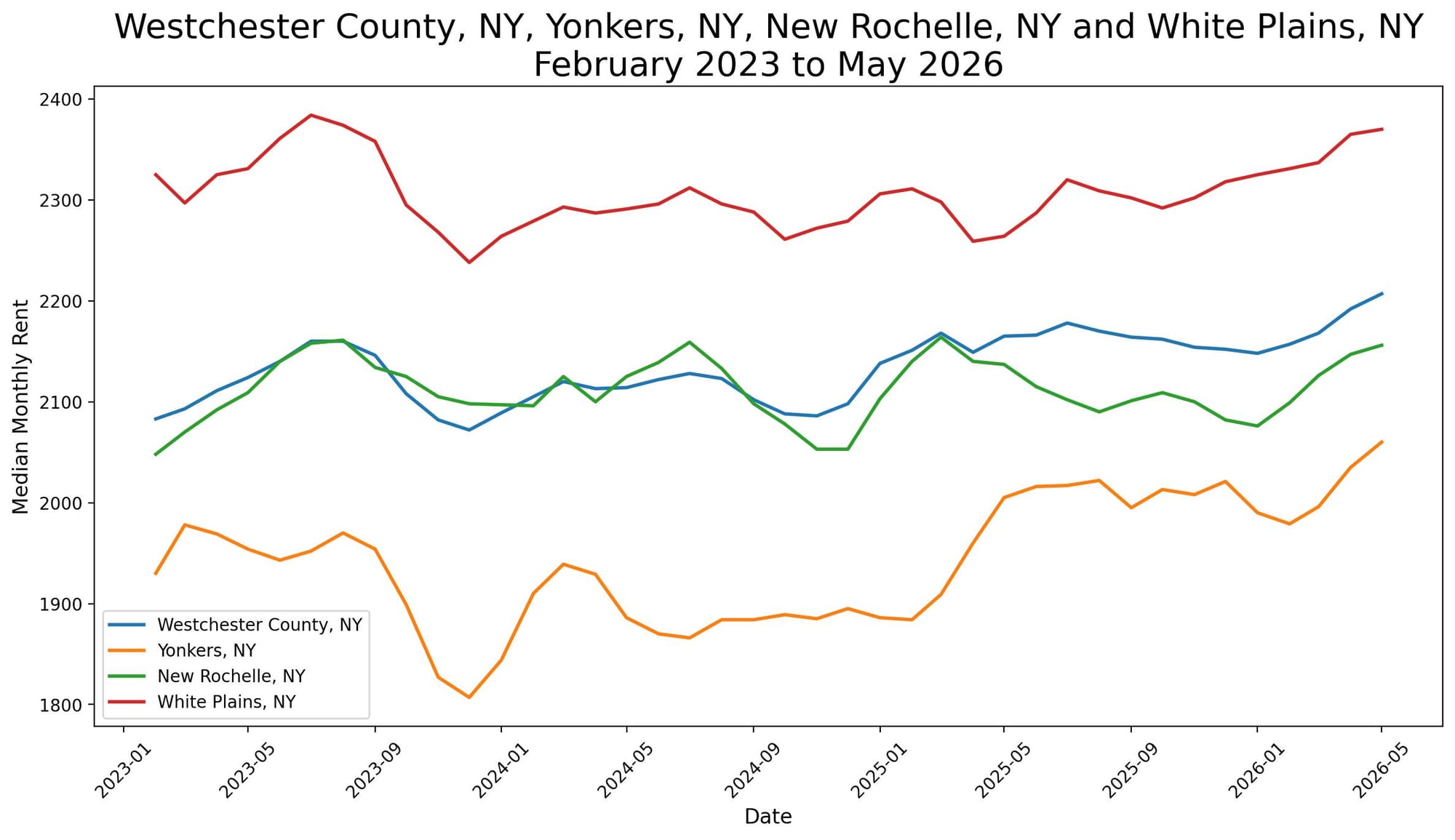
A comparison with neighboring communities provides additional perspective on New Rochelle’s rental performance. According to the Apartment List data obtained for this investigation, between February 2023 and May 2026, median monthly rents in New Rochelle increased 5.3%, from $2,048 to $2,156. Over the same period, rents in Yonkers increased 6.7%, from $1,930 to $2,060, while White Plains recorded a smaller increase of 1.9%, from $2,325 to $2,370. Westchester County as a whole experienced an increase of 6.0%. New Rochelle therefore performed somewhat better than Yonkers and the county overall, but considerably worse than White Plains. The accompanying chart illustrates that New Rochelle’s rental trajectory was not especially unusual among neighboring communities, raising further questions about the claims that its downtown redevelopment program produced a uniquely successful housing affordability model.
The question becomes more consequential when national political figures begin invoking New Rochelle’s supposed success as evidence for their own housing policies. By February 2026, Gov. Kathy Hochul was celebrating the city as proof that building more housing could bring rents down, citing a decline of 3% to 5% and contrasting it with substantial national increases. Where those figures came from, which months they measured and why the governor was relying on that comparison in 2026 are questions that deserve examination.
How a Claim Becomes Conventional Wisdom
By October 2026, New Rochelle’s housing story had appeared in national newspapers, commercial real estate publications, university-affiliated commentary, local and national television, policy discussions, political speeches and the materials accompanying a prestigious housing award.
Some of those accounts directly cited Picciotto’s reporting. Others relied on Pew, earlier redevelopment research or the statements of New Rochelle officials. The connections are not identical, and it would be inaccurate to suggest that every favorable article originated with the Journal.
What is clear is that the same small collection of favorable statistics circulated repeatedly, often accompanied by the conclusion that New Rochelle had demonstrated how building more housing could bring rents down.
The story gained institutional credibility with each new appearance. A newspaper article became a television segment. The same figures appeared in real estate publications and policy commentary. A mayor described the reporting as a study. A national housing organization incorporated the comparisons into its recognition of the city’s redevelopment program.
At each stage, a reader or viewer could reasonably assume that the growing number of endorsements reflected a growing body of independent evidence.
The record instead shows substantial reliance on overlapping sources, repeated measurements and interpretations that did not establish the causal relationship being promoted.
None of this means New Rochelle’s redevelopment program accomplished nothing. The city changed its zoning rules, streamlined approvals and facilitated the construction of thousands of apartments, substantially altering its downtown.
The question is whether those achievements justify the considerably larger claim that New Rochelle had discovered a replicable formula for lowering rents.
The Journal presented that proposition to a national audience in August 2025. Over the next year, other organizations and public figures repeated it, promoted it and rewarded it.
What began as a reported account of one city’s rental statistics had become something approaching conventional wisdom about American housing policy.
And once that happened, the distinction between what New Rochelle had actually demonstrated and what its admirers claimed it had demonstrated became increasingly difficult to see.
In Part IV: The investigation turns from the national promotion of the New Rochelle model to the conditions in the city itself: the disappearance of active construction, the growing inventory of approved but unbuilt apartments, and Gov. Kathy Hochul’s decision to make New Rochelle a showcase for her statewide housing agenda.
RELATED
The Great Wall Street Journal Hoax of New Rochelle
This article was prepared with the assistance of AI tools under the direction and editing of Robert Cox.
Have information about this story? Email robertcox@talkofthesound.com (preferred) or contact via WhatsApp: +353 89 972 0669.