The Great Wall Street Journal Hoax of New Rochelle — Part IV: How New York’s Governor Embraced the Economic Absurdity Behind a Supposed Housing Miracle

New Rochelle transformed its downtown and attracted billions of dollars in development. But claims that a few thousand apartments produced a housing affordability miracle became a national narrative — and eventually part of Gov. Kathy Hochul’s argument for changing housing policy across New York.
DUBLIN, IRELAND (October 27, 2026) — Imagine dropping a handful of sand into the Atlantic Ocean and claiming that you have changed the tides. That is roughly the scale of the economic argument behind New Rochelle’s celebrated housing miracle, a story promoted by The Wall Street Journal, embraced by housing-policy organizations and repeated by elected officials as evidence that the city discovered a formula for bringing rents down.
The argument sounds simple enough. New Rochelle changed its zoning laws in 2015, developers constructed thousands of apartments, and rents subsequently declined or increased more slowly than in surrounding communities. Therefore, the new apartments must have caused the favorable rental performance. Build more housing, the argument goes, and prices will fall.
But New Rochelle is not an island, economically speaking. It is a small part of the New York metropolitan housing market, where millions of households choose among apartments, condominiums and houses spread across New York City, Long Island, Westchester County, northern New Jersey and southwestern Connecticut. Those households respond to rents, employment opportunities, transportation, neighborhood amenities and countless other factors when deciding where to live.
The metropolitan area contains approximately 8.1 million housing units, according to U.S. Census Bureau estimates. Against that enormous supply, New Rochelle added approximately 4,500 apartments under its Downtown Overlay Zone redevelopment program, with the first major building, RXR’s 360 Huguenot, beginning leasing in June 2019.
Those 4,500 apartments represent approximately 0.055% of the metropolitan area’s housing stock. Spread over six years, they amount to an average of 750 apartments annually, equivalent to less than one one-hundredth of 1% of the regional housing supply each year.
And New Rochelle was hardly the only community building apartments. New residential developments were also underway in Yonkers, White Plains, Stamford, Norwalk, Jersey City, Hoboken, Long Island City and elsewhere throughout the region. Developers in those communities were competing for many of the same prospective tenants, including people leaving New York City in search of more space, different amenities or lower housing costs.
The relevant housing market does not end at New Rochelle’s municipal boundaries. A prospective tenant considering a new apartment near the New Rochelle train station might also consider Yonkers, Stamford, Hoboken or Queens. A landlord in New Rochelle cannot set rents without regard to the prices and alternatives available elsewhere in that interconnected market.
Yet the central premise of the New Rochelle housing miracle treats the city’s relatively small addition to regional housing supply as the explanation for changes in rental prices within New Rochelle itself.
That proposition raises an elementary economic question: How could adding a few hundred apartments annually to a market containing millions of housing units produce the distinctive rental-price effects attributed to New Rochelle, while the much larger economic forces operating throughout the region supposedly played a secondary role?
There are circumstances in which new construction can affect rents in nearby buildings or within particular segments of a housing market. Apartments are not perfectly interchangeable, and a substantial concentration of new housing can change competitive conditions in a neighborhood. But demonstrating such an effect requires identifying the relevant market, measuring the actual increase in supply and separating its impact from other influences on rental prices.
Neither simply counting completed apartments nor comparing rents at two conveniently selected dates accomplishes that task.
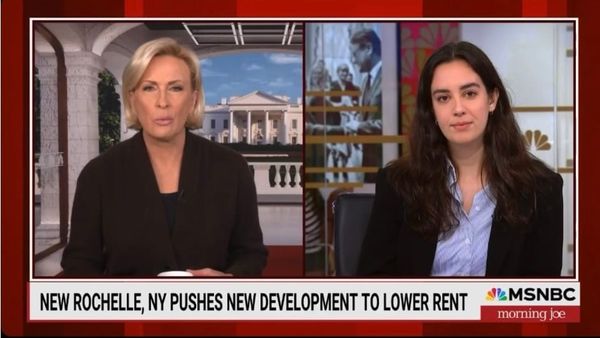
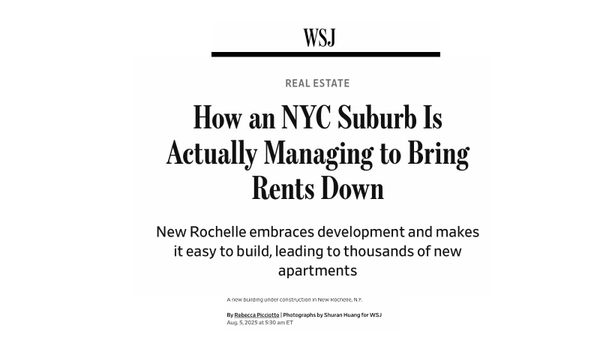
The Wall Street Journal reported in August 2025 that New Rochelle’s median rents had declined 2% between 2020 and 2023 and increased just 1.6% over a longer period beginning in 2020. The Pew Charitable Trusts had previously published similar comparisons, and both organizations pointed to New Rochelle’s development program as evidence that increasing housing supply could restrain rents.
But the rental statistics concerned the entire city, not merely the downtown area where the apartments were constructed. And the reporting did not establish how much of New Rochelle’s rental performance resulted from its own construction, how much reflected housing supply elsewhere in the metropolitan area, or how much was attributable to changes in demand and other economic conditions.
Those distinctions are not academic technicalities. They go directly to whether New Rochelle’s experience demonstrates the economic proposition that made the city famous.
Consider the difference between an observation and an explanation. It is possible to observe that thousands of apartments were constructed in New Rochelle and that a particular measure of rents subsequently declined. Both observations can be accurate without the first explaining the second.
Establishing that relationship requires more than invoking the law of supply and demand. It requires demonstrating that the additional supply was sufficiently significant within the relevant housing market to produce the measured effect, while accounting for the other forces influencing rents during the same period.
There is a familiar Latin phrase for the assumption that other economic conditions remain unchanged: ceteris paribus, or all else being equal. Under that assumption, increasing the supply of something, with demand held constant, generally tends to lower its price.
But all else was emphatically not equal in New Rochelle.
On March 10, 2020, Gov. Andrew Cuomo announced a one-mile coronavirus containment zone in New Rochelle, then the center of New York’s earliest major outbreak. Schools, houses of worship and other gathering places were closed, and the National Guard was deployed to assist with cleaning and deliveries. The announcement made New Rochelle a focus of national attention at an extraordinarily frightening moment.
The pandemic also changed the economic proposition underlying much of New Rochelle’s downtown redevelopment. Proximity to Manhattan and the Metro-North railroad station had been major selling points for the new residential buildings. Then millions of Americans began working from home, and many never returned to commuting five days a week.
For a city marketing downtown apartments to people who worked in New York City, the sudden disappearance of the daily commute was hardly an irrelevant economic event. It potentially affected the appeal of living near the railroad station, the competition among residential communities and the amount tenants were willing to pay for the convenience of a particular location.
At the same time, interest rates, inflation, employment, household formation, construction financing and housing demand were undergoing significant changes. Developers elsewhere in the region continued adding apartments, while existing landlords responded to shifting market conditions.
Nobody has established how much these forces affected New Rochelle rents individually. That is precisely the problem with attributing the city’s rental performance to a relatively small increase in local housing supply.
And there is an even more fundamental defect in the argument.
As Parts I and II of this investigation demonstrated, the celebrated rental declines and unusually slow increases were themselves the product of cherry-picked comparisons. The underlying Apartment List data showed a much more complicated pattern, including substantial rent increases outside the selected periods. The figures were citywide, not specific to the downtown redevelopment district.
The economic argument was therefore being constructed on two questionable propositions: that the chosen rental comparisons accurately described New Rochelle’s broader rental experience, and that the construction of several thousand downtown apartments explained the results.
The national narrative largely skipped both questions. Instead, New Rochelle became an example of a housing policy supposedly validated by real-world experience, with the same rental comparisons repeated in newspapers, television interviews, research publications and political speeches.
The first three installments of this investigation examined how that narrative developed, the selective rental statistics used to support it and the extensive national publicity that followed. The final question is whether the reality of New Rochelle’s redevelopment program bears any resemblance to the extraordinary claims made on its behalf.
That examination begins with a construction boom that had already begun losing momentum, thousands of proposed apartments that never materialized and a governor who arrived in New Rochelle in February 2026 to celebrate the city as a model for the rest of New York.
By then, New Rochelle’s housing miracle had become more than a local redevelopment story. It had become a political argument for changing housing policy across the state — even the country.
The trouble was that the supposed miracle had never been convincingly explained.
The Construction Boom Was Already Slowing Down
On January 19, 2023, more than two years before the Wall Street Journal published its celebrated account of New Rochelle’s housing success, a group of real estate executives gathered at the VIP Country Club on Davenport Neck to discuss development in New Rochelle and the Westchester County commercial real estate market.
The event, organized by CBIZ Marks Paneth, featured then-Mayor Noam Bramson, Development Commissioner Adam Salgado and Colliers executive Craig Ruoff. Neil Sonenberg of CBIZ Marks Paneth moderated the discussion, attended by more than 100 industry representatives.

I attended the event and photographed the presentations. During the discussion, Salgado described a development pipeline that was drying up, even as projects approved and started in earlier years continued moving toward completion. One of his presentation slides was titled “A Shift in Focus,” identifying new priorities that included resilience, environmental and social goals, affordable housing and amendments to the Downtown Overlay Zone.
That was a revealing moment. New Rochelle’s first wave of redevelopment was still producing visible construction activity, but the city was already looking beyond the program’s initial surge of large residential projects.
A January 31, 2023, account of the event in the New York Real Estate Journal reported that 12 projects had been completed and were leasing approximately 2,100 apartments, while another 12 projects were under construction. The latter represented thousands of additional units that would become available as construction progressed.
Those numbers help explain what happened over the following two years. Apartments continued entering the market, and the total number of completed units rose substantially, but much of that growth reflected construction that had already begun.
The distinction between apartments under construction and entirely new construction starts became increasingly important.
By late 2024, the city’s own development figures showed 21 completed projects with 3,848 rental units, four projects under construction with 1,285 units, and six additional projects with site plan approval covering 1,692 units.
Most revealing was another statistic in the same presentation: Only one new development project had been approved during the preceding 12 months.
These were not the figures of a city continuously launching new residential towers at the same pace that characterized the first years of its redevelopment program. They described a city still benefiting from its earlier construction pipeline while the flow of newly approved projects had slowed.
The distinction was largely absent from the national celebration of New Rochelle’s housing boom.
When the Wall Street Journal reported in August 2025 that approximately 4,500 apartments had been built, the figure was a cumulative measure of earlier development. It did not mean thousands of additional apartments were beginning construction in 2025, or that the city’s development pipeline remained as active as it had been several years before.
A construction boom can continue producing completed buildings long after the underlying wave of investment has diminished. Developers finish projects already financed and underway, even as changing market conditions make them reluctant to begin new ones.
Rising borrowing costs, higher construction expenses, changing demand and uncertainty about achievable rents can all influence those decisions. New Rochelle was not exempt from the financial pressures affecting developers elsewhere.
There was another problem with the imagery being used to sell the city’s success.
As Part I documented, the Wall Street Journal’s Rebecca Picciotto described cranes visible around New Rochelle, reinforcing the impression of construction activity throughout downtown. Mayor Yadira Ramos-Herbert had similarly described a skyline filled with cranes in her 2025 State of the City address.
But the construction records and photographs examined for this investigation show the descriptions were entirely false. A single city permit identified as a crane or boom truck operation at 455 Main Street did not, by itself, establish the presence of a tower crane, and the contemporary skyline did not resemble the forest of construction cranes suggested by the rhetoric.
The real question was no longer how many apartments New Rochelle had built since 2015. It was how many new projects developers were prepared to build next.
Thousands of Apartments Remain on Paper
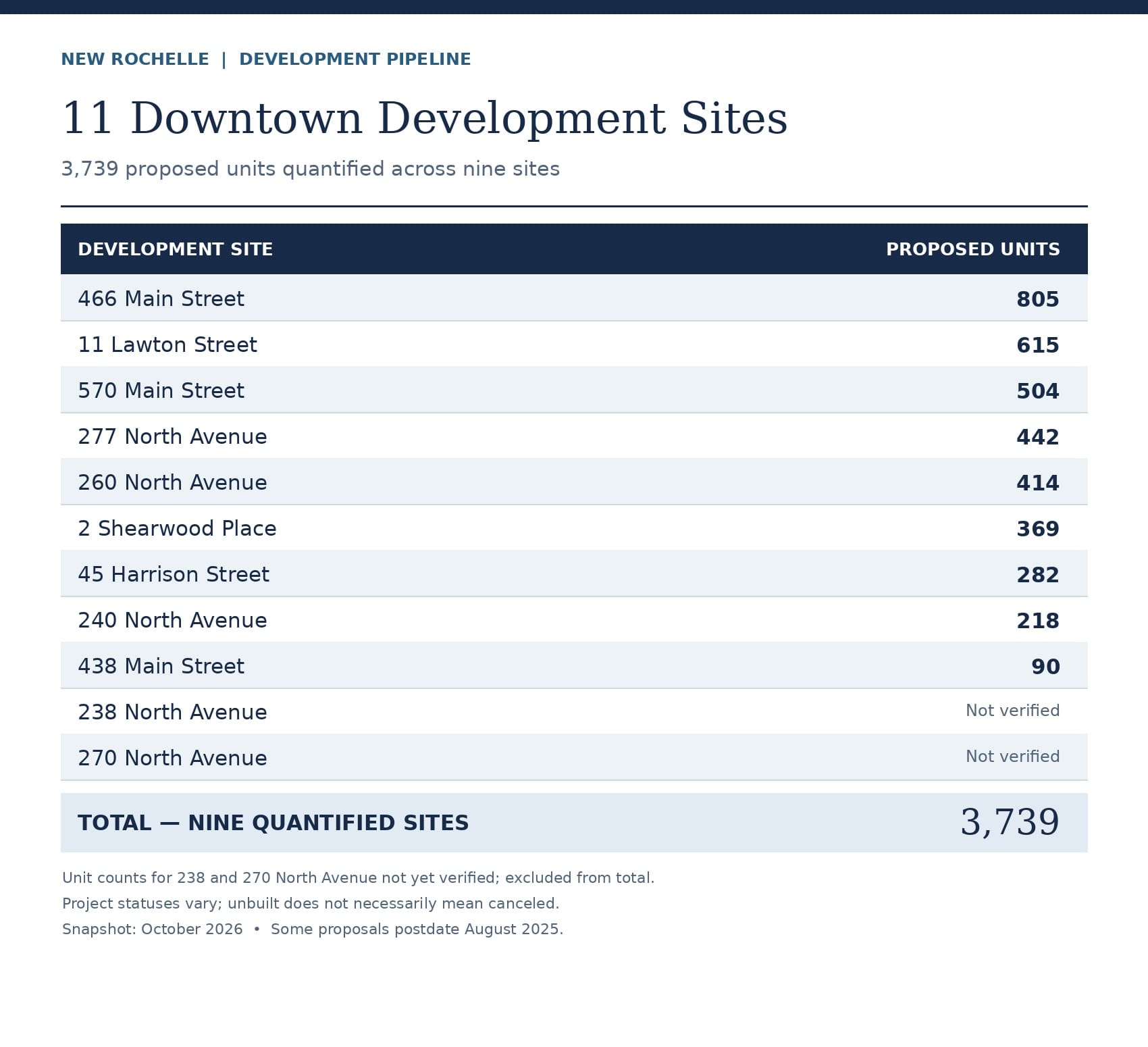
An examination of New Rochelle’s development pipeline reveals a substantial inventory of proposed apartments that, as of October 2026, had not materialized. I could find no comprehensive, publicly available city inventory identifying every proposed development and its current status, so I assembled the accompanying table from press releases, news reports, Planning Board agendas and other available records. It is a good-faith effort to illustrate the scope of unbuilt development, not a definitive accounting. Some information may be incomplete or outdated, and I will update the table as additional information becomes available.
My best-efforts review identified 11 prominent downtown development sites that remain unbuilt, nine of which account for approximately 3,739 proposed residential units. Apartment counts for the remaining two sites have not been established and are excluded from that total. The projects are at different stages: some appear to have been abandoned, others have remained inactive for years, and still others have obtained approvals, changed developers or recently made progress toward construction. Their inclusion in the table does not mean that every project has been canceled or that none will ultimately be built.
Other projects outside the central downtown area, including some within other Downtown Overlay Zone districts, remain on New Rochelle’s development radar, among them Pratt Landing (482 units), 475 North Avenue (162 units), 50 Lockwood Avenue (89 senior housing units) and 420 North Avenue (unit count not established), all at various stages of planning or approval, with none currently under construction.
The largest downtown project is the proposed redevelopment of 466 Main Street, the former Arnold Constable property, where BRP Companies secured site plan approval in October 2025 for two 28-story towers containing 805 apartments. The development would include 257 studios, 377 one-bedroom apartments, 156 two-bedroom apartments and just 15 three-bedroom apartments.
The project illustrates two issues at once. The approval represents a substantial potential investment in downtown New Rochelle, but no construction timetable had been announced as of October 2026. Its proposed apartment mix also demonstrates the concentration of new downtown housing in studios and one-bedroom units rather than larger family-oriented apartments.
At 11 Lawton Street, plans for the historic National City Bank property and surrounding land have circulated for years, evolving through different versions and development concepts. The latest proposal calls for approximately 615 apartments, but the promised residential complex has not been constructed.
The property at 277 North Avenue presents another long-running example. A 442-apartment project received approval in 2018, and the former Bank of America property was demolished. Years later, however, the apartments remain unbuilt, with new development interests attempting to advance the project.
Other sites include 45 Harrison Street, where plans for approximately 282 apartments never became a completed development; 240 North Avenue, associated with a proposed 218-unit project; and 2 Shearwood Place, where a revised Toll Brothers proposal calls for 369 apartments.
The proposed 414-unit development at 260 North Avenue and the 504-unit project at 570 Main Street are additional examples of plans introduced or advanced more recently. Their inclusion underscores why announcements and approvals must be distinguished from actual construction.
Some of these projects may ultimately be built. Indeed, changes in ownership, revised approvals and progress through environmental or legal proceedings demonstrate that stalled projects can regain momentum.
But that possibility does not change the fundamental distinction between housing authorized on paper and housing actually delivered.
New Rochelle’s redevelopment publicity has frequently combined completed apartments, buildings under construction, approved projects and future proposals to demonstrate the magnitude of its development program. Each category has a legitimate meaning, but they are not interchangeable.
An approved apartment does not house anyone. It does not create an additional rental unit available for immediate occupancy. It does not increase the operating supply of housing until a building is actually constructed and brought to market.
The accumulation of thousands of unbuilt units therefore matters when evaluating whether the original development boom remains intact. A planning pipeline can look impressive long after the pace of new construction has slowed.
What Did the New Apartments Actually Change?
The addition of thousands of apartments undeniably changed the physical appearance of downtown New Rochelle. Whether those apartments produced all the broader economic and demographic effects anticipated by redevelopment advocates is a different question.
Much of the new housing was oriented toward smaller households. Studios and one-bedroom apartments feature prominently in the buildings that have opened, while larger apartments suitable for families with several school-age children are far less common.
The proposed 466 Main Street project provides a particularly clear illustration: Of 805 planned apartments, only 15 would contain three bedrooms. More than three-quarters would be studios or one-bedroom units.
That housing mix matters when evaluating claims about the population attracted by downtown redevelopment, its impact on public schools and the amount of commercial activity generated by new residents.
New Rochelle’s public-school enrollment offers one useful measure.
The City School District of New Rochelle enrolled approximately 10,696 students in 2015. By 2024, that number had fallen to approximately 9,722, a decline of 974 students, or about 9%.
The decline occurred during the same period that thousands of apartments were being added downtown, and school-enrollment projections had taken expected residential development into account.
Those figures do not establish that downtown redevelopment caused enrollment to fall. They do demonstrate that the new construction did not reverse the districtwide decline, despite the scale of the development program.
A plausible explanation is the composition of the apartments and the households they attract. A studio or one-bedroom apartment is generally not designed to accommodate a family with several school-age children. Even many two-bedroom apartments may be less attractive to larger families than houses or apartments with three or more bedrooms.
The impact on downtown businesses is similarly more complicated than counting apartment openings.
One of the original ambitions of redevelopment was to restore commercial vitality to a downtown that had struggled for decades. More residents were expected to support restaurants, stores and services, helping create a livelier pedestrian environment and attract additional investment.
There has been real progress. The city reports new business openings and improvement in storefront occupancy. Downtown has gained establishments and amenities that would have been difficult to imagine during its earlier decades of decline.
But the city’s own 2026 proposed amendments to the Downtown Overlay Zone also acknowledge continuing problems with retail vacancy and commercial activation. Among the stated objectives are improving ground-floor frontage requirements, supporting the long-term viability of large-format retail and encouraging the occupation of vacant storefronts.
That is an important acknowledgment. More residential construction does not automatically guarantee thriving retail businesses or a commercially successful downtown.
The economic contribution of 4,500 apartments depends in part on how many people occupy them, the types of households involved, their disposable income, where they shop and how much of their spending stays in New Rochelle.
A building filled primarily with smaller households commuting or working elsewhere can have a very different impact from a comparable number of residences occupied by larger families. The number of apartments alone cannot establish the extent of downtown’s commercial revitalization.
None of this means downtown redevelopment failed. It means that the program’s actual results are more varied and complicated than the simple housing-miracle narrative suggests.
The Long Road to a Vibrant Downtown
In late 2020, shortly before Luiz Aragon retired as New Rochelle’s development commissioner on December 31, I sat down with him for a lengthy interview that, for reasons I can no longer justify, I never published. But the conversation profoundly influenced how I understood the city’s downtown redevelopment program and the patience required to make it successful. One observation in particular stayed with me: Aragon believed New Rochelle would need approximately 10,000 new residential units to achieve the critical mass necessary to support a genuinely vibrant downtown, with enough residents to sustain restaurants, shops, services and a thriving local commercial economy. He understood that reaching that threshold would require time, sustained investment and considerable patience.
When Aragon retired, the Downtown Overlay Zone was only five years old, and relatively few apartments had been completed and occupied. More than a decade after the program’s adoption in 2015, New Rochelle is still only about halfway to the level he envisioned. Although thousands of additional apartments have opened since his departure, the city remains well short of the 10,000-unit benchmark he described. At the pace of the first 11 years, reaching that level could take another decade or longer, assuming development continues at anything approaching its earlier rate.
That perspective helps explain why expectations of an already fully activated downtown may be premature. Aragon understood that transforming a city’s physical landscape and building the residential population necessary to sustain a self-supporting commercial ecosystem were related but distinct accomplishments. New Rochelle has made remarkable progress on the former, but the latter was always going to take substantially more time. His observation remains a useful reminder that a successful redevelopment program should be judged against realistic expectations, rather than the assumption that constructing several thousand apartments would immediately produce a thriving downtown economy.
The Governor Discovers New Rochelle’s Housing Miracle
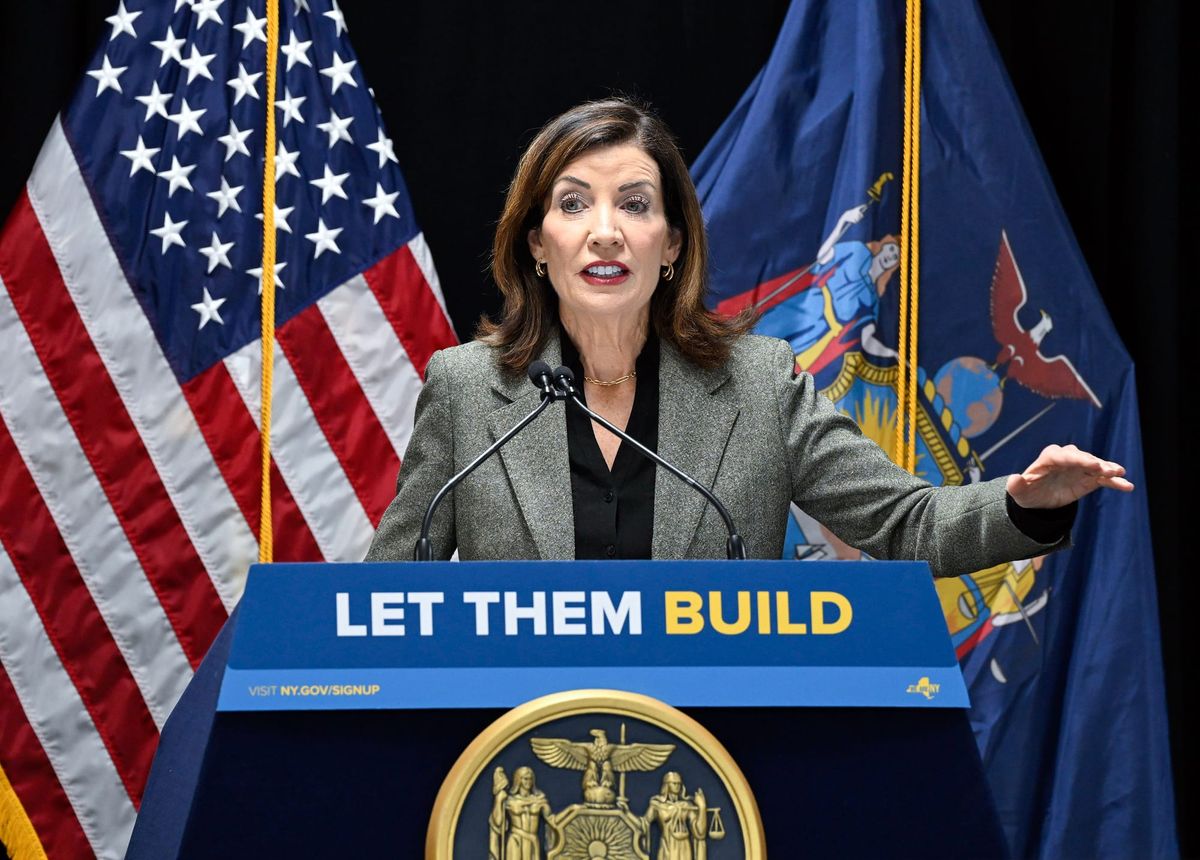
On February 18, 2026, Gov. Kathy Hochul visited New Rochelle and delivered perhaps the clearest example of how the city’s redevelopment story had been transformed into a sweeping economic claim.
Standing in a community whose new apartments she had just celebrated, Hochul invoked the law of supply and demand as the explanation for New Rochelle’s rental performance.
“Supply and demand Economics 101, which I didn’t even take a class, I just knew this without even taking the class,” Hochul said. “You build more supply, the prices go down.”
Her statement demonstrates precisely why an introductory economics course might have been useful. The law of supply and demand does not say that adding housing automatically causes rents to fall, regardless of what else is happening in the market. It describes the relationship between supply and demand, with the familiar prediction that increasing supply tends to lower prices when other conditions remain equal — ceteris paribus, again. Hochul ignored the demand side of the equation entirely, along with the size of the regional housing market, the minuscule contribution of New Rochelle’s construction to its overall supply and the extraordinary economic disruptions of the pandemic. She invoked Economics 101 while overlooking some of its most elementary qualifications.
She then made a remarkable assertion about New Rochelle rents.
“The average rent in this community has dropped by three-to-five percent,” Hochul said. “Nationwide is up about 31 percent. But It’s dropping here in New Rochelle because they had the ambition to keep building.”
The governor continued: “And that’s money back in people’s pockets.”
Her remarks went beyond the Wall Street Journal’s already selective comparisons. The Journal had reported a 2% decline between 2020 and 2023 and a 1.6% increase over its longer comparison ending in 2025. Hochul instead described a 3% to 5% decline in average rents without identifying the dates or underlying calculation during her remarks.
Her administration’s written announcement used different language, describing 4,500 new apartments alongside a 5% decline in rent growth. A reduction in the rate at which rents increase is not the same as a reduction in rents themselves.
That distinction matters. If rent increases slow from 5% annually to 2%, tenants are still paying more, not less. Describing such a change as rents going down gives the public a different impression of what happened.
The governor’s remarks also compressed years of development into a more recent period. Hochul said New Rochelle had built more than 4,500 homes since 2020, although the city’s redevelopment program was adopted in 2015 and the first major building under the program, 360 Huguenot, began leasing in June 2019.
Those are not trivial differences when an entire policy argument depends on the chronology of new housing supply and changes in rental prices.
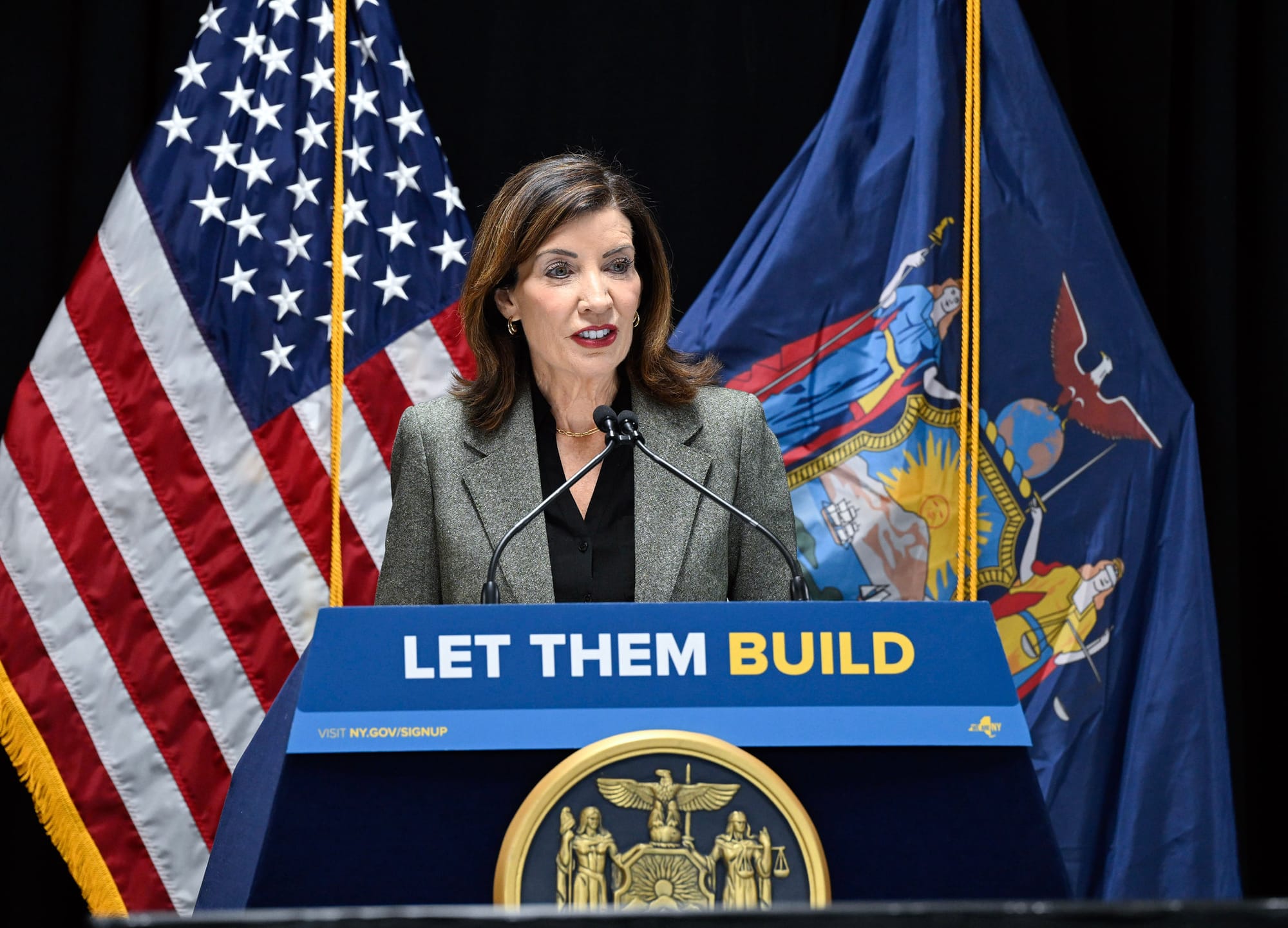
The governor presented New Rochelle as evidence supporting her “Let Them Build” initiative, a package of proposed changes intended to accelerate housing construction and infrastructure projects by reducing regulatory delays.
But the rhetorical certainty of the governor’s explanation was not matched by evidence establishing that New Rochelle’s construction caused the rental results she described.
There was no analysis presented that separated the effects of local construction from changes in regional housing supply, demand, interest rates, pandemic-era migration or other market conditions.
There was no explanation of why the governor’s figures differed from those published by the Wall Street Journal, or why selected comparisons from the pandemic period should be treated as representative of the city’s longer rental history.
And there was no demonstration that adding several thousand apartments to a metropolitan housing market containing millions of existing units produced the exceptional result she attributed to New Rochelle.
Nevertheless, the governor offered New Rochelle as an example other communities should follow.
“Thank you for showing us the way,” Hochul told the city.
From a Local Redevelopment Program to Statewide Housing Policy
The significance of Hochul’s remarks extends beyond another politician repeating an appealing housing statistic.
New Rochelle had become part of the justification for a statewide policy initiative.
On March 23, 2026, Mayor Yadira Ramos-Herbert joined Hochul and other local leaders at an Albany roundtable promoting the governor’s “Let Them Build” agenda.
The proposal included changes to New York’s State Environmental Quality Review Act, commonly known as SEQRA, intended to expedite certain housing and infrastructure projects while retaining environmental protections.
New Rochelle’s original Downtown Overlay Zone had already incorporated an important environmental-review innovation. Rather than requiring developers to undertake an entirely new comprehensive environmental review for each qualifying project, the city performed a Generic Environmental Impact Statement addressing the anticipated effects of the broader redevelopment program.
Together with form-based zoning and a master developer agreement involving RXR, the generic environmental review helped create a system in which qualifying projects could move through an expedited approval process.
That was a genuine innovation in local planning and development administration. It provided developers with a clearer framework and reduced uncertainty about the approvals required for projects consistent with the city’s redevelopment plan.
But the distinction between the original New Rochelle model and the simplified economic promoted nationally is important. The city did not originally undertake its redevelopment program primarily as an experiment in lowering rents throughout the New York metropolitan area. Its central objectives involved revitalizing downtown, encouraging private investment, expanding the tax base and bringing new life to underused or deteriorated properties.
The claim that New Rochelle had discovered an unusually successful method of controlling rental prices became prominent later, particularly through the Pew reports and subsequent national coverage.
Former Mayor Bramson himself acknowledged during an April 2025 appearance on The Housing Problem podcast that, to his knowledge, no other municipality had replicated New Rochelle’s complete three-part redevelopment model, although individual elements had been adopted elsewhere.
That raises another problem with the national narrative.
A city can develop a successful approach to zoning and environmental review without proving that the approach produced a particular change in rental prices. And a reform that encourages construction may have benefits without demonstrating that the results experienced in one community will necessarily follow elsewhere.
The governor’s proposal deserves to be evaluated on its own merits, including its effects on permitting delays, environmental safeguards, construction costs and the availability of new homes.
New Rochelle’s redevelopment experience is relevant to that debate. Its purported rental miracle, however, cannot substitute for evidence about the actual consequences of the reforms being proposed.
Another $16 Million Announcement, Another Unfinished Project
Hochul’s February visit also included an announcement that illustrated another familiar feature of New Rochelle redevelopment: the distance between public announcements and completed projects.
The governor pledged $16 million in state funding to advance the LINC, a long-planned project intended to transform part of Memorial Highway into a more pedestrian-friendly connection between downtown New Rochelle and the Lincoln Avenue neighborhood.
The state said the money would replace federal funding that had been rescinded, allowing the city to move forward with a project promoted as an opportunity to improve access, add green space and reconnect neighborhoods separated by highway infrastructure.
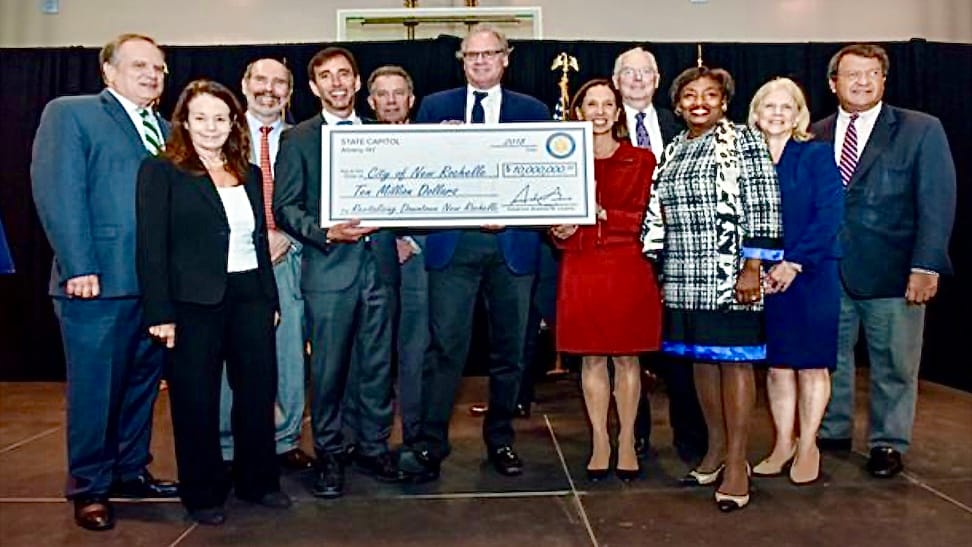
The LINC predates Hochul’s announcement by years. It traces its origins to an earlier period of downtown revitalization planning during the Cuomo administration and has repeatedly been presented as a major investment in the city’s future.
Yet as of October 2026, the transformation envisioned in the project’s promotional material had not been completed.
That does not mean the project will never be built. The city’s plans involve engineering, financing, state transportation approvals and public infrastructure work that can require years to complete.
But the long history of the LINC demonstrates why promises of investment and projected future benefits must be distinguished from what has actually been delivered.
The governor’s announcement also included the prospect of unlocking additional housing development in the area. Again, the distinction between potential housing and homes that exist is essential.
A state funding commitment is not a finished park. A redevelopment plan is not a completed street. And apartments that a public works project may someday facilitate are not part of the current housing supply.
Those distinctions become particularly important when development announcements are incorporated into claims about a city’s established success.
The Real New Rochelle Model
Ten years after the adoption of its Downtown Overlay Zone, New Rochelle was still revising the program.
In 2026, the city undertook amendments to its zoning framework and updated the theoretical development scenario used to evaluate anticipated construction.
According to the city’s official explanation, the changes were intended to reflect current market conditions, observed absorption patterns and lessons learned during the first decade of redevelopment.
The revisions included changes involving retail uses, ground-floor commercial space, sustainability standards, parking requirements and opportunities for smaller-scale housing.
Those adjustments offer a useful contrast with the idea of a completed economic experiment that had already demonstrated a universally applicable formula.
New Rochelle was still responding to the practical challenges of redevelopment. Demand, financing, apartment occupancy, retail vacancy and the availability of development sites continued to influence what could be built and whether completed projects would succeed.
That is not evidence of failure. It is the ordinary reality of a complex urban redevelopment program operating within a changing regional economy.
The city had created conditions that encouraged private developers to invest billions of dollars in downtown. Many of those investments produced completed buildings, new residents, improved properties and an unmistakable physical transformation.
But New Rochelle did not repeal the economic forces affecting the rest of the metropolitan area. It remained subject to the same fluctuations in interest rates, construction costs, employment, migration and housing demand as its neighbors.
Nor did constructing thousands of apartments establish that those apartments caused the particular rental trends highlighted by the Wall Street Journal.
The entire national success story rested on a leap from documented redevelopment activity to an inadequately demonstrated claim about rental prices.
That leap was repeated so often, by so many publications and influential organizations, that the distinction between the city’s actual accomplishments and the economic narrative surrounding them became increasingly difficult to recognize.
By February 2026, the governor of New York was standing in New Rochelle treating the supposed connection as established fact.
It was an extraordinary destination for an argument built around a relatively small increase in regional housing supply and selective comparisons of citywide rents.
A Success Story That Never Needed a Miracle
My experience with downtown New Rochelle goes back much further than the adoption of the Downtown Overlay Zone in 2015. In 1994, after finishing grad school and moving from Chicago back to Westchester County, where I grew up, I remember driving through downtown New Rochelle while considering where to buy a house. The place looked so devastated that my immediate thought was that it resembled downtown Beirut during the Lebanese civil war.
I decided New Rochelle might be a good place to buy precisely because downtown seemed to have nowhere to go but up. There was so little happening, so much neglect and so little apparent reason for optimism that I figured things could hardly get worse. It was not exactly a conventional endorsement of the city’s prospects, but it was the beginning of my nearly three-decade experience watching New Rochelle try to reinvent itself.
There were many false starts along the way. I watched ambitious plans announced, debated, revised and sometimes abandoned. I was there when the city adopted the Downtown Overlay Zone in 2015, and I attended the ceremonial demolition event at the old RKO theater that helped launch what became 360 Huguenot. I watched the excavations, the construction cranes and the buildings rise. Before moving to Ireland in 2023, I lived in two of the new downtown apartment buildings myself, The Printhouse and The Stella.
When I return to New Rochelle today, the contrast with what I saw in 1994 is remarkable. Downtown is substantially better than it was three decades ago. Billions of dollars have been invested, thousands of apartments have been built, and properties that once symbolized the city’s decline have been transformed. It took decades, countless setbacks and the efforts of many people, but New Rochelle accomplished something substantial. The city and everyone who contributed to that transformation have every reason to be proud.
That is what makes the story examined in this four-part series so profoundly perplexing.
New Rochelle already had a genuine success story, one that could be documented in the buildings themselves, the private investment they attracted and the transformation of a downtown that had struggled for generations. It was a story of perseverance, redevelopment and urban renewal. It did not require invented economic miracles, cherry-picked rental statistics or the economically absurd proposition that adding a few thousand apartments to an enormous metropolitan housing market had somehow demonstrated a revolutionary formula for lowering rents.
Yet that is the story The Wall Street Journal helped popularize, that housing-policy organizations amplified and that Gov. Kathy Hochul embraced as a model for the rest of New York. In the process, a legitimate account of urban redevelopment became something else entirely: an unsupported claim of extraordinary economic achievement, promoted with a certainty the underlying evidence could not justify.
I have no interest in diminishing what New Rochelle accomplished. I watched much of it happen, supported the redevelopment of downtown and chose to live in the new housing myself. What I cannot understand is why anyone found it necessary to turn that genuine accomplishment into a fantasy. Why embellish a remarkable, decades-long turnaround with questionable statistics and an implausible economic explanation when the truth was already an impressive story?
New Rochelle did not need a housing miracle. It had something better: a real success story.
Why wasn’t that enough?
RELATED
The Great Wall Street Journal Hoax of New Rochelle
This article was prepared with the assistance of AI tools under the direction and editing of Robert Cox.
Have information about this story? Email robertcox@talkofthesound.com (preferred) or contact via WhatsApp: +353 89 972 0669.